
Title
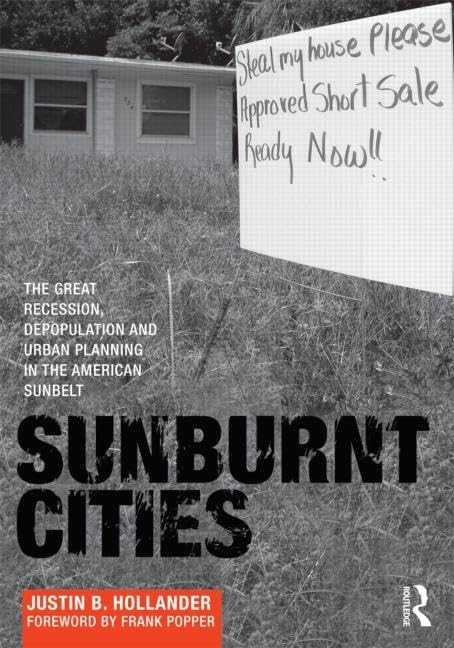
Sunburnt Cities: The Great Recession, Depopulation and Urban Planning in the American Sunbelt,New
Sold by Ergodebooks, an authorized reseller.
Returns accepted within 30 days | support@ergodebooks.com
Shipping Information
- Free Standard Shipping — United States only
- Processing Time: 3–5 business days
- Estimated Delivery: 6–10 business days after dispatch
- Double-boxed, fully insured & discreetly packaged
- Tracking number sent via email once dispatched
Returns & Refund
Returns accepted within 30 days of delivery.
Damaged or Defective Item
Free return shipping + replacement or full refund
Wrong Item Received
Free return shipping + replacement or full refund
Change of Mind
Return shipping at customer's expense · 25% restocking fee applies
Payment Option

In recent years there has been a growing focus on urban and environmental studies, and the skills and techniques needed to address the wider challenges of how to create sustainable communities. Central to that demand is the increasing urgency of addressing the issue of urban decline, and the response has almost always been to pursue growth policies to attempt to reverse that decline. The track record of growth policies has been mixed at best.Until the first decade of the twentyfirst century decline was assumed to be an issue only for former industrial cities the socalled Rust Belt. But the sudden reversal in growth in the major cities of the American Sunbelt has shown that urban decline can be a much wider issue. Justin Hollanders research into urban decline in both the Sun and Rust Belts draws lessons planners and policy makers that can be applied universally.Hollander addresses the reasons and statistics behind these 'shrinking cities' with a positive outlook, arguing that growth for growths sake is not beneficial for communities, suggesting instead that urban development could be achieved through shrinkage. Case studies on Phoenix, Flint, Orlando and Fresno support the argument, and Hollander delves into the numbers, literature and individual lives affected and how they have changed in response to the declining regions.Written for urban scholars and to suit a wide range of courses focused on contemporary urban studies, this text forms a base for all study on shrinking cities for professionals, academics and students in urban design, planning, public administration and sociology.
⚠️ WARNING (California Proposition 65):
This product may contain chemicals known to the State of California to cause cancer, birth defects, or other reproductive harm.
For more information, please visit www.P65Warnings.ca.gov.