
Title
Supervenience and Normativity (Law and Philosophy Library, 120),Used
Sold by Ergodebooks, an authorized reseller.
Returns accepted within 30 days | support@ergodebooks.com
Shipping Information
- Free Standard Shipping — United States only
- Processing Time: 3–5 business days
- Estimated Delivery: 6–10 business days after dispatch
- Double-boxed, fully insured & discreetly packaged
- Tracking number sent via email once dispatched
Returns & Refund
Returns accepted within 30 days of delivery.
Damaged or Defective Item
Free return shipping + replacement or full refund
Wrong Item Received
Free return shipping + replacement or full refund
Change of Mind
Return shipping at customer's expense · 25% restocking fee applies
Payment Option

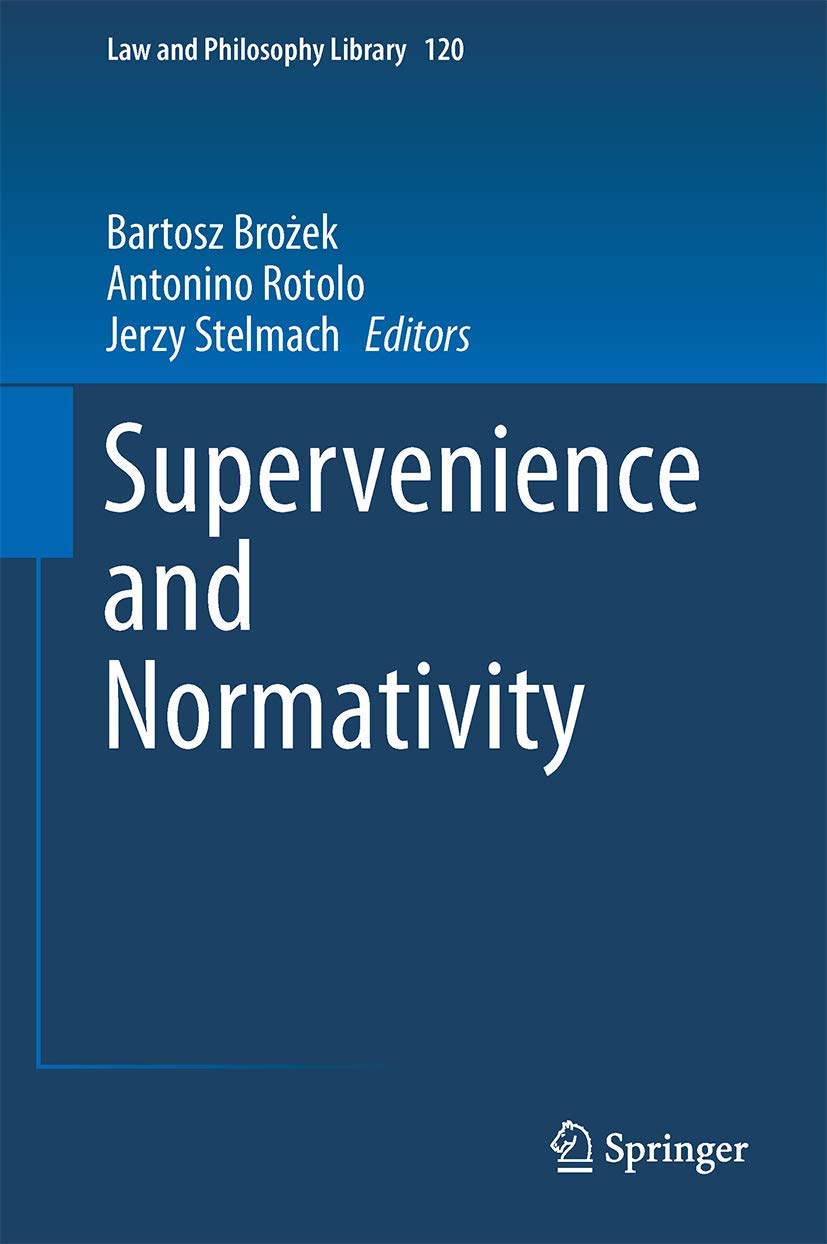
The present collection represents an attempt to bring together several contributions to the ongoing debate pertaining to supervenience of the normative in law and morals and strives to be the first work that addresses the topic comprehensively. It addresses the controversies surrounding the idea of normative supervenience and the philosophical conceptions they generated, deserve a recapitulation, as well as a new impulse for further development.Recently, there has been renewed interest in the concepts of normativity and supervenience. The research on normativity a term introduced to the philosophical jargon by Edmund Husserl almost one hundred years ago gained impetus in the 1990s through the works of such philosophers as Robert Audi, Christine Korsgaard, Robert Brandom, Paul Boghossian or Joseph Raz. The problem of the nature and sources of normativity has been investigated not only in morals and in relation to language, but also in other domains, e.g. in law or in the c ontext of the theories of rationality. Supervenience, understood as a special kind of relation between properties and weaker than entailment, has become analytic philosophers favorite formal tool since 1980s. It features in the theories pertaining to mental properties, but also in aesthetics or the law.In recent years, the marriage of normativity and supervenience has become an object of many philosophical theories as well as heated debates. It seems that the conceptual apparatus of the supervenience theory makes it possible to state precisely some claims pertaining to normativity, as well as illuminate the problems surrounding it.
⚠️ WARNING (California Proposition 65):
This product may contain chemicals known to the State of California to cause cancer, birth defects, or other reproductive harm.
For more information, please visit www.P65Warnings.ca.gov.