
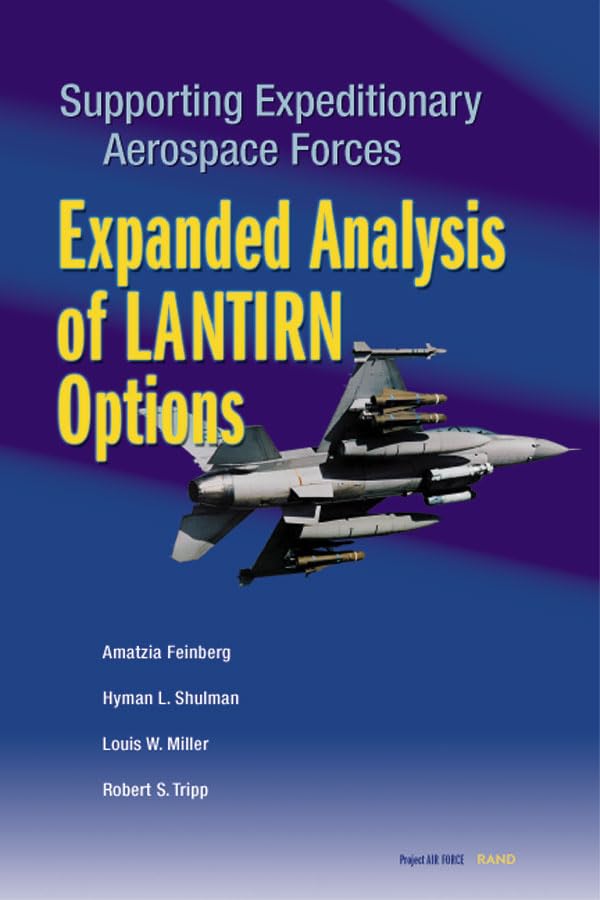
Title
Supporting Expeditionary Aerospace Forces: Expanded Analysis Of Lantirn Options
Sold by Ergodebooks, an authorized reseller.
Returns accepted within 30 days | support@ergodebooks.com
Shipping Information
- Free Standard Shipping — United States only
- Processing Time: 3–5 business days
- Estimated Delivery: 6–10 business days after dispatch
- Double-boxed, fully insured & discreetly packaged
- Tracking number sent via email once dispatched
Returns & Refund
Returns accepted within 30 days of delivery.
Damaged or Defective Item
Free return shipping + replacement or full refund
Wrong Item Received
Free return shipping + replacement or full refund
Change of Mind
Return shipping at customer's expense · 25% restocking fee applies
Payment Option

Product Descriptionthis Analysis Addresses Logistics Structure Alternatives For Meeting Demands For Low Altitude Navigation And Targeting Infrared For Night (Lantirn) Across A Spectrum Of Operational Requirements. The Study Amends Earlier Research With New Data Collected During The Air War Over Serbia By Comparing The Current Decentralized Policy With Consolidated Options In Which Maintenance Capabilities Do Not Deploy. Consolidating The Lantirn Intermediate Maintenance Support System May Enhance Operational Flexibility, Improve Support Responsiveness, And Decrease The Requirements For Highly Skilled Personnel. However, A Regional Support Structure Would Be More Sensitive To Transportation Delays And Require Greater Crossorganizational Communication. New Data Suggest That The Usaf May Not Have Enough Equipment To Support Two Coincident Wars. The Decision To Centralize Or Decentralize Lantirn Repair Operations Hinges On The Capability And Risk Levels The Air Force Is Willing To Accommodate.From The Publisheralthough Much Work Remains To Define And Prepare Air Force Unitsfor Expeditionary Aerospace Force (Eaf) Responsibilities, It Is Clearthat Eaf Concepts Will Play A Central Role In The Future Air Force. Theeaf Relies On Rapidly Deployable, Immediately Employable, Andhighly Flexible Forces To Serve A Strategic Role As An Alternative To Alarge Permanent Forward Presence In Deterring And Responding Toaggressive Acts. Eaf Success Will, To A Great Extent, Depend On Theeffectiveness And Efficiency Of The System Supporting Flyingoperations. The Air Force Has Named Such A Support System One Ofits Six Necessary Core Competencies And Labeled It The Agile Combatsupport (Acs) System.Acs Efficiency And Effectiveness Are Affected By Decisions Madeacross Planning, Programming, And Budgeting System Timelines.Farterm Acs Decisions Affect Support Structures Required To Meetfuture Operational Requirements. Midterm Acs Decisions Affect Thedesign, Development, And Evolution Of The Support Infrastructure Formeeting Operational Requirements Within The Programming Andbudgeting Time Horizons. Nearterm Decisions Affect Where, When,And How Existing Resources Are Employed. Across This Time Spectrum,Logistics Requirements Can Be Satisfied In A Variety Of Ways,Each With Different Costs, Flexibility, Response Times, And Risks. Thisstudy Addresses Logistics Structure Alternatives For Meeting Demandsfor Low Altitude Navigation And Targeting Infrared For Night(Lantirn) Across The Spectrum Of Eaf Operational Requirementsfrom Major Theater Wars To Peacetime Operations And Amends Earlierrand Research With New Data Collected During The Air War Overserbia (Awos).In This Study We Compare The Current Decentralized Policy, In Whichintermediate Maintenance Capabilities Are Deployed With Flyingunits, With Consolidated Options In Which Maintenance Capabilitiesdo Not Deploy. This Dipole Decision Space Offers Many Opportunitieswhile Introducing Multiple Risksall Of Which The Air Force Mustconsider.This Research, Sponsored By The Air Force Deputy Chief Of Staff Forinstallations And Logistics (Af/Il), Was Conducted In The Resourcemanagement Program Of Project Air Force. This And Related Projectsseek To Identify Ways Of Enhancing The Effectiveness Of The Airexpeditionary Force.This Report Should Be Of Interest To Logisticians, Operators, Andmobility Planners Throughout The Air Force. It Is One Of A Seriesaddressing Acs Options To Enhance The Effectiveness Of Eafoperations. Other Titles In This Series Include An Integrated Strategicagile Combat Support Planning Framework (Mr1056Af, 1999),New Agile Combat Support Postures (Mr1075Af, 2000), Flexbasing:Achieving Global Presence For Expeditionary Aerospace Forces (Mr1113Af, 2000), An Analysis Of F15 Avionics Options (Mr1174Af,2000), And A Concept For Evolving The Agile Combat Support/Mobilitysystem Of The Future (Mr1179Af, 2000).Project Air Forceproject Air Force, A Division Of Rand, Is The Air Force Federa
⚠️ WARNING (California Proposition 65):
This product may contain chemicals known to the State of California to cause cancer, birth defects, or other reproductive harm.
For more information, please visit www.P65Warnings.ca.gov.
- Q: What is the page count of the book? A: The book has eighty-six pages. It provides a detailed analysis of logistics for LANTIRN operations.
- Q: What type of binding does this book have? A: This book is available in paperback binding. It makes it lightweight and portable for readers.
- Q: Who is the author of this book? A: The author of the book is Amatzia Feinberg. His expertise contributes to the depth of the analysis presented.
- Q: How can I use this book for research? A: You can use this book as a reference for logistics and military strategy. It provides insights into LANTIRN support options.
- Q: Is this book suitable for beginners in aerospace logistics? A: Yes, this book is suitable for beginners. It offers a comprehensive overview of LANTIRN logistics.
- Q: What operational requirements does this analysis address? A: The analysis addresses the demands for Low Altitude Navigation and Targeting Infrared for Night. It focuses on logistical structures.
- Q: How should I care for this book? A: Keep the book in a dry place away from direct sunlight. This will help maintain its condition over time.
- Q: Is there a specific way to store this book? A: Store this book upright on a shelf or in a bookcase. This prevents bending and keeps it in good shape.
- Q: Can this book be returned if I'm unsatisfied? A: Yes, the book can typically be returned if unsatisfied. Check the return policy of the retailer for specific details.
- Q: What if the book arrives damaged? A: If the book arrives damaged, contact the seller for a replacement or refund. Most vendors have policies for damaged goods.
- Q: How does this book compare to other aerospace logistics texts? A: This book offers a unique analysis of LANTIRN options. It includes recent data from military operations, making it a valuable resource.
- Q: Is this book geared towards military professionals? A: Yes, the book is geared towards military professionals. It discusses logistics strategies relevant to operational needs.
- Q: Does this book include case studies? A: Yes, it includes case studies from the air war over Serbia. This adds practical context to the analysis.
- Q: What is the main focus of the book? A: The main focus is on logistics structure alternatives for LANTIRN operations. It explores centralized versus decentralized support models.
- Q: Is there a glossary of terms in the book? A: Yes, the book includes a glossary of relevant terms. This aids in understanding the technical language used throughout the analysis.