
Title
Supreme Neglect: How to Revive Constitutional Protection For Private Property (Inalienable Rights),Used
Sold by Ergodebooks, an authorized reseller.
Returns accepted within 30 days | support@ergodebooks.com
Shipping Information
- Free Standard Shipping — United States only
- Processing Time: 3–5 business days
- Estimated Delivery: 6–10 business days after dispatch
- Double-boxed, fully insured & discreetly packaged
- Tracking number sent via email once dispatched
Returns & Refund
Returns accepted within 30 days of delivery.
Damaged or Defective Item
Free return shipping + replacement or full refund
Wrong Item Received
Free return shipping + replacement or full refund
Change of Mind
Return shipping at customer's expense · 25% restocking fee applies
Payment Option

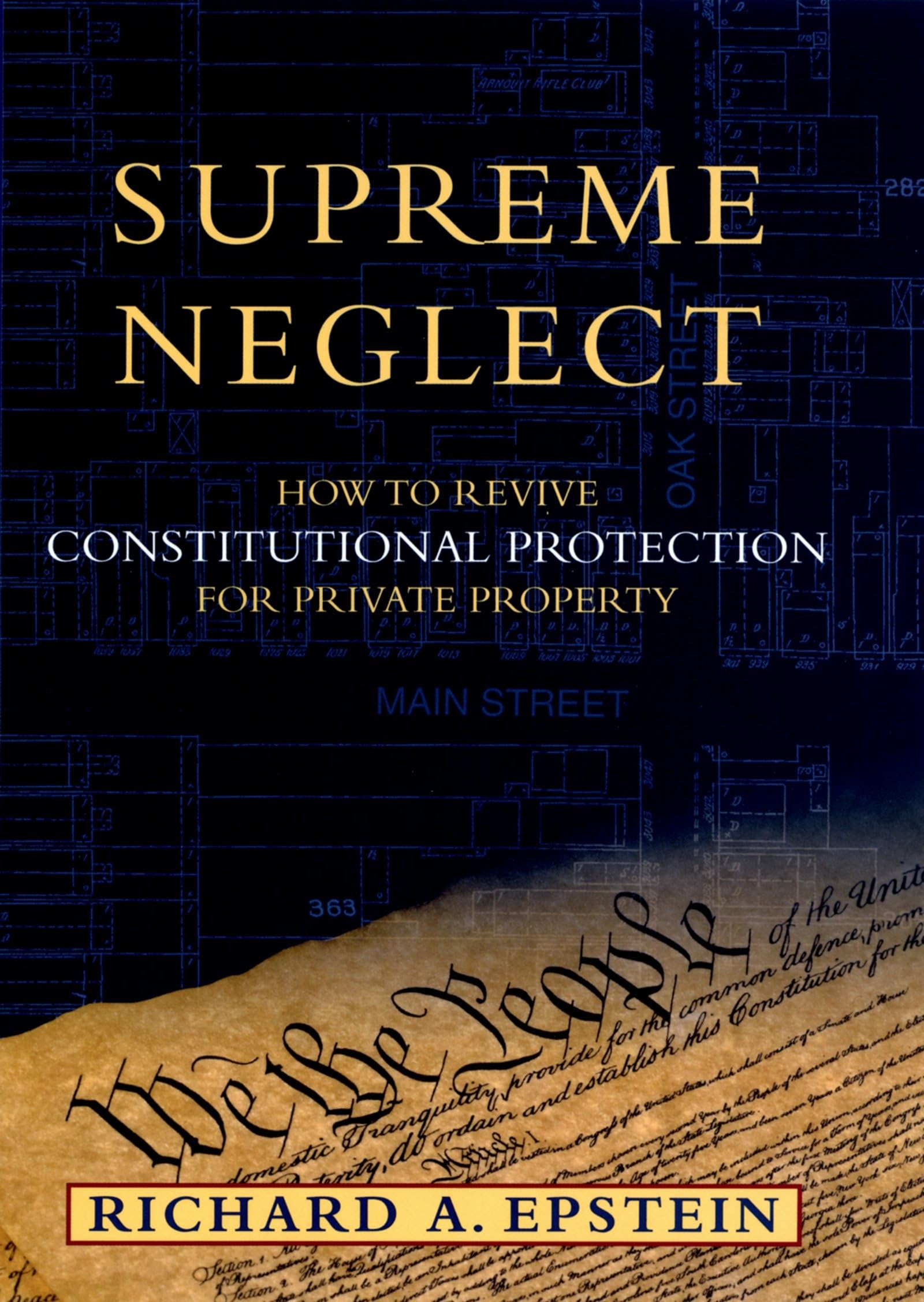
As far back as the Magna Carta in 1215, the right of private property was seen as a bulwark of the individual against the arbitrary power of the state. Indeed, commonlaw tradition holds that 'property is the guardian of every other right.' And yet, for most of the last seventy years, property rights had few staunch supporters in America.This latest addition to Oxford's Inalienable Rights series provides a succinct, pointed look at property rights in Americahow they came to be, how they have evolved, and why they should once again be a mainstay of the law. Richard A. Epstein, the nation's preeminent authority on the subject, examines all aspects of private propertyfrom real estate to air rights to intellectual property. He takes the reader from the strongly protective property rights advocated by the framers of the Constitution through to the weak property rights supported by Progressive and liberal politicians of the twentieth century and finally to our own time, which has seen a renewed appreciation of property rights in the aftermath of the Supreme Court's landmark Kelo v. New London decision in 2005. The author's own powerful defense of property rights threads through the narrative. Using both political theory and economic analysis, Epstein argues that above all that private property is a sound social institution, and not just an excuse for selfishness and greed. Only a system of private property lets people form and raise families, organize religious and other charitable organizations, and earn a living through honest labor.Supreme Neglect offers a compact, incisive look at this hotly contested constitutional right, championing property rights as an essential social institution.
⚠️ WARNING (California Proposition 65):
This product may contain chemicals known to the State of California to cause cancer, birth defects, or other reproductive harm.
For more information, please visit www.P65Warnings.ca.gov.