
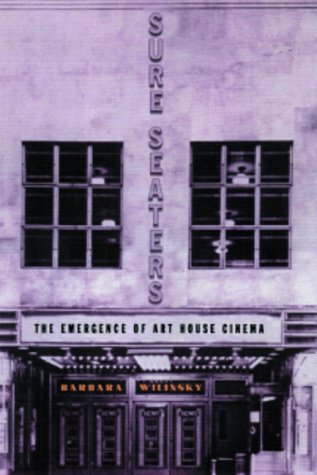
Title
Sure Seaters: The Emergence Of Art House Cinema (Volume 5) (Commerce And Mass Culture),Used
Sold by Ergodebooks, an authorized reseller.
Returns accepted within 30 days | support@ergodebooks.com
Shipping Information
- Free Standard Shipping — United States only
- Processing Time: 3–5 business days
- Estimated Delivery: 6–10 business days after dispatch
- Double-boxed, fully insured & discreetly packaged
- Tracking number sent via email once dispatched
Returns & Refund
Returns accepted within 30 days of delivery.
Damaged or Defective Item
Free return shipping + replacement or full refund
Wrong Item Received
Free return shipping + replacement or full refund
Change of Mind
Return shipping at customer's expense · 25% restocking fee applies
Payment Option

Film/American StudiesAn engaging look at the development of the movie theaters that introduced American audiences to the masterpieces of world cinema.By the end of the Second World War, a growing segment of the American filmgoing public was wearying of mainstream Hollywood films and began to seek out something different. In major cities and college towns across the country, art film theaters provided a venue for alternatives to the films playing in mainstreet movie palaces: British, foreignlanguage, and independent American films, as well as documentaries and revivals of Hollywood classics. A skeptical film industry dubbed such cinemas 'sure seaters,' convinced that patrons would have no trouble finding seats there. However, with the success of art films like Rossellini's Open City and Mackendrick's Tight Little Island, the meaning of the term 'sure seater' changed and, by the end of the 1940s, reflected the frequency with which art house cinemas filled all their seats.After defining what an 'art film' was in this period, she looks at the rise of art house cinemas, their prewar predecessors, and the traditional film distribution system dominated by the Hollywood studios. She next looks at the appeal that art film theaters had for a certain audience, the efforts made by cinema owners to create an appropriately intellectual and exclusive environment, the role of film critics and censors, the expectations and attitudes of art house filmgoers, and the experience of attending art film theaters in the 1940s. By examining the development of the theaters that introduced such challenging, personal, and artistic films as The Bicycle Thief and The Red Shoes to American audiences, Wilinsky offers a more complete understanding of postwar popular culture and the often complicated relationship between art cinema and the commercial film industry that ultimately shaped both and resulted in today's vibrant film culture.Barbara Wilinsky is assistant professor in the Department of Media Arts at the University of Arizona.Translation Inquiries: University of Minnesota Press
⚠️ WARNING (California Proposition 65):
This product may contain chemicals known to the State of California to cause cancer, birth defects, or other reproductive harm.
For more information, please visit www.P65Warnings.ca.gov.
- Q: How many pages does the book have? A: The book has two hundred eighty-eight pages. This provides a comprehensive exploration of art house cinema and its impact.
- Q: What are the dimensions of the book? A: The book measures five point eighty-eight inches in length, zero point four inches in width, and nine point zero two inches in height. These dimensions make it a convenient size for reading.
- Q: What type of binding does the book have? A: The book is paperback bound. This type of binding is lightweight and flexible, making it easy to carry.
- Q: Who is the author of this book? A: The author of the book is Barbara Wilinsky. She is an assistant professor in the Department of Media Arts at the University of Arizona.
- Q: What is the main topic covered in this book? A: The book focuses on the emergence of art house cinema in America. It details the history and cultural significance of alternative film theaters.
- Q: Is this book suitable for film studies students? A: Yes, this book is suitable for film studies students. It provides detailed insights into the evolution of art house cinemas and their cultural impact.
- Q: Can I read this book as a casual film enthusiast? A: Yes, casual film enthusiasts can enjoy this book. It is written in an engaging style that appeals to those interested in cinema history.
- Q: What aspects of art house cinema does this book explore? A: The book explores the rise of art house cinemas, their audience appeal, and the complex relationship between art and commercial films. It provides a thorough overview of the genre.
- Q: How do I take care of this paperback book? A: To care for the paperback book, store it upright in a cool, dry place to avoid moisture damage. Avoid exposing it to direct sunlight to prevent fading.
- Q: Is this book safe for children? A: Yes, the book is generally safe for older children, but parental discretion is advised due to its themes and context related to cinema.
- Q: What should I do if the book arrives damaged? A: If the book arrives damaged, contact the seller to request a return or exchange. Most sellers have policies in place for damaged items.
- Q: Is there a warranty for this book? A: No, books typically do not come with a warranty. However, check the seller's return policy for options if you encounter issues.
- Q: What makes this book unique compared to other film studies texts? A: This book uniquely focuses on the niche of art house cinema, providing detailed historical context and cultural analysis that is often overlooked in broader film studies.
- Q: How does this book relate to today's film culture? A: This book examines the historical roots of art house cinema, offering insights into how these cinemas shaped today's diverse film culture and audience preferences.
- Q: Can I find similar themes in other volumes? A: Yes, similar themes may be found in other volumes of the 'Commerce and Mass Culture' series, which explores various aspects of culture and media.
- Q: Does this book include illustrations or photographs? A: No, the book does not specifically mention including illustrations or photographs. It primarily focuses on textual analysis and historical accounts.