
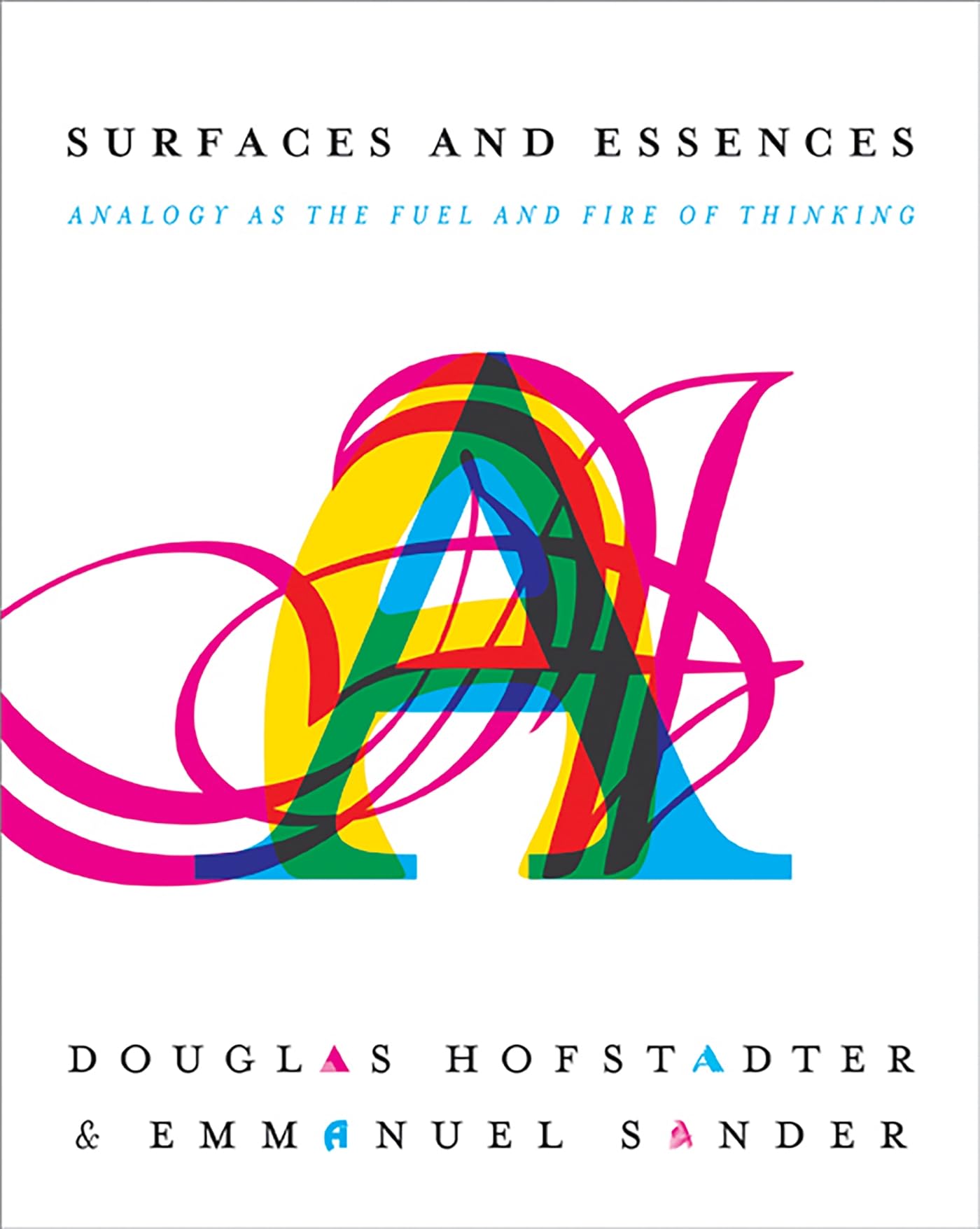
Title
Surfaces and Essences: Analogy as the Fuel and Fire of Thinking,New
Sold by Ergodebooks, an authorized reseller.
Returns accepted within 30 days | support@ergodebooks.com
Shipping Information
- Free Standard Shipping — United States only
- Processing Time: 3–5 business days
- Estimated Delivery: 6–10 business days after dispatch
- Double-boxed, fully insured & discreetly packaged
- Tracking number sent via email once dispatched
Returns & Refund
Returns accepted within 30 days of delivery.
Damaged or Defective Item
Free return shipping + replacement or full refund
Wrong Item Received
Free return shipping + replacement or full refund
Change of Mind
Return shipping at customer's expense · 25% restocking fee applies
Payment Option

Analogy is the core of all thinking.This is the simple but unorthodox premise that Pulitzer Prize winning author Douglas Hofstadter and French psychologist Emmanuel Sander defend in their new work. Hofstadter has been grappling with the mysteries of human thought for over thirty years. Now, with his trademark wit and special talent for making complex ideas vivid, he has partnered with Sander to put forth a highly novel perspective on cognition.We are constantly faced with a swirling and intermingling multitude of illdefined situations. Our brain's job is to try to make sense of this unpredictable, swarming chaos of stimuli. How does it do so? The ceaseless hail of input triggers analogies galore, helping us to pinpoint the essence of what is going on. Often this means the spontaneous evocation of words, sometimes idioms, sometimes the triggering of nameless, longburied memories.Why did twoyearold Camille proudly exclaim, 'I undressed the banana!'? Why do people who hear a story often blurt out, 'Exactly the same thing happened to me!' when it was a completely different event? How do we recognize an aggressive driver from a splitsecond glance in our rearview mirror? What in a friend's remark triggers the offhand reply, 'That's just sour grapes'? What did Albert Einstein see that made him suspect that light consists of particles when a century of research had driven the final nail in the coffin of that longdead idea?The answer to all these questions, of course, is analogymaking the meat and potatoes, the heart and soul, the fuel and fire, the gist and the crux, the lifeblood and the wellsprings of thought. Analogymaking, far from happening at rare intervals, occurs at all moments, defining thinking from top to toe, from the tiniest and most fleeting thoughts to the most creative scientific insights.Like G, Escher, Bach before it, Surfaces and Essences will profoundly enrich our understanding of our own minds. By plunging the reader into an extraordinary variety of colorful situations involving language, thought, and memory, by revealing bit by bit the constantly churning cognitive mechanisms normally completely hidden from view, and by discovering in them one central, invariant core the incessant, unconscious quest for strong analogical links to past experiences this book puts forth a radical and deeply surprising new vision of the act of thinking.
⚠️ WARNING (California Proposition 65):
This product may contain chemicals known to the State of California to cause cancer, birth defects, or other reproductive harm.
For more information, please visit www.P65Warnings.ca.gov.
- Q: How many pages does this book have? A: This book has five hundred ninety-two pages. It offers an in-depth exploration of analogy and cognition.
- Q: What is the binding type of this book? A: The book is hardcover. This durable binding ensures longevity and a premium feel.
- Q: What are the dimensions of this book? A: The book measures seven point eight eight inches in length, one point eight nine inches in width, and nine point five inches in height.
- Q: Who is the author of this book? A: The author is Douglas R. Hofstadter, a Pulitzer Prize-winning writer known for his work on human thought and cognition.
- Q: What category does this book fall under? A: This book is categorized under History and Philosophy. It delves into complex ideas surrounding analogy in thinking.
- Q: What is the main theme of this book? A: The main theme revolves around the role of analogy in human cognition. It presents a novel perspective on how we think.
- Q: How should I approach reading this book? A: You can read this book at your own pace. It’s suitable for anyone interested in philosophy, psychology, or cognitive science.
- Q: Is this book suitable for beginners? A: Yes, this book is suitable for beginners. It explains complex ideas in an engaging and accessible manner.
- Q: What age group is this book appropriate for? A: This book is appropriate for adults and older teens. It deals with advanced cognitive concepts.
- Q: How do I keep this book in good condition? A: To keep this book in good condition, store it upright on a shelf and avoid exposure to moisture or direct sunlight.
- Q: What if the book arrives damaged? A: If the book arrives damaged, you can return it for a replacement or a refund. Check the return policy for specifics.
- Q: Can I get support if I have questions about the book? A: Yes, you can contact customer support for any questions regarding the book. They can assist you with any inquiries.
- Q: Is there a warranty for this book? A: No, there is no warranty for this book. However, it can be returned if it arrives in unsatisfactory condition.
- Q: How does this book compare to Hofstadter's other works? A: This book builds on Hofstadter's previous explorations of thought. It offers fresh insights while retaining his signature style.
- Q: Is this book a good choice for philosophy students? A: Yes, this book is an excellent choice for philosophy students. It provides deep insights into cognitive processes through analogy.
- Q: Does this book contain any illustrations or images? A: No, this book does not contain illustrations. It focuses on text to convey complex ideas about thinking.