
Title
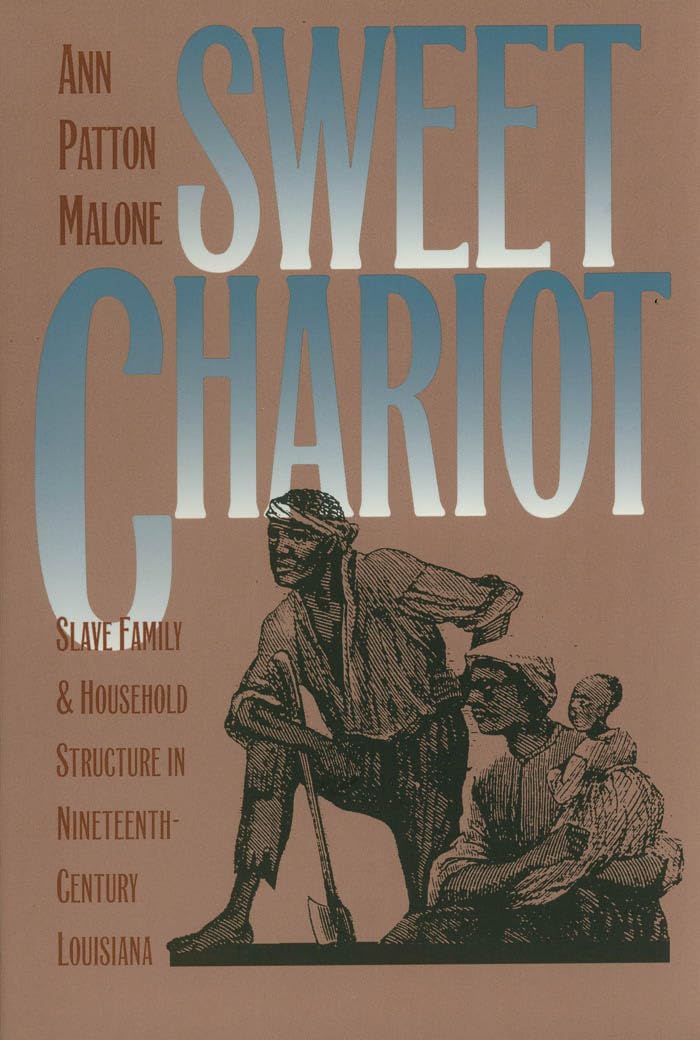
Sweet Chariot: Slave Family And Household Structure In Nineteenthcentury Louisiana (Fred W. Morrison Series In Southern Studies,Used
Sold by Ergodebooks, an authorized reseller.
Returns accepted within 30 days | support@ergodebooks.com
Shipping Information
- Free Standard Shipping — United States only
- Processing Time: 3–5 business days
- Estimated Delivery: 6–10 business days after dispatch
- Double-boxed, fully insured & discreetly packaged
- Tracking number sent via email once dispatched
Returns & Refund
Returns accepted within 30 days of delivery.
Damaged or Defective Item
Free return shipping + replacement or full refund
Wrong Item Received
Free return shipping + replacement or full refund
Change of Mind
Return shipping at customer's expense · 25% restocking fee applies
Payment Option

Sweet Chariot is a pathbreaking analysis of slave families and household composition in the nineteenthcentury South. Ann Malone presents a carefully drawn picture of the ways in which slaves were constituted into families and households within a community and shows how and why that organization changed through the years. Her book, based on massive research, is both a statistical study over time of 155 slave communities in twentysix Louisiana parishes and a descriptive study of three plantations: Oakland, Petite Anse, and Tiger Island.Malone first provides a regional analysis of family, household, and community organization. Then, drawing on qualitative sources, she discusses patterns in slave family household organization, identifying the most significant ones as well as those that consistantly acted as indicators of change. Malone shows that slave community organization strongly reflected where each community was in its own developmental cycle, which in turn was influenced by myriad factors, ranging from impersonal economic conditions to the arbitrary decisions of individual owners. She also projects a statistical model that can be used for comparisons with other populations.The two persistent themes that Malone uncovers are the mutability and yet the constancy of Louisiana slave household organization. She shows that the slave family and its extensions, the slave household and community, were far more diverse and adaptable than previously believed. The real strength of the slave comunity was its multiplicity of forms, its tolerance for a variety of domestic units and its adaptability. She finds, for example, that the preferred family form consisted of two parents and children but that all types of families and households were accepted as functioning and contributing members of the slave community.'Louisiana slaves had a welldefined and collective vision of the structure that would serve them best and an iron determination to attain it, ' Malone observes. 'But along with this constancy in vision and perseverance was flexibility. Slave domestic forms in Louisiana bent like willows in the wind to keep from shattering. The suppleness of their forms prevented domestic chaos and enabled most slave communities to recover from even serious crises.'
⚠️ WARNING (California Proposition 65):
This product may contain chemicals known to the State of California to cause cancer, birth defects, or other reproductive harm.
For more information, please visit www.P65Warnings.ca.gov.