If you have any questions, you are always welcome to contact us. We'll get back to you as soon as possible, withing 24 hours on weekdays.
Customer service
All questions about your order, return and delivery must be sent to our customer service team by e-mail at yourstore@yourdomain.com
Sale & Press
If you are interested in selling our products, need more information about our brand or wish to make a collaboration, please contact us at press@yourdomain.com
Help
If you have any questions, you are always welcome to contact us. We'll get back to you as soon as possible, withing 24 hours on weekdays.
Customer service
All questions about your order, return and delivery must be sent to our customer service team by e-mail at yourstore@yourdomain.com
Sale & Press
If you are interested in selling our products, need more information about our brand or wish to make a collaboration, please contact us at press@yourdomain.com
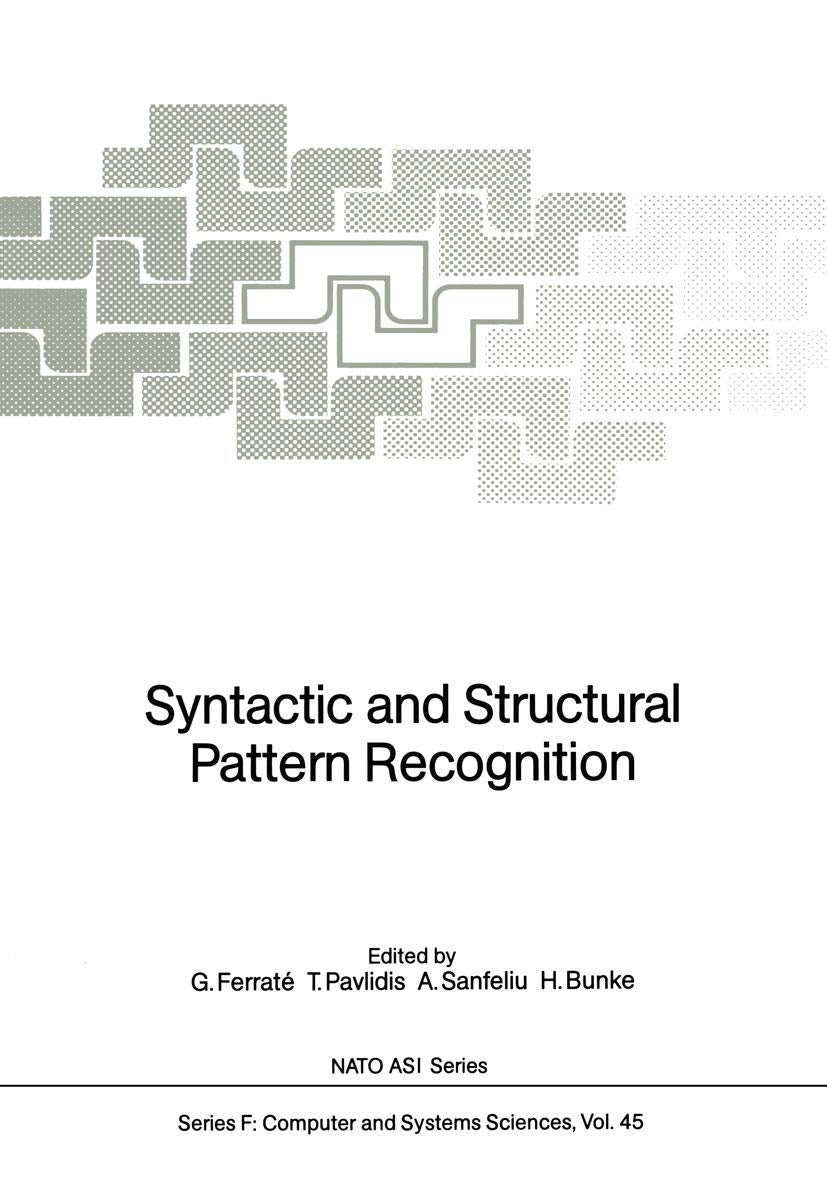
Thirty years ago pattern recognition was dominated by the learning machine concept: that one could automate the process of going from the raw data to a classifier. The derivation of numerical features from the input image was not considered an important step. One could present all possible features to a program which in turn could find which ones would be useful for pattern recognition. In spite of significant improvements in statistical inference techniques, progress was slow. It became clear that feature derivation was a very complex process that could not be automated and that features could be symbolic as well as numerical. Furthennore the spatial relationship amongst features might be important. It appeared that pattern recognition might resemble language analysis since features could play the role of symbols strung together to form a word. This led. to the genesis of syntactic pattern recognition, pioneered in the middle and late 1960's by Russel Kirsch, Robert Ledley, Nararimhan, and Allan Shaw. However the thorough investigation of the area was left to KingSun Fu and his students who, until his untimely death, produced most of the significant papers in this area. One of these papers (syntactic recognition of fingerprints) received the distinction of being selected as the best paper published that year in the IEEE Transaction on Computers. Therefore syntactic pattern recognition has a long history of active research and has been used in industrial applications.
⚠️ WARNING (California Proposition 65):
This product may contain chemicals known to the State of California to cause cancer,
birth defects, or other reproductive harm.
For MAP (Minimum Advertised Price) violations and Intellectual Property (IP) or Trademark concerns, please contact:
support@ergodebooks.com
⚠️ California Proposition 65 Warning: Some products sold on this website may expose you to chemicals known to the State of California to cause cancer, birth defects, or other reproductive harm. For more information, visit www.P65Warnings.ca.gov.