If you have any questions, you are always welcome to contact us. We'll get back to you as soon as possible, withing 24 hours on weekdays.
Customer service
All questions about your order, return and delivery must be sent to our customer service team by e-mail at yourstore@yourdomain.com
Sale & Press
If you are interested in selling our products, need more information about our brand or wish to make a collaboration, please contact us at press@yourdomain.com
Help
If you have any questions, you are always welcome to contact us. We'll get back to you as soon as possible, withing 24 hours on weekdays.
Customer service
All questions about your order, return and delivery must be sent to our customer service team by e-mail at yourstore@yourdomain.com
Sale & Press
If you are interested in selling our products, need more information about our brand or wish to make a collaboration, please contact us at press@yourdomain.com
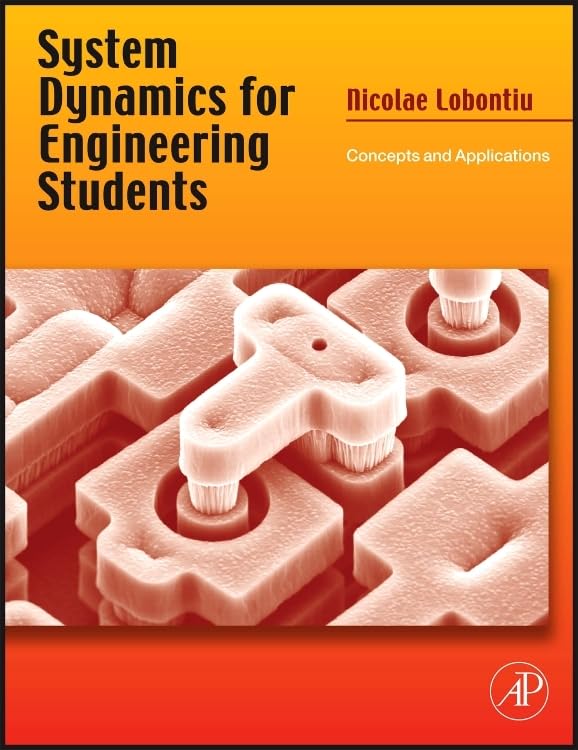
System Dynamics for Engineering Students: Concepts and Applications discusses the basic concepts of engineering system dynamics. Engineering system dynamics focus on deriving mathematical models based on simplified physical representations of actual systems, such as mechanical, electrical, fluid, or thermal, and on solving the mathematical models. The resulting solution is utilized in design or analysis before producing and testing the actual system.The book discusses the main aspects of a system dynamics course for engineering students; mechanical, electrical, and fluid and thermal system modeling; the Laplace transform technique; and the transfer function approach. It also covers the state space modeling and solution approach; modeling system dynamics in the frequency domain using the sinusoidal (harmonic) transfer function; and coupledfield dynamic systems.The book is designed to be a onesemester systemdynamics text for upperlevel undergraduate students with an emphasis on mechanical, aerospace, or electrical engineering. It is also useful for understanding the design and development of micro and macroscale structures, electric and fluidic systems with an introduction to transduction, and numerous simulations using MATLAB and SIMULINK. The first textbook to include a chapter on the important area of coupledfield systems Provides a more balanced treatment of mechanical and electrical systems, making it appealing to both engineering specialties
⚠️ WARNING (California Proposition 65):
This product may contain chemicals known to the State of California to cause cancer,
birth defects, or other reproductive harm.
For MAP (Minimum Advertised Price) violations and Intellectual Property (IP) or Trademark concerns, please contact:
support@ergodebooks.com
⚠️ California Proposition 65 Warning: Some products sold on this website may expose you to chemicals known to the State of California to cause cancer, birth defects, or other reproductive harm. For more information, visit www.P65Warnings.ca.gov.