If you have any questions, you are always welcome to contact us. We'll get back to you as soon as possible, withing 24 hours on weekdays.
Customer service
All questions about your order, return and delivery must be sent to our customer service team by e-mail at yourstore@yourdomain.com
Sale & Press
If you are interested in selling our products, need more information about our brand or wish to make a collaboration, please contact us at press@yourdomain.com
Help
If you have any questions, you are always welcome to contact us. We'll get back to you as soon as possible, withing 24 hours on weekdays.
Customer service
All questions about your order, return and delivery must be sent to our customer service team by e-mail at yourstore@yourdomain.com
Sale & Press
If you are interested in selling our products, need more information about our brand or wish to make a collaboration, please contact us at press@yourdomain.com
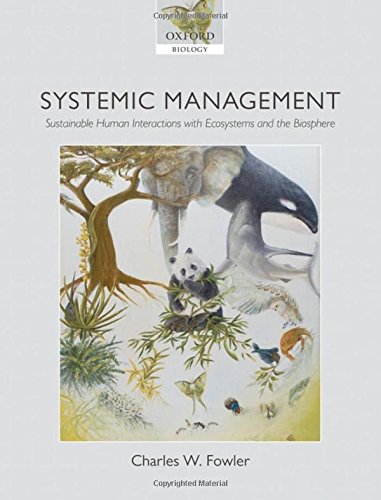
Systemic Management describes a holistic, objective, and universally applicable form of management, providing a framework for addressing environmental challenges such as global warming, emergent diseases, deforestation, overpopulation, the extinction crisis, pollution, overfishing, and habitat destruction. Its goals are the consistently sustainable relationships between humans and ecosystems, between humans and other species, and between humans and the biosphere. This book presents a convincing argument that these goals, and the means to achieve them, can be inferred from empirical information. It describes how comparisons between humans and other species reveal patterns that can serve to guide management toward true sustainability, i.e. ways that are empirically observed to work in natural systems. This objective approach has rarely been possible in conventional management because sustainability is invariably undermined by conflicting human values.Systemic Management is presented as a specialized process of patternbased decisionmaking that avoids the inconsistency, subjectivity and error in current management practice. It clearly demonstrates how mimicking nature's empirical examples of sustainability can circumvent anthropocentric tendencies to overuse/misuse human values in management, and illustrates the science best suited for achieving sustainability through examples of research that address specific management questions.
⚠️ WARNING (California Proposition 65):
This product may contain chemicals known to the State of California to cause cancer,
birth defects, or other reproductive harm.
For MAP (Minimum Advertised Price) violations and Intellectual Property (IP) or Trademark concerns, please contact:
support@ergodebooks.com
⚠️ California Proposition 65 Warning: Some products sold on this website may expose you to chemicals known to the State of California to cause cancer, birth defects, or other reproductive harm. For more information, visit www.P65Warnings.ca.gov.