If you have any questions, you are always welcome to contact us. We'll get back to you as soon as possible, withing 24 hours on weekdays.
Customer service
All questions about your order, return and delivery must be sent to our customer service team by e-mail at yourstore@yourdomain.com
Sale & Press
If you are interested in selling our products, need more information about our brand or wish to make a collaboration, please contact us at press@yourdomain.com
Help
If you have any questions, you are always welcome to contact us. We'll get back to you as soon as possible, withing 24 hours on weekdays.
Customer service
All questions about your order, return and delivery must be sent to our customer service team by e-mail at yourstore@yourdomain.com
Sale & Press
If you are interested in selling our products, need more information about our brand or wish to make a collaboration, please contact us at press@yourdomain.com
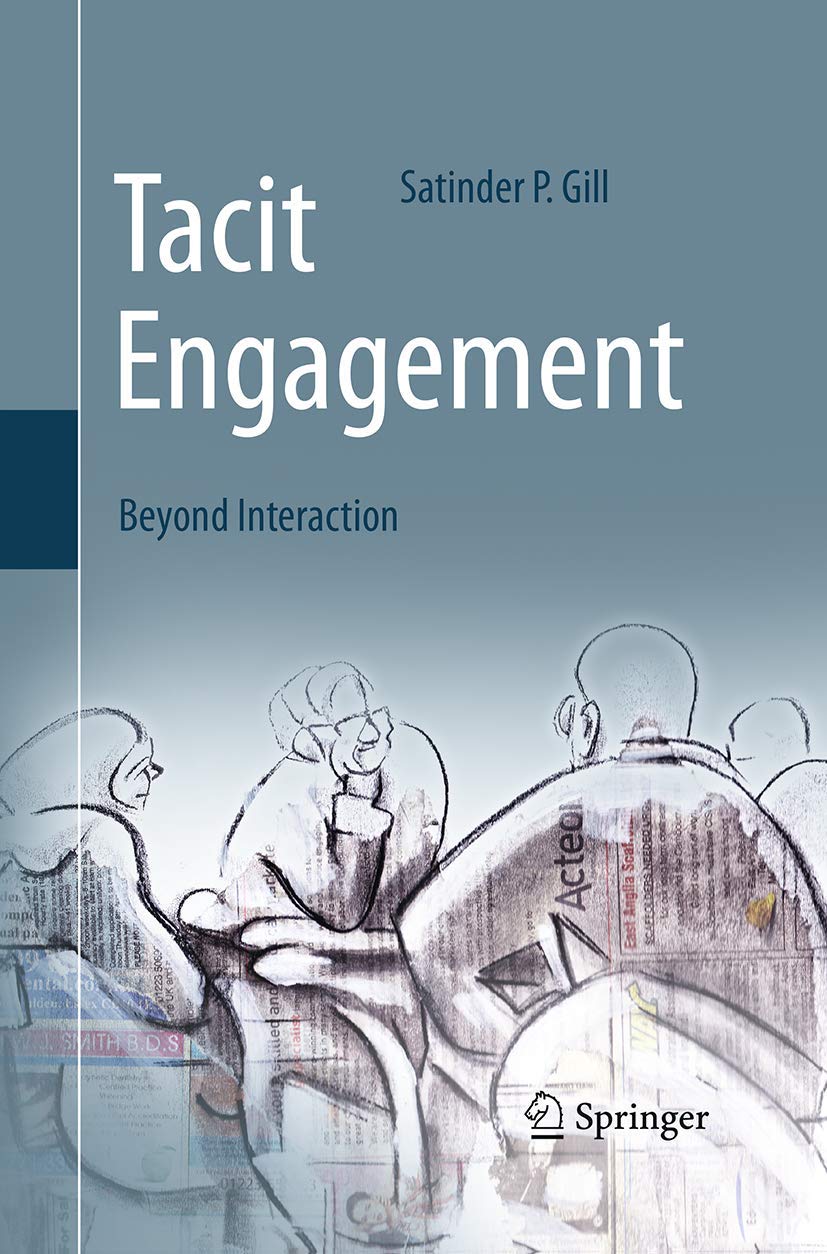
This book explores how digital technology is altering the relationships between people and how the very nature of interface itself needs to be reconsidered to reflect this how we can make sense of each other, handle ambiguities, negotiate differences, empathise and collectively make skilled judgments in our modern society. The author presents new directions for research at the relationaltransactional intersection of contrasting disciplines of arts, science and technology,and in so doing, presents philosophical and artistic questions for future research on human connectivity in our digital age.The book presents frameworks and methods for conducting research and study of tacit engagement that includes ethnography, experiments, discourse analysis, gesture analysis, psycholinguistic analysis, artistic experiments, installations, and improvisation. Case studies illustrate the use of various methods and the application and emergence of frameworks.Tacit Engagement will be of interest to researchers, designers, teachers and students concerned with new media, social media and communications networks; interactive interfaces, including information systems, knowledge management, robotics, and presence technologies.Not since Michael Polanyi have we seen such wise science about the tacit: how we know more than we can tell. Gill brings to the present era of design and data a profoundly needed perspective on meaning that comes from social dialogue, skilled performance, relational gesture and rhythm. Sha Xin Wei, Ph.D. (Synthesis, ASU)
⚠️ WARNING (California Proposition 65):
This product may contain chemicals known to the State of California to cause cancer,
birth defects, or other reproductive harm.
For MAP (Minimum Advertised Price) violations and Intellectual Property (IP) or Trademark concerns, please contact:
support@ergodebooks.com
⚠️ California Proposition 65 Warning: Some products sold on this website may expose you to chemicals known to the State of California to cause cancer, birth defects, or other reproductive harm. For more information, visit www.P65Warnings.ca.gov.