If you have any questions, you are always welcome to contact us. We'll get back to you as soon as possible, withing 24 hours on weekdays.
Customer service
All questions about your order, return and delivery must be sent to our customer service team by e-mail at yourstore@yourdomain.com
Sale & Press
If you are interested in selling our products, need more information about our brand or wish to make a collaboration, please contact us at press@yourdomain.com
Help
If you have any questions, you are always welcome to contact us. We'll get back to you as soon as possible, withing 24 hours on weekdays.
Customer service
All questions about your order, return and delivery must be sent to our customer service team by e-mail at yourstore@yourdomain.com
Sale & Press
If you are interested in selling our products, need more information about our brand or wish to make a collaboration, please contact us at press@yourdomain.com
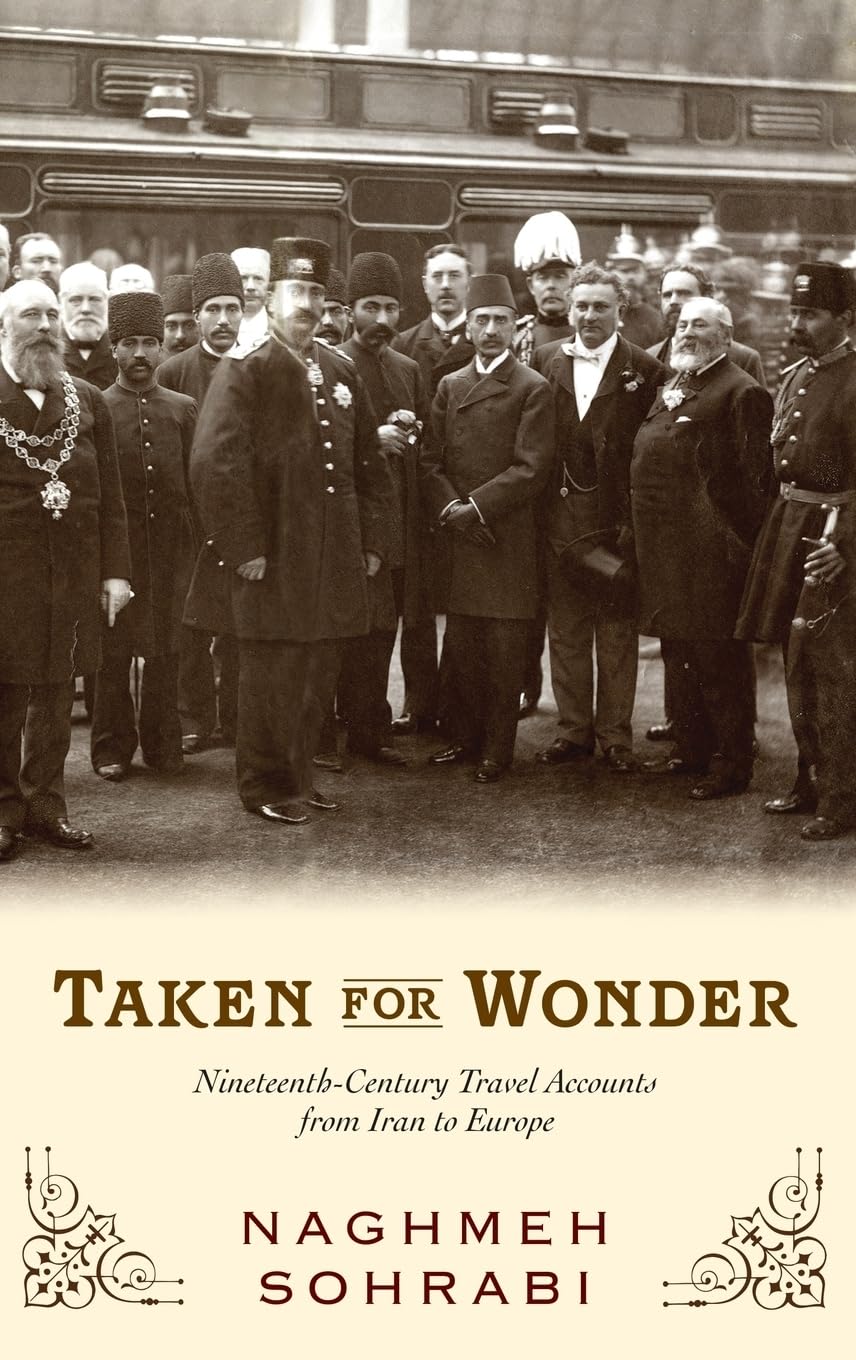
Accounts of travel to farflung places have deservedly gripped the imagination of readers for centuries. Yet travelogues can reveal much more than the customs of a foreign land; they can also serve as a window into the culture and concerns of their place of origin. Drawing on a series of travel narratives by Iranian visitors to Europe in the nineteenth century, Taken for Wonder illustrates how these writings reflect the complicated political agendas of diplomats, merchants, kings, and others during the Qajar Dynasty.Using texts that correspond to four monarchic reigns in this period, the book shifts the traditional framework of analysis from the act of travel to that of writing travel. Hayratnamah (The Book of Wonder), an Iranian ambassador's account of his visit to the court of King George III, provides the first example. Sohrabi's reading reveals a narrative calculated to reinforce the grandeur and stability of the Qajars to its Persian readers rather than merely recount the lifestyle of the English court. Similarly, the political motives at work in Mirza Fattah Khan Garmrudi's accounts of his European journey are explored in light of Britain's 1837 occupation of Iran. A subsequent chapter considers the ways Nasir alDin Shah, the longest reigning Qajar monarch, viewed his European travelogues as a tool for domestic politics and international diplomacy. The study concludes with two travel accounts by nongovernment officials, demonstrating how the genre became a mode for critiquing the Qajar Dynasty and instigating political reform at the close of the nineteenth century.
⚠️ WARNING (California Proposition 65):
This product may contain chemicals known to the State of California to cause cancer,
birth defects, or other reproductive harm.
For MAP (Minimum Advertised Price) violations and Intellectual Property (IP) or Trademark concerns, please contact:
support@ergodebooks.com
⚠️ California Proposition 65 Warning: Some products sold on this website may expose you to chemicals known to the State of California to cause cancer, birth defects, or other reproductive harm. For more information, visit www.P65Warnings.ca.gov.