If you have any questions, you are always welcome to contact us. We'll get back to you as soon as possible, withing 24 hours on weekdays.
Customer service
All questions about your order, return and delivery must be sent to our customer service team by e-mail at yourstore@yourdomain.com
Sale & Press
If you are interested in selling our products, need more information about our brand or wish to make a collaboration, please contact us at press@yourdomain.com
Help
If you have any questions, you are always welcome to contact us. We'll get back to you as soon as possible, withing 24 hours on weekdays.
Customer service
All questions about your order, return and delivery must be sent to our customer service team by e-mail at yourstore@yourdomain.com
Sale & Press
If you are interested in selling our products, need more information about our brand or wish to make a collaboration, please contact us at press@yourdomain.com
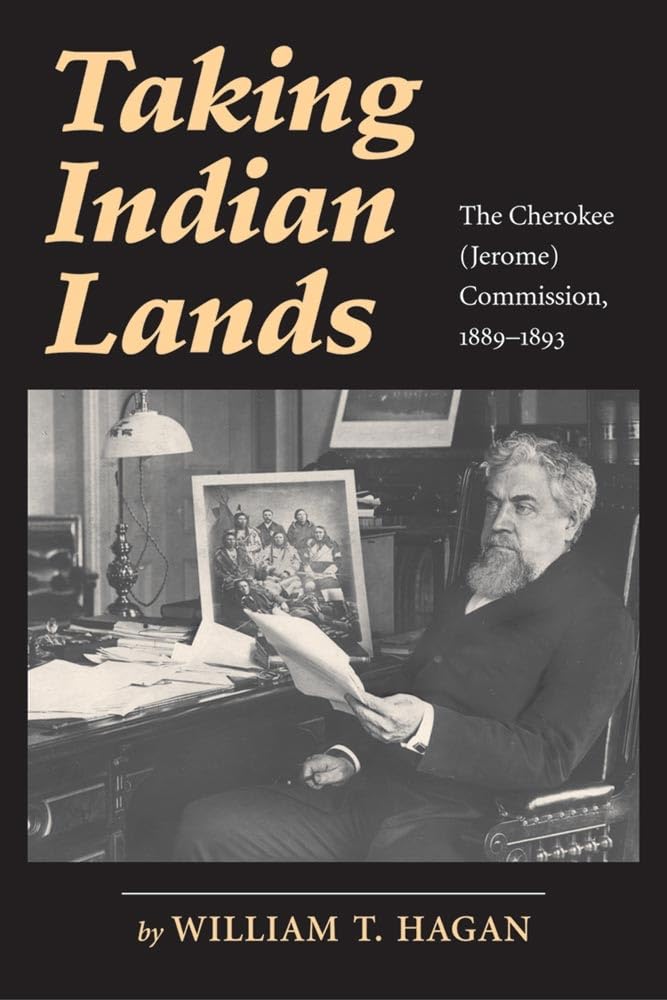
Authorized by Congress in 1889, the Cherokee Commission was formed to negotiate the purchase of huge areas of land from the Cherokees, Ioways, Pawnees, Poncas, Tonakawas, Wichitas, Cheyennes, Arapahos, Sac and Fox, and other tribes in Indian Territory. Some humanitarian reformers argued that dissolving tribal holdings into individual private properties would help civilize the Indians and speed their assimilation into American culture. Whatever the hopedfor effects, the coerced sales opened to white settlement the vast unused expanses of land that had been held communally by the tribes. In Taking Indian Lands, William T. Hagan presents a detailed and disturbing account of the deliberations between the Cherokee Commission and the tribes.Often called the Jerome Commission after its leading negotiator, David H. Jerome, the commission intimidated Indians into first accepting allotment in severalty and then selling to the United States, at it price, the fifteen million acres declared surplus after allotment. This land then went to white settlers, making possible the state of Oklahoma at the expense of the Indian tribes who had held claim to it.Hagan has mined nearly two thousand pages of commission journals in the National Archives to reveal the commissioners dramatic rhetoric and strategies and the Indian responses. He also records the words of tribal leaders as they poignantly defended their attachment to the land and expressed their fears of how their lives would be changed.
⚠️ WARNING (California Proposition 65):
This product may contain chemicals known to the State of California to cause cancer,
birth defects, or other reproductive harm.
For MAP (Minimum Advertised Price) violations and Intellectual Property (IP) or Trademark concerns, please contact:
support@ergodebooks.com
⚠️ California Proposition 65 Warning: Some products sold on this website may expose you to chemicals known to the State of California to cause cancer, birth defects, or other reproductive harm. For more information, visit www.P65Warnings.ca.gov.