If you have any questions, you are always welcome to contact us. We'll get back to you as soon as possible, withing 24 hours on weekdays.
Customer service
All questions about your order, return and delivery must be sent to our customer service team by e-mail at yourstore@yourdomain.com
Sale & Press
If you are interested in selling our products, need more information about our brand or wish to make a collaboration, please contact us at press@yourdomain.com
Help
If you have any questions, you are always welcome to contact us. We'll get back to you as soon as possible, withing 24 hours on weekdays.
Customer service
All questions about your order, return and delivery must be sent to our customer service team by e-mail at yourstore@yourdomain.com
Sale & Press
If you are interested in selling our products, need more information about our brand or wish to make a collaboration, please contact us at press@yourdomain.com
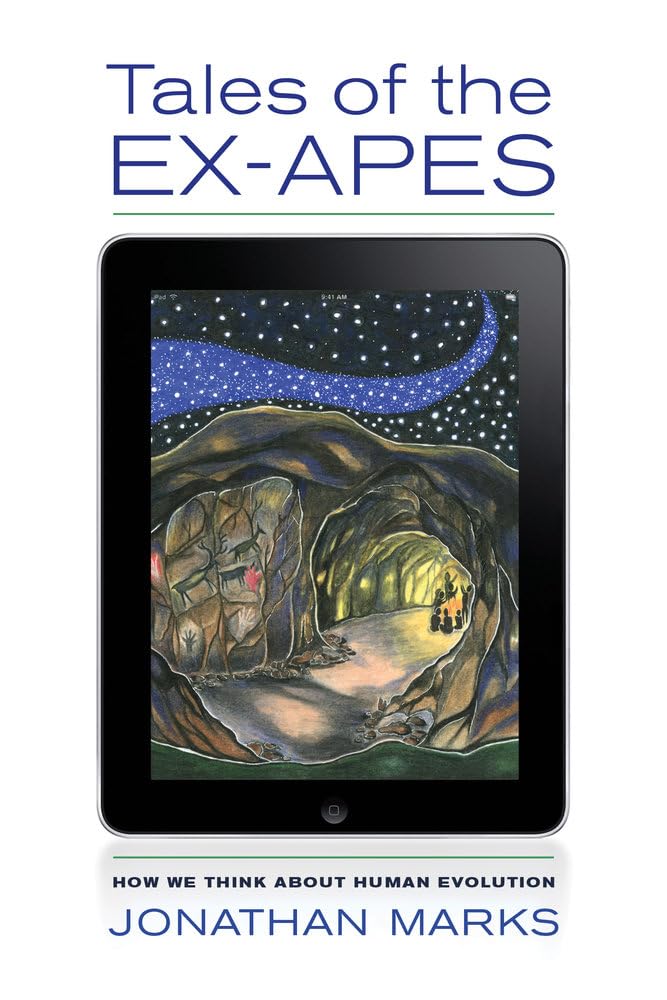
What do we think about when we think about human evolution? With his characteristic wit and wisdom, anthropologist Jonathan Marks explores our scientific narrative of human originsthe study of evolutionand examines its cultural elements and theoretical foundations. In the process, he situates human evolution within a general anthropological framework and presents it as a special case of kinship and mythology.Tales of the ExApes argues that human evolution has incorporated the emergence of social relations and cultural histories that are unprecedented in the apes and thus cannot be reduced to purely biological properties and processes. Marks shows that human evolution has involved the transformation from biological to biocultural evolution. Over tens of thousands of years, new social rolesnotably spouse, father, inlaws, and grandparentshave coevolved with new technologies and symbolic meanings to produce the human species, in the absence of significant biological evolution. We are biocultural creatures, Marks argues, fully comprehensible by recourse to neither our real ape ancestry nor our imaginary cultureless biology.
⚠️ WARNING (California Proposition 65):
This product may contain chemicals known to the State of California to cause cancer,
birth defects, or other reproductive harm.
For MAP (Minimum Advertised Price) violations and Intellectual Property (IP) or Trademark concerns, please contact:
support@ergodebooks.com
⚠️ California Proposition 65 Warning: Some products sold on this website may expose you to chemicals known to the State of California to cause cancer, birth defects, or other reproductive harm. For more information, visit www.P65Warnings.ca.gov.