
Title
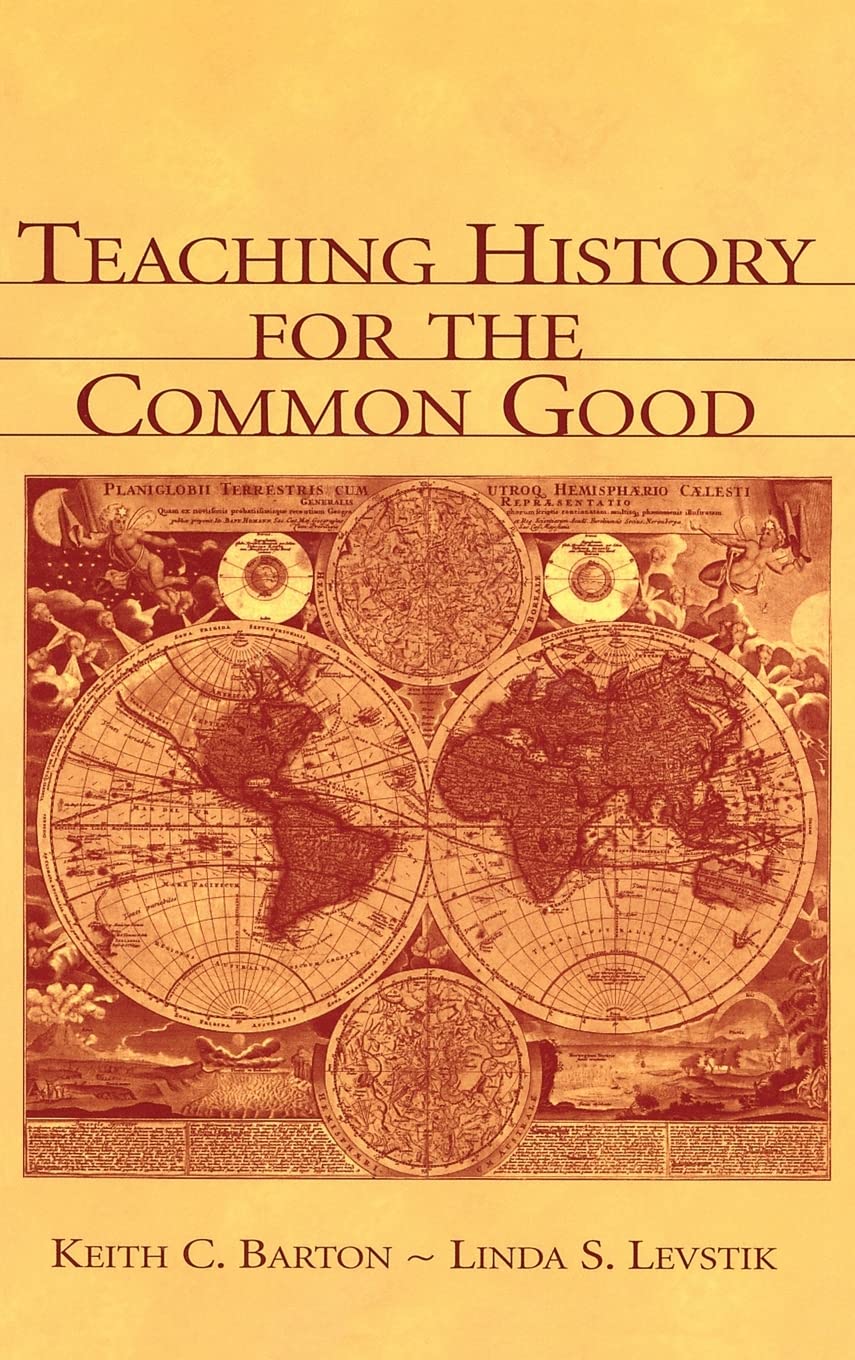
Teaching History For The Common Good,Used
Sold by Ergodebooks, an authorized reseller.
Returns accepted within 30 days | support@ergodebooks.com
Shipping Information
- Free Standard Shipping — United States only
- Processing Time: 3–5 business days
- Estimated Delivery: 6–10 business days after dispatch
- Double-boxed, fully insured & discreetly packaged
- Tracking number sent via email once dispatched
Returns & Refund
Returns accepted within 30 days of delivery.
Damaged or Defective Item
Free return shipping + replacement or full refund
Wrong Item Received
Free return shipping + replacement or full refund
Change of Mind
Return shipping at customer's expense · 25% restocking fee applies
Payment Option

In Teaching History for the Common Good, Barton and Levstik present a clear overview of competing ideas among educators, historians, politicians, and the public about the nature and purpose of teaching history, and they evaluate these debates in light of current research on students' historical thinking. In many cases, disagreements about what should be taught to the nation's children and how it should be presented reflect fundamental differences that will not easily be resolved. A central premise of this book, though, is that systematic theory and research can play an important role in such debates by providing evidence of how students think, how their ideas interact with the information they encounter both in school and out, and how these ideas differ across contexts. Such evidence is needed as an alternative to the untested assumptions that plague so many discussions of history education.The authors review research on students' historical thinking and set it in the theoretical context of mediated actionan approach that calls attention to the concrete actions that people undertake, the human agents responsible for such actions, the cultural tools that aid and constrain them, their purposes, and their social contexts. They explain how this theory allows educators to address the breadth of practices, settings, purposes, and tools that influence students' developing understanding of the past, as well as how it provides an alternative to the academic discipline of history as a way of making decisions about teaching and learning the subject in schools.Beyond simply describing the factors that influence students' thinking, Barton and Levstik evaluate their implications for historical understanding and civic engagement. They base these evaluations not on the disciplinary study of history, but on the purpose of social educationpreparing students for participation in a pluralist democracy. Their ultimate concern is how history can help citizens engage in collaboration toward the common good.In Teaching History for the Common Good, Barton and Levstik:*discuss the contribution of theory and research, explain the theory of mediated action and how it guides their analysis, and describe research on children's (and adults') knowledge of and interest in history;*lay out a vision of pluralist, participatory democracy and its relationship to the humanistic study of history as a basis for evaluating the perspectives on the past that influence students' learning;*explore four principal 'stances' toward history (identification, analysis, moral response, and exhibition), review research on the extent to which children and adolescents understand and accept each of these, and examine how the stances might contribute toor detract fromparticipation in a pluralist democracy;*address six of the principal 'tools' of history (narrative structure, stories of individual achievement and motivation, national narratives, inquiry, empathy as perspectivetaking, and empathy as caring); and*review research and conventional wisdom on teachers' knowledge and practice, and argue that for teachers to embrace investigative, multiperspectival approaches to history they need more than knowledge of content and pedagogy, they need a guiding purpose that can be fulfilled only by these approachesand preparation for participatory democracy provides such purpose.Teaching History for the Common Good is essential reading for history and social studies professionals, researchers, teacher educators, and students, as well as for policymakers, parents, and members of the general public who are interested in history education or in students' thinking and learning about the subject.
⚠️ WARNING (California Proposition 65):
This product may contain chemicals known to the State of California to cause cancer, birth defects, or other reproductive harm.
For more information, please visit www.P65Warnings.ca.gov.