
Title
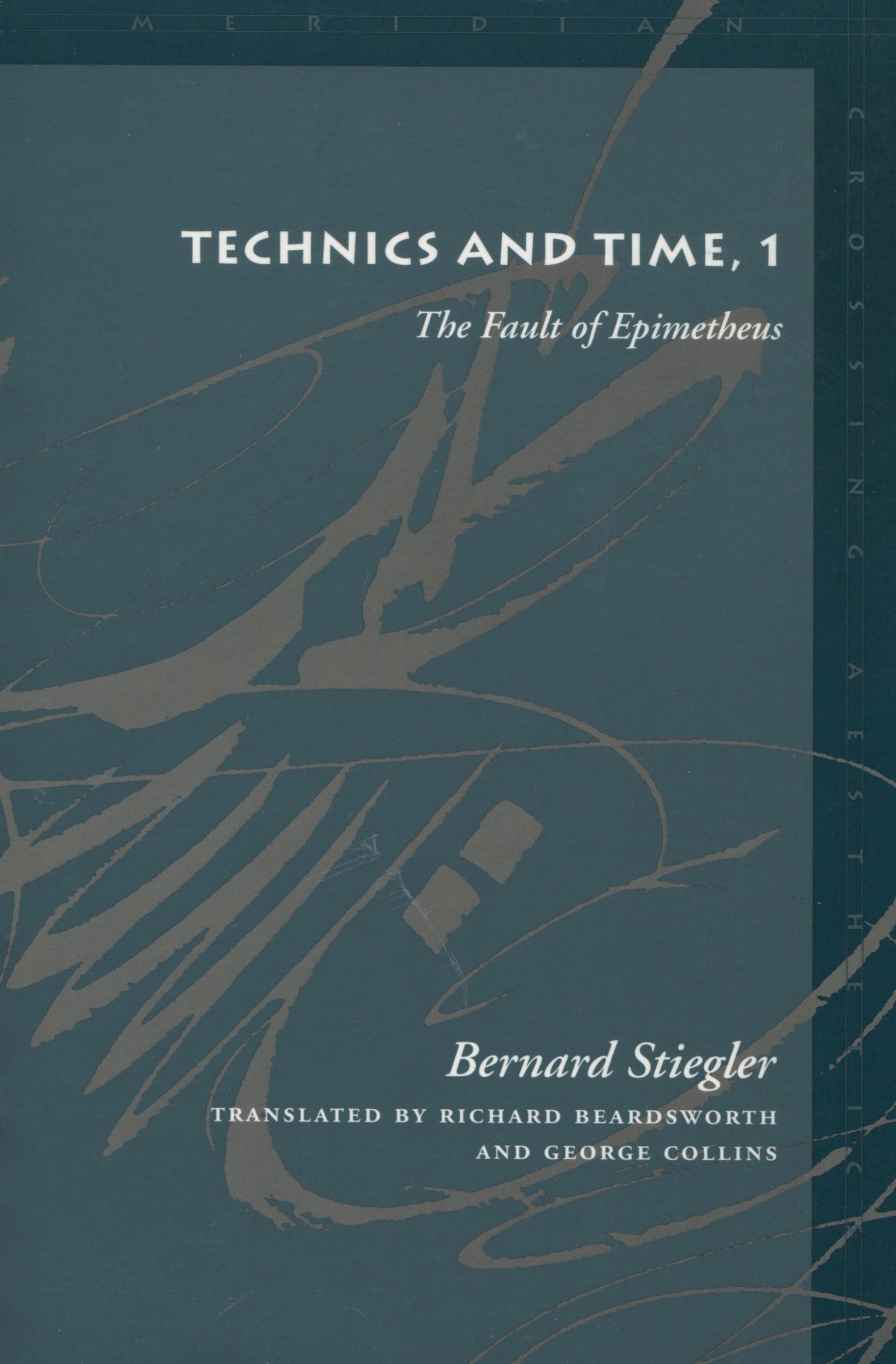
Technics And Time, 1: The Fault Of Epimetheus (Meridian: Crossing Aesthetics),New
Sold by Ergodebooks, an authorized reseller.
Returns accepted within 30 days | support@ergodebooks.com
Shipping Information
- Free Standard Shipping — United States only
- Processing Time: 3–5 business days
- Estimated Delivery: 6–10 business days after dispatch
- Double-boxed, fully insured & discreetly packaged
- Tracking number sent via email once dispatched
Returns & Refund
Returns accepted within 30 days of delivery.
Damaged or Defective Item
Free return shipping + replacement or full refund
Wrong Item Received
Free return shipping + replacement or full refund
Change of Mind
Return shipping at customer's expense · 25% restocking fee applies
Payment Option

What is a technical object? At the beginning of Western philosophy, Aristotle contrasted beings formed by nature, which had within themselves a beginning of movement and rest, and manmade objects, which did not have the source of their own production within themselves. This book, the first of three volumes, revises the Aristotelian argument and develops an innovative assessment whereby the technical object can be seen as having an essential, distinct temporality and dynamics of its own.The Aristotelian concept persisted, in one form or another, until Marx, who conceived of the possibility of an evolution of technics. Lodged between mechanics and biology, a technical entity became a complex of heterogeneous forces. In a parallel development, while industrialization was in the process of overthrowing the contemporary order of knowledge as well as contemporary social organization, technology was acquiring a new place in philosophical questioning. Philosophy was for the first time faced with a world in which technical expansion was so widespread that science was becoming more and more subject to the field of instrumentality, with its ends determined by the imperatives of economic struggle or war, and with its epistemic status changing accordingly. The power that emerged from this new relation was unleashed in the course of the two world wars.Working his way through the history of the Aristotelian assessment of technics, the author engages the ideas of a wide range of thinkersRousseau, Husserl, and Heidegger, the paleoontologist LeroiGourhan, the anthropologists Vernant and Detienne, the sociologists Weber and Habermas, and the systems analysts Maturana and Varela.
⚠️ WARNING (California Proposition 65):
This product may contain chemicals known to the State of California to cause cancer, birth defects, or other reproductive harm.
For more information, please visit www.P65Warnings.ca.gov.
- Q: How many pages does this book have? A: This book has three hundred eighteen pages. It offers an in-depth exploration of the philosophy surrounding technical objects.
- Q: What are the dimensions of this book? A: The dimensions of this book are five point seven five inches in length, eight point seven five inches in height, and zero point eight inches in width.
- Q: Is this book a hardcover or paperback? A: This book is a paperback. This binding type is commonly used for literary works, making it more affordable and lightweight.
- Q: Who is the author of this book? A: The author of this book is Bernard Stiegler. He is known for his contributions to philosophy and technology studies.
- Q: What is the genre of this book? A: The genre of this book is the history of technology. It delves into philosophical questions about technical objects and their implications.
- Q: How should I read this book? A: You can read this book at your own pace, as it is suitable for both casual readers and those seeking deeper philosophical understanding. Some prior knowledge of philosophical concepts may enhance your experience.
- Q: Is this book suitable for beginners in philosophy? A: Yes, this book can be suitable for beginners with an interest in philosophy and technology. However, some sections may require additional background knowledge.
- Q: How do I care for this book? A: To maintain this book, store it in a dry place away from direct sunlight. Avoid exposing it to moisture to preserve the pages and binding.
- Q: Can I clean the book if it gets dirty? A: Yes, you can gently wipe the cover with a soft, dry cloth. Avoid using water or cleaning solutions that may damage the paper.
- Q: What if I receive a damaged book? A: If you receive a damaged book, you can contact the seller for a return or exchange. Most sellers provide customer support for such issues.
- Q: How does this book compare to other works on technology? A: This book offers a unique philosophical perspective compared to other technology texts. It engages with historical figures and concepts, making it distinct.
- Q: Is this book appropriate for academic study? A: Yes, this book is appropriate for academic study, especially in philosophy and technology courses. It provides valuable insights into the evolution of technical thought.
- Q: Does this book have any illustrations or images? A: No, this book does not include illustrations or images. It focuses on philosophical discourse and textual analysis.
- Q: What if I want to return this book? A: You can return this book according to the seller's return policy. Ensure you follow the instructions provided at the time of purchase.
- Q: Can I find this book in libraries? A: Yes, this book is likely available in university and public libraries, especially those with strong philosophy or technology collections.
- Q: Is there a digital version of this book available? A: Yes, a digital version may be available for purchase or borrowing through various online platforms and libraries.