
Title
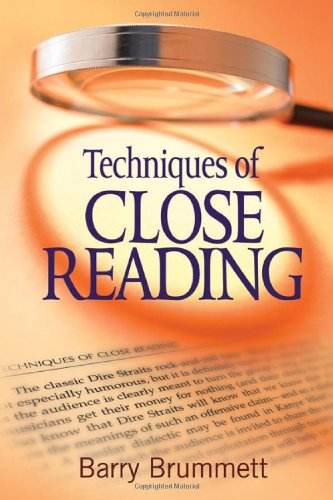
Techniques of Close Reading,New
Sold by Ergodebooks, an authorized reseller.
Returns accepted within 30 days | support@ergodebooks.com
Shipping Information
- Free Standard Shipping — United States only
- Processing Time: 3–5 business days
- Estimated Delivery: 6–10 business days after dispatch
- Double-boxed, fully insured & discreetly packaged
- Tracking number sent via email once dispatched
Returns & Refund
Returns accepted within 30 days of delivery.
Damaged or Defective Item
Free return shipping + replacement or full refund
Wrong Item Received
Free return shipping + replacement or full refund
Change of Mind
Return shipping at customer's expense · 25% restocking fee applies
Payment Option

In a world in which messages increasingly ask us to believe, accept, buy, and follow, the ability to read texts closely in order to gain a deeper understanding of their meanings is an indispensable survival skill.Techniques of Close Reading is a brief book that helps students see what texts may be saying, be they written, oral, visual, or mediated. Renowned scholar and professor Barry Brummett explains and explores the various ways to 'read' messages (such as speeches, cartoons, or magazine ads), teaching students how to see deeper levels of meaning and to share those insights with others. Students learn techniques for discovering form, rhetorical tropes, argument, and ideologies within texts.This book differs from other books in rhetorical criticism, textual analysis, or critical thinking by:Focusing on the act and techniques of criticism rather than on schools of thought, grand theories, and specific methods, thus helping students to engage in the act of critical close reading in ways that are congenial to a wide range of methods making the book an ideal companion to texts focused on specific methods Explaining the relationships among theory, methods, and techniques of rhetorical criticism Examining the ethics and risks of doing and reading rhetorical criticism via plenty of examples, figures, and exercises taken from everyday life Serving as a brief, affordable text, thus allowing instructors the flexibility to assign other textbooks
⚠️ WARNING (California Proposition 65):
This product may contain chemicals known to the State of California to cause cancer, birth defects, or other reproductive harm.
For more information, please visit www.P65Warnings.ca.gov.
- Q: How many pages does the book have? A: The book has one hundred fifty-two pages. This length makes it a concise resource for students learning close reading techniques.
- Q: What is the binding type of this book? A: The binding type is paperback. This makes it a lightweight option that is easy to carry and read.
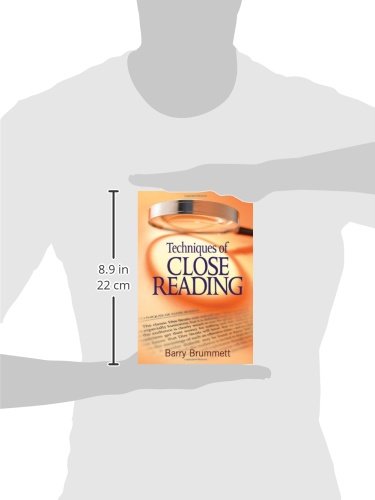
- Q: What are the dimensions of the book? A: The dimensions are six point two six inches in length, zero point two five inches in width, and nine point two five inches in height. These dimensions make it portable for students.
- Q: Who is the author of 'Techniques of Close Reading'? A: The author is Barry S. Brummett. He is a renowned scholar and professor in the field of communication.
- Q: What topics does this book cover? A: The book covers various techniques for reading texts closely. It includes discussions on rhetorical tropes, arguments, and ideologies present in messages.
- Q: Is this book suitable for beginners? A: Yes, the book is suitable for beginners. It focuses on essential techniques that help new students engage in critical reading.
- Q: How can I apply what I learn from this book? A: You can apply the techniques by practicing close reading on various texts such as speeches and advertisements. The exercises provided enhance practical understanding.
- Q: Is this book appropriate for advanced readers? A: Yes, advanced readers can also benefit from this book. It offers insights into the ethics and risks of rhetorical criticism, valuable for all skill levels.
- Q: How should I store this book to keep it in good condition? A: Store the book upright in a cool, dry place. Avoid exposing it to direct sunlight to prevent fading or damage.
- Q: Can this book be used as a textbook? A: Yes, it can be used as a textbook. Its concise format makes it a flexible choice for instructors alongside other materials.
- Q: What if the book arrives damaged? A: If the book arrives damaged, you should contact the seller for a return or exchange. Most sellers have policies to handle such issues.
- Q: Does this book include exercises for practice? A: Yes, the book includes plenty of exercises. These are designed to help students apply the techniques of close reading in real-world contexts.
- Q: Is there a specific reading level recommended for this book? A: The book is suitable for high school and college students. It is designed to be accessible while still providing depth.
- Q: What makes this book different from others on critical thinking? A: This book focuses on techniques of criticism rather than theories. It encourages practical engagement with texts, making it unique.
- Q: How can I clean the book if it gets dirty? A: To clean the book, gently wipe the cover with a damp cloth. Avoid using any harsh chemicals that could damage the material.
- Q: Are there any specific methods discussed in the book? A: While it does not focus on specific methods, the book explains the relationships among theory, methods, and techniques in rhetorical criticism.