
Title
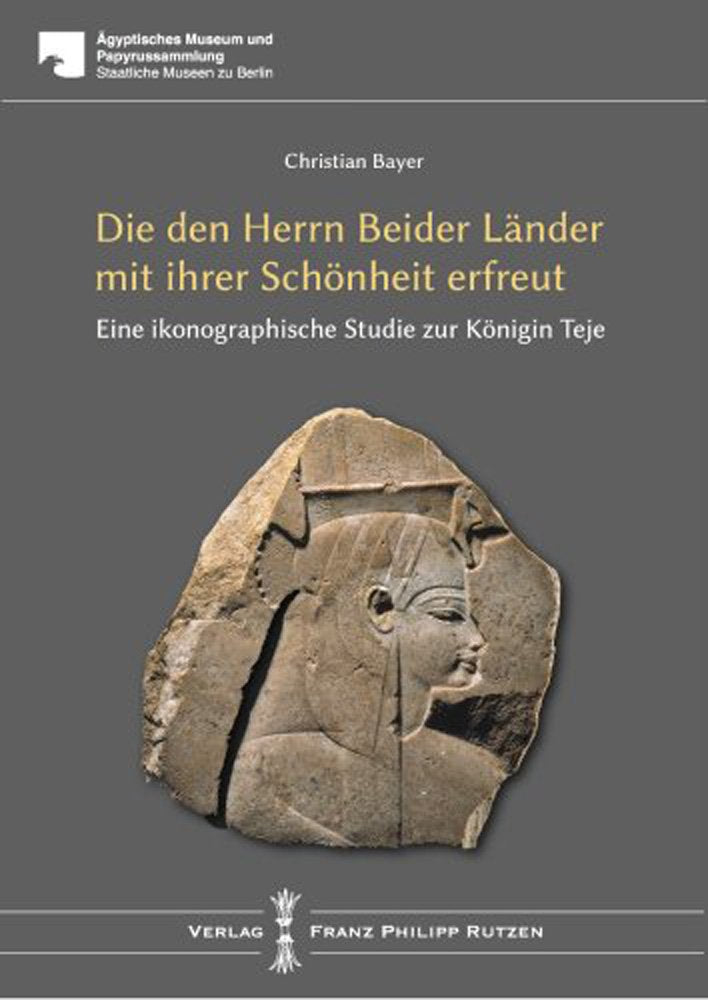
TEJE: Die den Herrn beider Lnder mit ihrer Schnheit erfreut Eine ikonographische Studie (Agyptisches Museum Und Papyrussammlung ,New
Sold by Ergodebooks, an authorized reseller.
Returns accepted within 30 days | support@ergodebooks.com
Shipping Information
- Free Standard Shipping — United States only
- Processing Time: 3–5 business days
- Estimated Delivery: 6–10 business days after dispatch
- Double-boxed, fully insured & discreetly packaged
- Tracking number sent via email once dispatched
Returns & Refund
Returns accepted within 30 days of delivery.
Damaged or Defective Item
Free return shipping + replacement or full refund
Wrong Item Received
Free return shipping + replacement or full refund
Change of Mind
Return shipping at customer's expense · 25% restocking fee applies
Payment Option

English summary: No Queen of the New Kingdom of Egypt, other than Nefertiti, has as prominent a role in Egyptian art as Tiye, the Great Royal Wife of Amenhotep III. The range of her appearances covers virtually the entire spectrum of Egyptian visual media from groups of monumental statues to small wooden figurines, from temple reliefs and sepulchral paintings to scarabs and cylinder seals, and from stelae to decorative jewelry and articles of everyday use. With this study, Christian Bayer is the first to present the complete portraits of Queen Tiye and to discuss their iconography and exact dating in detail. So far, researchers have divided the development of the royal art style of Amenhotep III into four consecutive phases, whereby the socalled 'baroque' phase shortly before the pharaoh's death is generally seen as being the pinnacle. Bayer questions this categorization and shows that this development might not have taken place in consecutive phases after all: the 'baroque' period should more likely represent the third phase, after which Amenhotep III returned to a more 'classical' style as shown in buildings constructed for the Sed festival towards the end of his reign. German description: Keine andere Konigin des Neuen Reiches ausser Nofretete tritt im Denkmalerbestand derart prominent in Erscheinung wie Teje, die Grosse Konigsgemahlin Amenhoteps III. Die Spannbreite ihres Auftretens umfasst nahezu das gesamte Spektrum agyptischer Bildmedien von monumentalen Statuengruppen bis zu kleinen Holzfigurchen, von Tempelreliefs und Grabmalereien bis zu Skarabaen und Rollsiegeln, von Stelen bis zu dekorativen Schmuck und Gebrauchsgegenstanden. Christian Bayer stellt in seiner Studie erstmals alle Bildnisse der Konigin Teje ausfuhrlich vor und diskutiert eingehend ihre Ikonographie und mogliche Feindatierung. Bislang wurde die Entwicklung des koniglichen Kunststils Amenhoteps III. von der Forschung in vier linear aufeinanderfolgende Phasen eingeteilt, wobei die sogenannte 'barocke' Phase als Gipfelpunkt kurz vor dem Tod des Herrschers interpretiert wurde. Bayer stellt diese Einteilung in Frage und kann zeigen, dass die Entwicklung im Gegenteil 'nichtlinear' verlaufen sein durfte: Die 'barocke' Phase wurde demnach die dritte Phase darstellen, in deren Anschluss Amenhotep III. mit den SedfestBauten am Ende seiner Regierung zu einer 'klassischeren' Darstellungsweise zuruckgekehrt ist.
⚠️ WARNING (California Proposition 65):
This product may contain chemicals known to the State of California to cause cancer, birth defects, or other reproductive harm.
For more information, please visit www.P65Warnings.ca.gov.