
Title
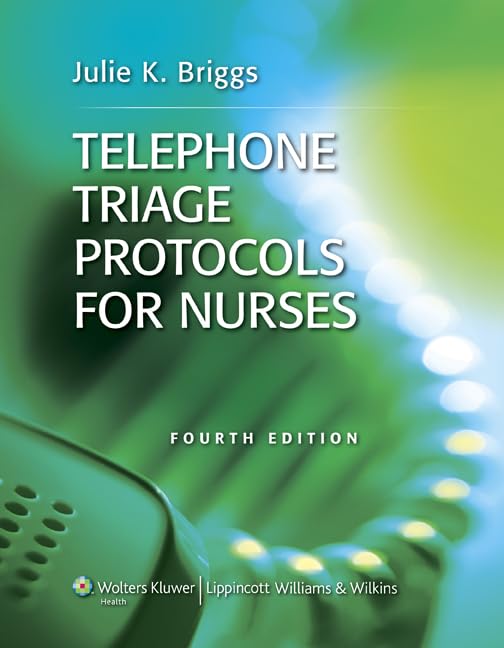
Telephone Triage Protocols For Nurses
Sold by Ergodebooks, an authorized reseller.
Returns accepted within 30 days | support@ergodebooks.com
Shipping Information
- Free Standard Shipping — United States only
- Processing Time: 3–5 business days
- Estimated Delivery: 6–10 business days after dispatch
- Double-boxed, fully insured & discreetly packaged
- Tracking number sent via email once dispatched
Returns & Refund
Returns accepted within 30 days of delivery.
Damaged or Defective Item
Free return shipping + replacement or full refund
Wrong Item Received
Free return shipping + replacement or full refund
Change of Mind
Return shipping at customer's expense · 25% restocking fee applies
Payment Option

Performing Telephone Triage Requires The Ability To Make Quick And Effective Decisions Based On Limited Information.This Rapidaccess Resource Delivers Over 200 Triage Protocols For Evaluating Patients' Symptoms Over The Telephone. Each Symptom Entry Lists Questions, Grouped By Urgency Level, To Determine Whether The Caller Should Seek Emergency Care Immediately, Seek Medical Care The Same Day, Call Back For Appointment, Or Follow Home Care Instructions. Detailed Home Care Instructions Are Then Provided. Simple, Direct, And Useful, This Is The Most Comprehensive And Userfriendly Telephone Triage Book Available.This New Edition Features Several New Protocolsswine Flu (H1N1 Virus), Bedbug Problems, Tattoo Problems, And Emergency Contraceptionas Well As New Information In The Introductory Chapter About Program Development, Management Issues, And Staff Development, Including Training. Other Features Include A New Reminder About Documentation In Each Protocol, A New Anatomic Table Of Contents, And Expanded Home Care Instructions.
⚠️ WARNING (California Proposition 65):
This product may contain chemicals known to the State of California to cause cancer, birth defects, or other reproductive harm.
For more information, please visit www.P65Warnings.ca.gov.
- Q: How many pages does this book have? A: This book has six hundred eight pages. It provides an extensive resource for telephone triage protocols.
- Q: What is the binding type of this book? A: The binding type is spiral bound. This allows for easy handling and quick access to information.
- Q: What are the dimensions of this book? A: The book measures eight inches in length, one inch in width, and nine point zero two inches in height. These dimensions make it portable and user-friendly.
- Q: How do I use the telephone triage protocols? A: To use the protocols, ask the caller specific questions based on their symptoms. Each entry guides you on whether to recommend immediate care or home instructions.
- Q: Is this book suitable for new nurses? A: Yes, this book is suitable for new nurses. It provides clear and concise protocols that are easy to follow.
- Q: Can I use this book for pediatric triage? A: Yes, it includes protocols applicable to pediatric patients. However, always consider additional pediatric-specific guidelines.
- Q: How should I store this book? A: Store this book in a cool, dry place to maintain its condition. Keep it away from direct sunlight to prevent fading.
- Q: Is this book safe to use in a clinical setting? A: Yes, it is safe to use in a clinical setting. The protocols are designed for professional use in emergency situations.
- Q: How do I keep this book in good condition? A: To keep the book in good condition, avoid bending the pages and clean it gently with a soft cloth if needed.
- Q: What if I receive a damaged book? A: If you receive a damaged book, contact the seller for a return or exchange. Most sellers have a return policy for damaged items.
- Q: Can I return this book if I don't like it? A: Yes, you can return the book if it doesn't meet your expectations. Check the seller's return policy for specific details.
- Q: Does this book include updated protocols? A: Yes, this edition includes several updated protocols, such as those for swine flu and bedbug problems. It reflects current medical guidelines.
- Q: Is there a specific audience this book targets? A: This book targets healthcare professionals, particularly nurses involved in triage. It serves as a practical reference for emergency care.
- Q: Does this book cover psychological symptoms? A: Yes, it includes protocols for psychological symptoms. This helps in assessing callers with mental health concerns.
- Q: Are there illustrations or charts in this book? A: Yes, the book features charts and tables to facilitate quick reference and understanding of the protocols.
- Q: Who is the author of this book? A: The author of this book is Julie K. Briggs. She has extensive experience in nursing and triage protocols.