
Title
Telling Lies: Clues To Deceit In The Marketplace, Politics, And Marriage,Used
Sold by Ergodebooks, an authorized reseller.
Returns accepted within 30 days | support@ergodebooks.com
Shipping Information
- Free Standard Shipping — United States only
- Processing Time: 3–5 business days
- Estimated Delivery: 6–10 business days after dispatch
- Double-boxed, fully insured & discreetly packaged
- Tracking number sent via email once dispatched
Returns & Refund
Returns accepted within 30 days of delivery.
Damaged or Defective Item
Free return shipping + replacement or full refund
Wrong Item Received
Free return shipping + replacement or full refund
Change of Mind
Return shipping at customer's expense · 25% restocking fee applies
Payment Option

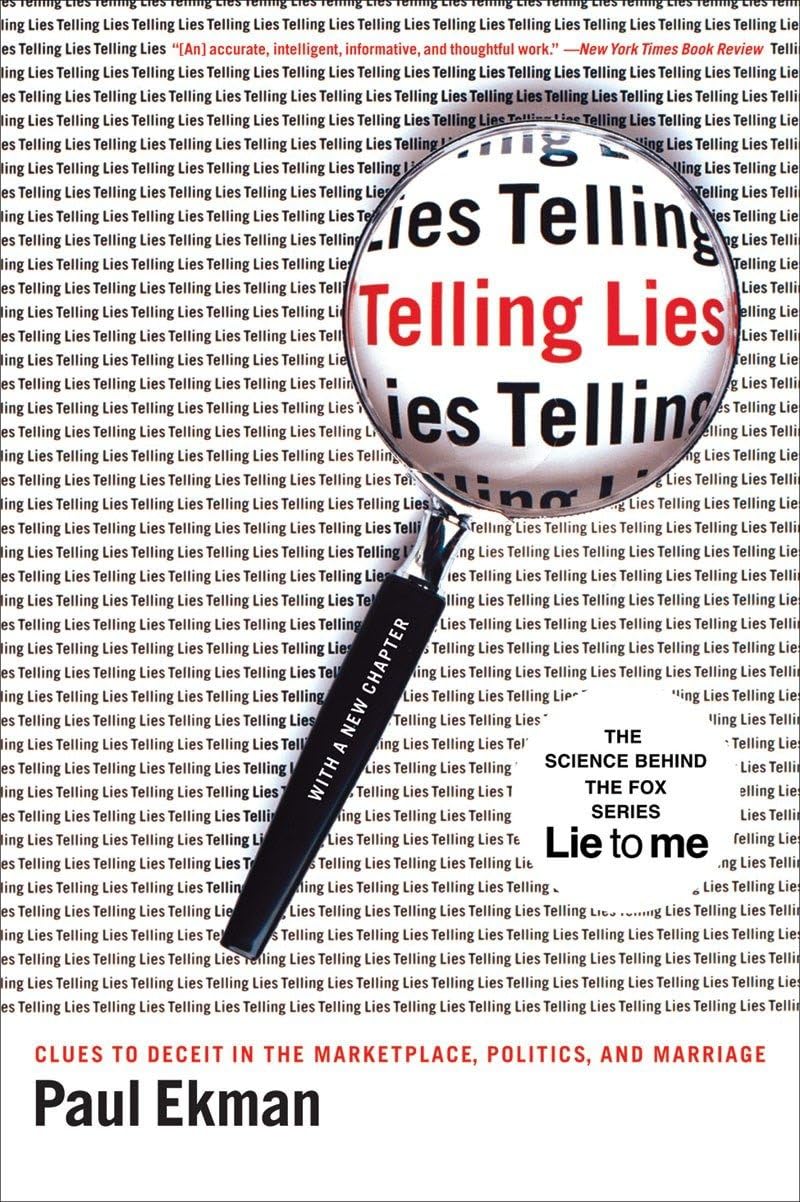
From Breaking The Law To Breaking A Promise, How Do People Lie And How Can They Be Caught?In This Revised Edition, Paul Ekman, A Renowned Expert In Emotions Research And Nonverbal Communication, Adds A New Chapter To Present His Latest Research On His Groundbreaking Inquiry Into Lying And The Methods For Uncovering Lies. Ekman Has Figured Out The Most Important Behavioral Clues To Deceit; He Has Developed A Onehour Selfinstructional Program That Trains People To Observe And Understand 'Micro Expressions'; And He Has Done Research That Identifies The Facial Expressions That Show Whether Someone Is Likely To Become Violenta Selfinstructional Program To Train Recognition Of These Dangerous Signals Has Also Been Developed.Telling Lies Describes How Lies Vary In Form And How They Can Differ From Other Types Of Misinformation That Can Reveal Untruths. It Discusses How A Persons Body Language, Voice, And Facial Expressions Can Give Away A Lie But Still Fool Professional Lie Hunters?Even Judges, Police Officers, Drug Enforcement Agents, And Secret Service Agents.
⚠️ WARNING (California Proposition 65):
This product may contain chemicals known to the State of California to cause cancer, birth defects, or other reproductive harm.
For more information, please visit www.P65Warnings.ca.gov.
- Q: What is the page count of 'Telling Lies'? A: The book has four hundred sixteen pages. This extensive length allows for an in-depth exploration of deceit and its nuances.
- Q: What size is the book 'Telling Lies'? A: The book measures five point five one inches in length and eight point three one inches in height. Its paperback binding makes it portable and easy to handle.
- Q: Who is the author of 'Telling Lies'? A: The author is Paul Ekman, a renowned expert in emotions research and nonverbal communication. His expertise lends credibility to the insights presented in the book.
- Q: How do I use the information in 'Telling Lies'? A: You can read it to improve your understanding of deceit and how to identify it. The book includes practical insights and observational techniques.
- Q: Is 'Telling Lies' suitable for a general audience? A: Yes, it is suitable for anyone interested in understanding human behavior and deception. The content is accessible to both professionals and lay readers.
- Q: What age group is 'Telling Lies' appropriate for? A: The book is best suited for adults and mature teens. Its themes may not be appropriate for younger children due to the complexity of the subject matter.
- Q: How should I care for my copy of 'Telling Lies'? A: Keep it in a dry place away from direct sunlight to prevent fading. You can wipe the cover with a soft cloth to keep it clean.
- Q: Is 'Telling Lies' a good book for academic study? A: Yes, it is an excellent resource for academic study in psychology and interpersonal relations. It provides a wealth of information and research findings.
- Q: What should I do if my copy of 'Telling Lies' arrives damaged? A: Contact the seller or publisher for a return or exchange. Most retailers have policies in place for damaged items.
- Q: Does the book include exercises or practical tools? A: Yes, it includes a one-hour self-instructional program for recognizing micro-expressions. This practical approach enhances the reading experience.
- Q: What category does 'Telling Lies' fall under? A: It falls under the category of Interpersonal Relations. This genre focuses on understanding and improving human interactions.
- Q: Can 'Telling Lies' help in professional settings? A: Yes, it can be beneficial in various professional fields, including law enforcement and counseling. The insights can improve communication and detection of deceit.
- Q: Is there a specific method taught in 'Telling Lies'? A: Yes, it teaches observational techniques to identify behavioral clues of deceit. This includes understanding body language and facial expressions.
- Q: Are there any additional resources included in the book? A: The revised edition contains a new chapter featuring the latest research by Paul Ekman. This adds value to the original content.
- Q: What themes are explored in 'Telling Lies'? A: The book explores themes of deceit in various contexts, including personal relationships, politics, and commerce. It provides a comprehensive view of how lies manifest.