If you have any questions, you are always welcome to contact us. We'll get back to you as soon as possible, withing 24 hours on weekdays.
Customer service
All questions about your order, return and delivery must be sent to our customer service team by e-mail at yourstore@yourdomain.com
Sale & Press
If you are interested in selling our products, need more information about our brand or wish to make a collaboration, please contact us at press@yourdomain.com
Help
If you have any questions, you are always welcome to contact us. We'll get back to you as soon as possible, withing 24 hours on weekdays.
Customer service
All questions about your order, return and delivery must be sent to our customer service team by e-mail at yourstore@yourdomain.com
Sale & Press
If you are interested in selling our products, need more information about our brand or wish to make a collaboration, please contact us at press@yourdomain.com
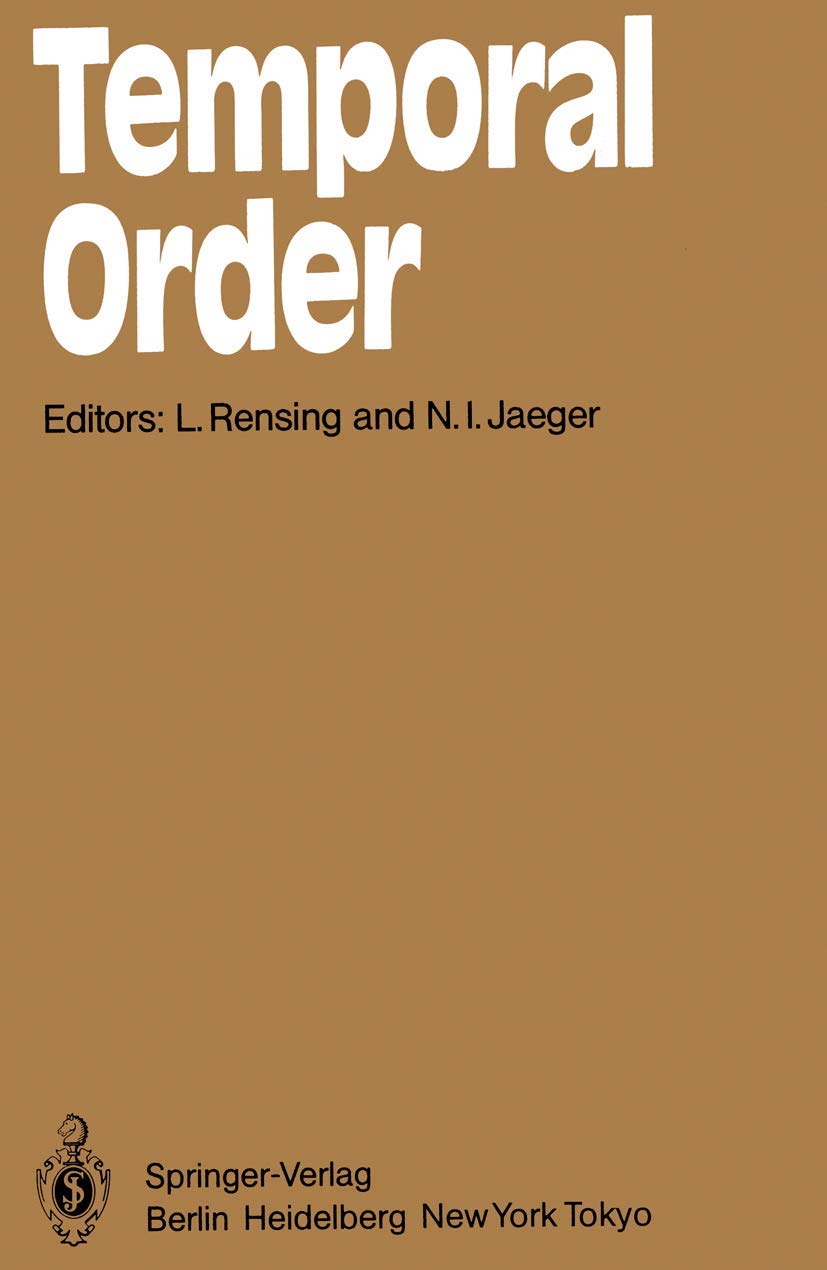
This volume contains the lectures and contributions presented at the International Symposium on Temporal Order held in Bremen, September 1722, 1984. Temporal order, such as a more or less regularly repeated temporal sequence of events, can evol ve in open systems far removed from equi 1 i bri um. Progress duri ng the last decade in the analysis and the modelling of this complex phenomenon in both biological and chemical systems gave rise to the idea of a joint conference. The purpose of the symposium was to stimulate future work by enhancing the exchange of experimental and theoretical results between neighbouring disciplines. Theoretical work in general, and mathematical models in particular, provided the basis for a mutual discussion and, thus, helped to overcome difficulties in under standing the results of different experimental fields. Chemical systems, for examp le, are more rigorously controllable through their experimental conditions in com parison to biological systems, which maintain highly effective autonomous control against environmental influences. Therefore, different states such as bistability, oscillations and chaos can be defined and, hence, described better in chemical sy stems. Chemical systems may thus provide some insights into functional structures that also exist in more complex biological systems.
⚠️ WARNING (California Proposition 65):
This product may contain chemicals known to the State of California to cause cancer,
birth defects, or other reproductive harm.
For MAP (Minimum Advertised Price) violations and Intellectual Property (IP) or Trademark concerns, please contact:
support@ergodebooks.com
⚠️ California Proposition 65 Warning: Some products sold on this website may expose you to chemicals known to the State of California to cause cancer, birth defects, or other reproductive harm. For more information, visit www.P65Warnings.ca.gov.