
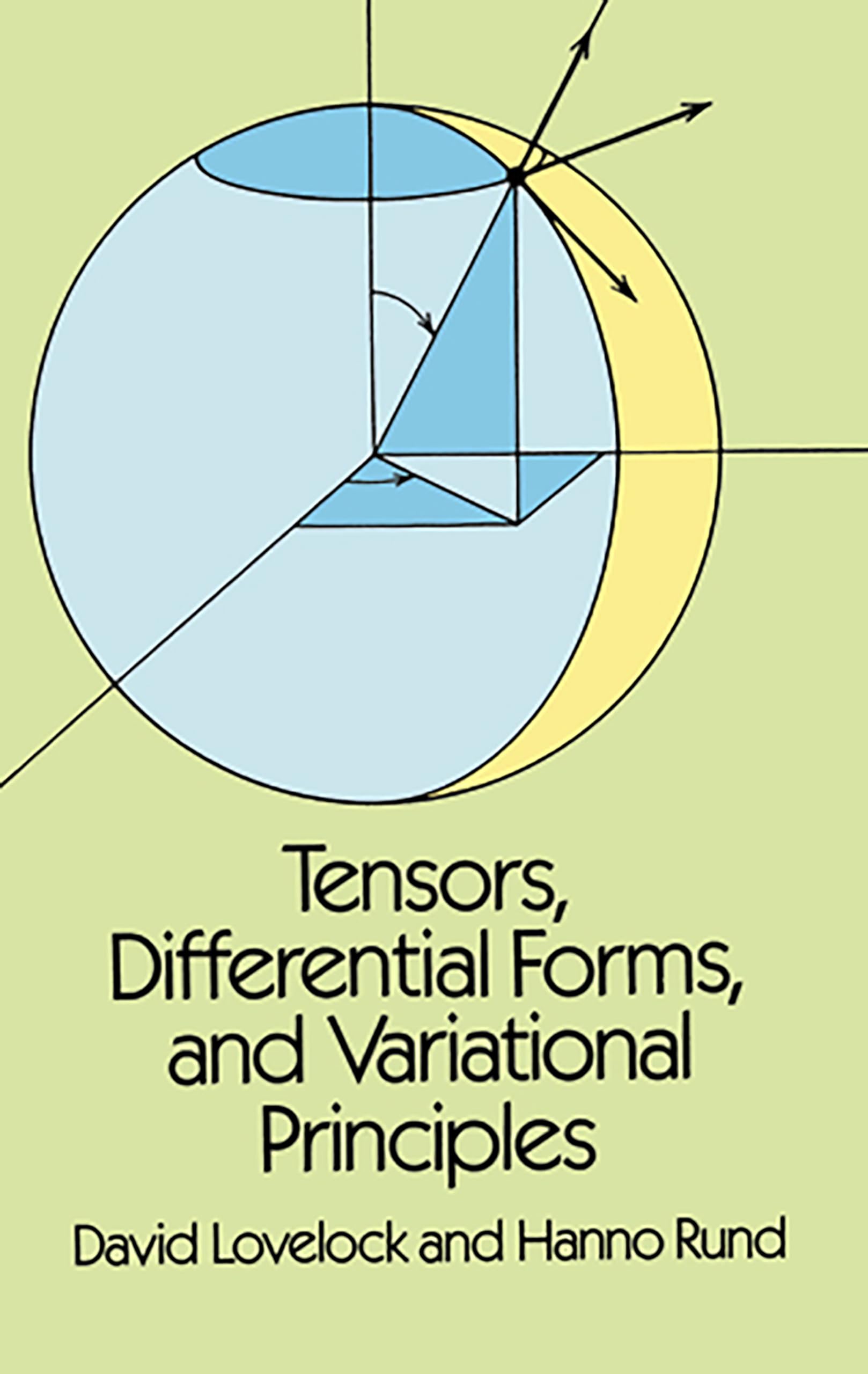
Title
Tensors, Differential Forms, And Variational Principles (Dover Books On Mathematics)
Sold by Ergodebooks, an authorized reseller.
Returns accepted within 30 days | support@ergodebooks.com
Shipping Information
- Free Standard Shipping — United States only
- Processing Time: 3–5 business days
- Estimated Delivery: 6–10 business days after dispatch
- Double-boxed, fully insured & discreetly packaged
- Tracking number sent via email once dispatched
Returns & Refund
Returns accepted within 30 days of delivery.
Damaged or Defective Item
Free return shipping + replacement or full refund
Wrong Item Received
Free return shipping + replacement or full refund
Change of Mind
Return shipping at customer's expense · 25% restocking fee applies
Payment Option

The aim of this book is to present a selfcontained, reasonably modern account of tensor analysis and the calculus of exterior differential forms, adapted to the needs of physicists, engineers, and applied mathematicians. In the later, increasingly sophisticated chapters, the interaction between the concept of invariance and the calculus of variations is examined. This interaction is of profound importance to all physical field theories.Beginning with simple physical examples, the theory of tensors and forms is developed by a process of successive abstractions. This enables the reader to infer generalized principles from concrete situations departing from the traditional approach to tensors and forms in terms of purely differentialgeometric concepts.The treatment of the calculus of variations of single and multiple integrals is based ab initio on Carathodory's method of equivalent integrals. Subsequent material explores the effects of invariance postulates on variational principles, focusing ultimately on relativistic field theories. Other discussions include: integral invariants simple and direct derivations of Noether's theorems Riemannian spaces with indefinite metricsThe emphasis in this book is on analytical techniques, with abundant problems, ranging from routine manipulative exercises to technically difficult problems encountered by those using tensor techniques in research activities. A special effort has been made to collect many useful results of a technical nature, not generally discussed in the standard literature. The Appendix, newly revised and enlarged for the Dover edition, presents a reformulation of the principal concepts of the main text within the terminology of current global differential geometry, thus bridging the gap between classical tensor analysis and the fundamentals of more recent global theories.
⚠️ WARNING (California Proposition 65):
This product may contain chemicals known to the State of California to cause cancer, birth defects, or other reproductive harm.
For more information, please visit www.P65Warnings.ca.gov.
- Q: How many pages does the book have? A: This book contains four hundred pages. It provides an in-depth exploration of tensor analysis and differential forms.
- Q: What are the dimensions of the book? A: The book measures five point twenty-five inches in length, zero point seventy-five inches in width, and eight point five inches in height.
- Q: What type of binding does this book have? A: The book is available in paperback binding. This makes it lightweight and easy to handle.
- Q: What is the main focus of the book? A: The main focus is on tensor analysis and the calculus of exterior differential forms. It is tailored for physicists, engineers, and applied mathematicians.
- Q: How does this book approach tensor analysis? A: It begins with simple physical examples, gradually developing the theory through successive abstractions. This helps readers infer generalized principles.
- Q: Is this book suitable for beginners? A: Yes, the book is suitable for beginners as it starts with basic concepts. However, it also delves into more complex topics for advanced readers.
- Q: Can this book be used for self-study? A: Yes, it is designed for self-study. The inclusion of numerous problems aids in independent learning and comprehension.
- Q: What kind of problems does the book contain? A: The book includes a range of problems, from routine exercises to technically challenging ones encountered in research activities.
- Q: Are there any prerequisites for understanding this book? A: Some familiarity with basic calculus and physics concepts would be beneficial. The book builds on these foundations.
- Q: How should I care for this book? A: To keep the book in good condition, store it upright in a dry place. Avoid exposure to moisture or direct sunlight.
- Q: Does this book have any special features? A: Yes, it features an Appendix that includes a reformulation of key concepts in current global differential geometry terminology.
- Q: Is this book appropriate for advanced learners? A: Yes, it contains sophisticated chapters addressing advanced topics like variational principles and relativistic field theories.
- Q: What is the author's background? A: The author, David Lovelock, is recognized for contributions to the field of mathematics and its applications in physics.
- Q: Where can this book be purchased? A: This book can be purchased through various online retailers, including major bookstores and academic publishers.
- Q: What genre does this book fall under? A: This book falls under the genre of mathematics, specifically focusing on vector analysis and theoretical physics.
- Q: What makes this book different from other mathematics books? A: It emphasizes analytical techniques and includes many useful results not commonly discussed in standard literature, making it unique.