If you have any questions, you are always welcome to contact us. We'll get back to you as soon as possible, withing 24 hours on weekdays.
Customer service
All questions about your order, return and delivery must be sent to our customer service team by e-mail at yourstore@yourdomain.com
Sale & Press
If you are interested in selling our products, need more information about our brand or wish to make a collaboration, please contact us at press@yourdomain.com
Help
If you have any questions, you are always welcome to contact us. We'll get back to you as soon as possible, withing 24 hours on weekdays.
Customer service
All questions about your order, return and delivery must be sent to our customer service team by e-mail at yourstore@yourdomain.com
Sale & Press
If you are interested in selling our products, need more information about our brand or wish to make a collaboration, please contact us at press@yourdomain.com
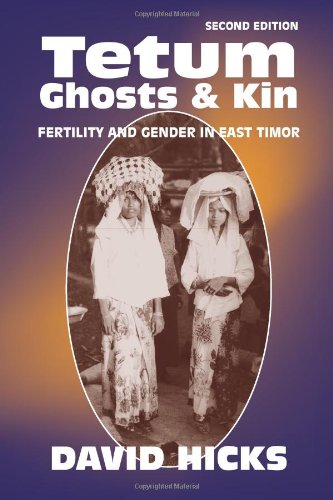
In the second edition of this study of religion and kinship in East Timor, David Hicks argues that reproductive rituals and ideas regarding fertility and gender direct the notion that for the Tetumspeaking people of Caraubalo suku, in the district of Viqueque, life and death derive from the same source. This source is the world of the ancestral ghosts (the mate bein). The soul of a person (the klamar mate) who has died becomes transformed by ritual action into an agency for lifeaffirming fertility, that is, an ancestral ghost, and it is from the ancestors that fertility, which sustains life down the generations, originates. Incorporated into this complex of ideas regarding life, fertility, gender, and death, are two recreational institutions, cockfighting and kickfighting, which Dr. Hicks argues are ritualized manifestations of fertility and infertility respectively, as well as gendered aspects of the sacred (lulik) and secular (sau) worlds. In addition to contributing to the comparative study of ritual and indigenous notions of reproduction, the second edition of Tetum Ghosts and Kin: Fertility and Gender in East Timor provides an ethnographic portrait of village life among a people whose traditions were about to be abruptly devastated by war and conquest. In a summary retrospect he outlines the events that overtook the East Timorese between the time of his first period of fieldwork and East Timor's becoming a nation on May 20, 2002, and concludes with a brief description of the present condition of Caraubalo.
⚠️ WARNING (California Proposition 65):
This product may contain chemicals known to the State of California to cause cancer,
birth defects, or other reproductive harm.
For MAP (Minimum Advertised Price) violations and Intellectual Property (IP) or Trademark concerns, please contact:
support@ergodebooks.com
⚠️ California Proposition 65 Warning: Some products sold on this website may expose you to chemicals known to the State of California to cause cancer, birth defects, or other reproductive harm. For more information, visit www.P65Warnings.ca.gov.