
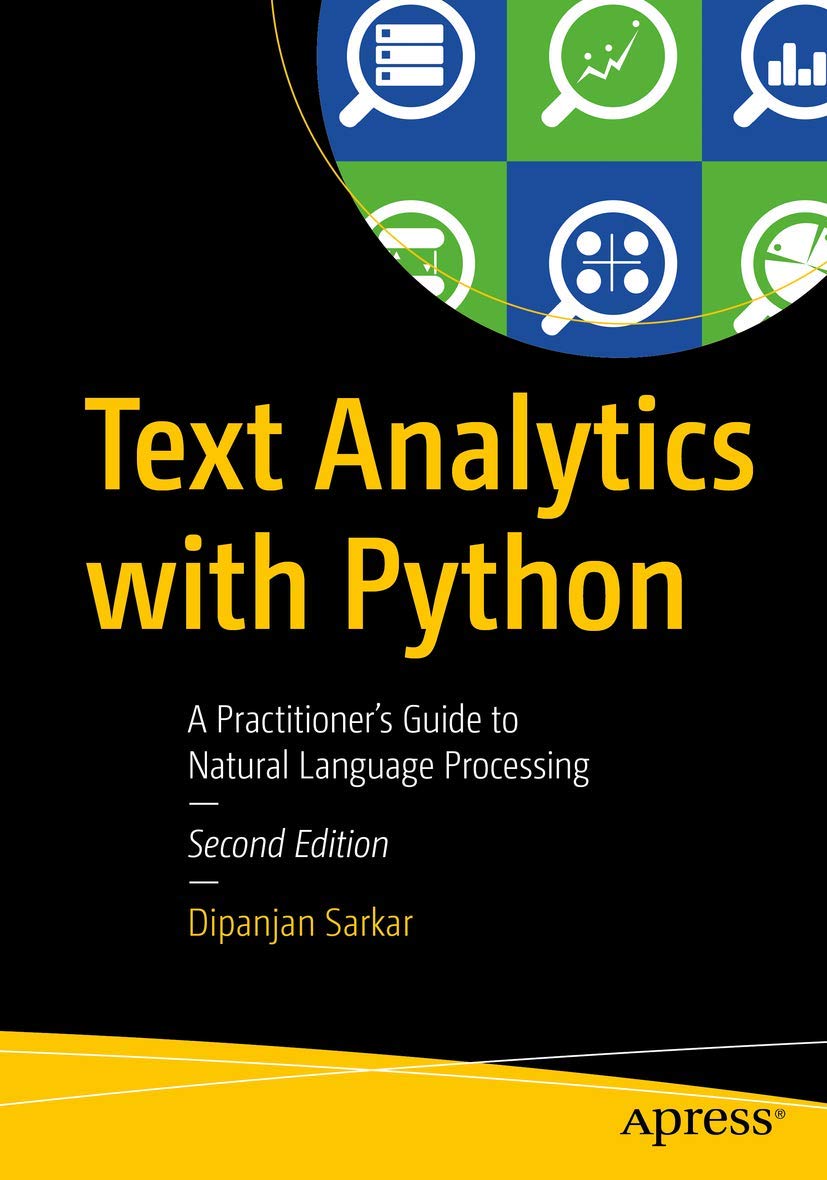
Title
Text Analytics with Python: A Practitioner's Guide to Natural Language Processing,Used
Sold by Ergodebooks, an authorized reseller.
Returns accepted within 30 days | support@ergodebooks.com
Shipping Information
- Free Standard Shipping — United States only
- Processing Time: 3–5 business days
- Estimated Delivery: 6–10 business days after dispatch
- Double-boxed, fully insured & discreetly packaged
- Tracking number sent via email once dispatched
Returns & Refund
Returns accepted within 30 days of delivery.
Damaged or Defective Item
Free return shipping + replacement or full refund
Wrong Item Received
Free return shipping + replacement or full refund
Change of Mind
Return shipping at customer's expense · 25% restocking fee applies
Payment Option

Leverage Natural Language Processing (NLP) in Python and learn how to set up your own robust environment for performing text analytics. This second edition has gone through a major revamp and introduces several significant changes and new topics based on the recent trends in NLP.Youll see how to use the latest stateoftheart frameworks in NLP, coupled with machine learning and deep learning models for supervised sentiment analysis powered by Python to solve actual case studies. Start by reviewing Python for NLP fundamentals on strings and text data and move on to engineering representation methods for text data, including both traditional statistical models and newer deep learningbased embedding models. Improved techniques and new methods around parsing and processing text are discussed as well. Text summarization and topic models have been overhauled so the book showcases how to build, tune, and interpret topic models in the context of an interest dataset on NIPS conference papers. Additionally, the book covers text similarity techniques with a realworld example of movie recommenders, along with sentiment analysis using supervised and unsupervised techniques.There is also a chapter dedicated to semantic analysis where youll see how to build your own named entity recognition (NER) system from scratch. While the overall structure of the book remains the same, the entire code base, modules, and chapters has been updated to the latest Python 3.x release.What You'll Learn Understand NLP and text syntax, semantics and structure Discover text cleaning and feature engineering Review text classification and text clustering Assess text summarization and topic models Study deep learning for NLPWho This Book Is ForIT professionals, data analysts, developers, linguistic experts, data scientists and engineers and basically anyone with a keen interest in linguistics, analytics and generating insights from textual data.
⚠️ WARNING (California Proposition 65):
This product may contain chemicals known to the State of California to cause cancer, birth defects, or other reproductive harm.
For more information, please visit www.P65Warnings.ca.gov.
- Q: What is the main focus of 'Text Analytics with Python'? A: The book primarily focuses on leveraging Natural Language Processing (NLP) in Python, guiding readers through setting up an environment for text analytics and covering techniques like sentiment analysis, text classification, and deep learning for NLP.
- Q: Who would benefit from reading this book? A: This book is ideal for IT professionals, data analysts, developers, linguistic experts, data scientists, and anyone interested in linguistics and generating insights from textual data.
- Q: What are some key topics covered in the second edition? A: The second edition includes updated frameworks in NLP, text cleaning, feature engineering, deep learning models, text summarization, topic models, and named entity recognition (NER) systems.
- Q: How many pages does this book have? A: The book contains 698 pages, providing comprehensive coverage of text analytics with practical examples.
- Q: Is the book suitable for beginners in NLP? A: Yes, the book starts with fundamental concepts of Python for NLP and gradually introduces more advanced topics, making it suitable for both beginners and experienced practitioners.
- Q: What programming language is primarily used in the book? A: The book primarily uses Python for implementing various NLP techniques, making it accessible to those familiar with the language.
- Q: Are there practical examples included in the book? A: Yes, the book features practical case studies and examples, including real-world applications like movie recommenders and sentiment analysis.
- Q: What edition is this book? A: This is the second edition of 'Text Analytics with Python', which has been significantly updated to reflect the latest trends and techniques in NLP.
- Q: When was the book published? A: The book was published on May 22, 2019.
- Q: What type of binding does this book have? A: The book is available in paperback binding, making it easy to handle and read.