
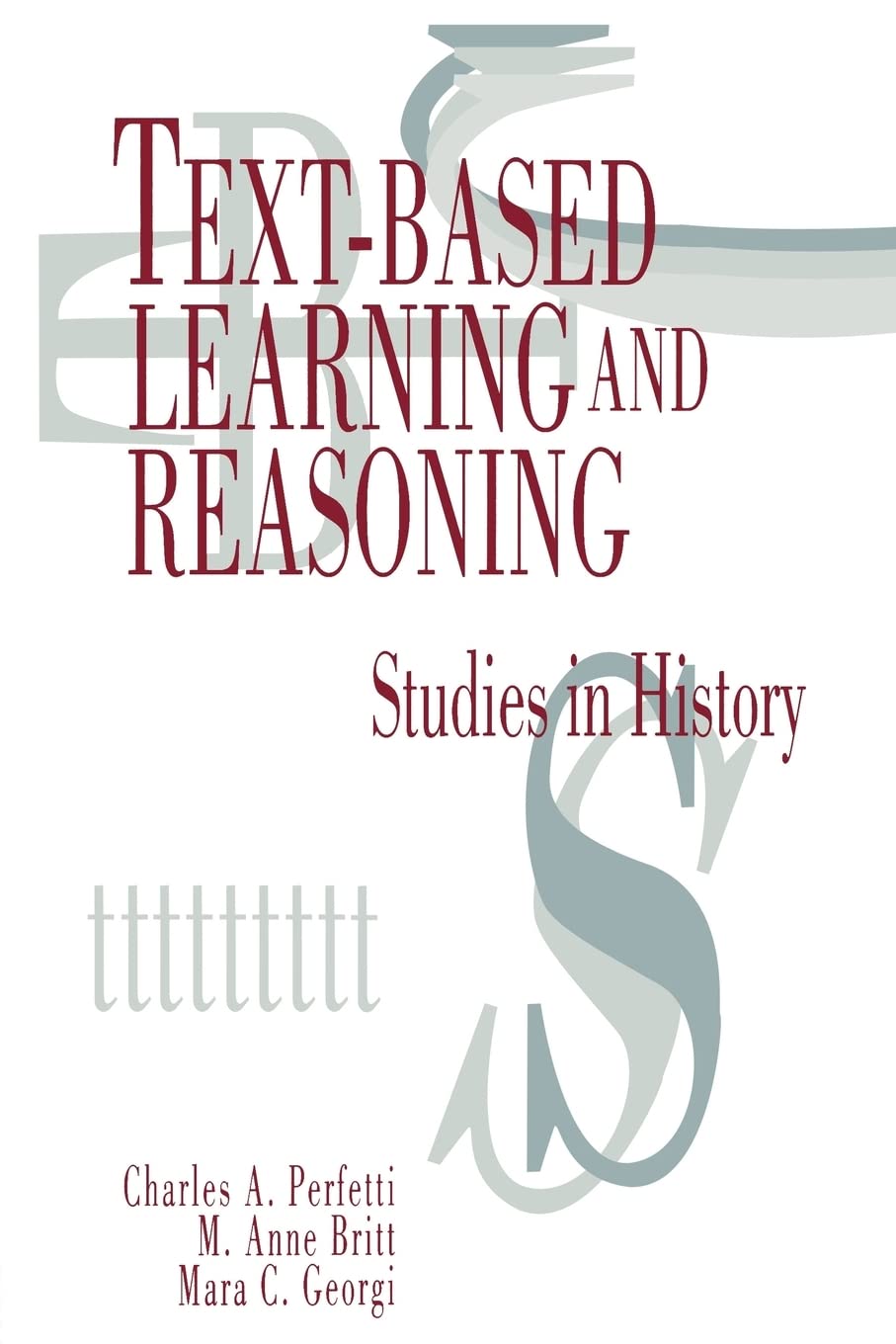
Title
Textbased Learning And Reasoning,Used
Sold by Ergodebooks, an authorized reseller.
Returns accepted within 30 days | support@ergodebooks.com
Shipping Information
- Free Standard Shipping — United States only
- Processing Time: 3–5 business days
- Estimated Delivery: 6–10 business days after dispatch
- Double-boxed, fully insured & discreetly packaged
- Tracking number sent via email once dispatched
Returns & Refund
Returns accepted within 30 days of delivery.
Damaged or Defective Item
Free return shipping + replacement or full refund
Wrong Item Received
Free return shipping + replacement or full refund
Change of Mind
Return shipping at customer's expense · 25% restocking fee applies
Payment Option

History is both an academic discipline and a school subject. As a discipline, it fosters a systematic way of discovering and evaluating the events of the past. As a school subject, American history is a staple of middle grades and high school curricula in the United States. In higher education, it is part of the liberal arts education tradition. Its role in school learning provides a context for our approach to history as a topic of learning. In reading history, students engage in cognitive processes of learning, text processing, and reasoning. This volume touches on each of these cognitive problems centered on an indepth study of college students' text learning and extended to broader issues of text understanding, the cognitive structures that enable learning of history, and reasoning about historical problems.Slated to occupy a distinctive place in the literature on human cognition, this volume combines at least three key features in a unique examination of the course of learning and reasoning in one academic domain history. The authors draw theory and analysis of text understanding from cognitive science; and focus on multiple 'natural' texts of extended length rather than laboratory texts as well as multiple and extended realistic learning situations.The research demonstrates that history stories can be described by causaltemporal event models and that these models capture the learning achieved by students. This text establishes that history learning includes learning a story, but does not assume that story learning is all there is in history. It shows a growth in students' reasoning about the story and a linkage developed over time and with study between learning and reasoning. It then illustrates that students can be exceedingly malleable in their opinions about controversial questions and generally quite influenced by the texts they read. And it presents patterns of learning and reasoning within and between individuals as well as within the group of students as a whole.By examining students' ability to use historical documents, this volume goes beyond story learning into the problem of documentbased reasoning. The authors show not just that history is a story from the learner's point of view, but also that students can develop a certain expertise in the use of documents in reasoning.
⚠️ WARNING (California Proposition 65):
This product may contain chemicals known to the State of California to cause cancer, birth defects, or other reproductive harm.
For more information, please visit www.P65Warnings.ca.gov.