
Title
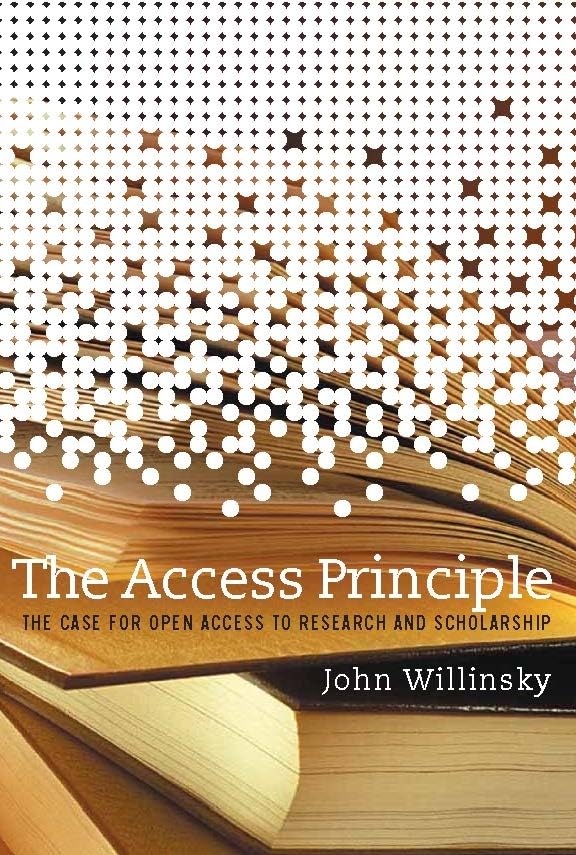
The Access Principle: The Case for Open Access to Research and Scholarship (Digital Libraries and Electronic Publishing),Used
Sold by Ergodebooks, an authorized reseller.
Returns accepted within 30 days | support@ergodebooks.com
Shipping Information
- Free Standard Shipping — United States only
- Processing Time: 3–5 business days
- Estimated Delivery: 6–10 business days after dispatch
- Double-boxed, fully insured & discreetly packaged
- Tracking number sent via email once dispatched
Returns & Refund
Returns accepted within 30 days of delivery.
Damaged or Defective Item
Free return shipping + replacement or full refund
Wrong Item Received
Free return shipping + replacement or full refund
Change of Mind
Return shipping at customer's expense · 25% restocking fee applies
Payment Option

An argument for extending the circulation of knowledge with new publishing technologies considers scholarly, economic, philosophical, and practical issues.Questions about access to scholarship go back farther than recent debates over subscription prices, rights, and electronic archives suggest. The great libraries of the pastfrom the fabled collection at Alexandria to the early public libraries of nineteenthcentury Americastood as arguments for increasing access. In The Access Principle, John Willinsky describes the latest chapter in this ongoing storyonline open access publishing by scholarly journalsand makes a case for open access as a public good.A commitment to scholarly work, writes Willinsky, carries with it a responsibility to circulate that work as widely as possible: this is the access principle. In the digital age, that responsibility includes exploring new publishing technologies and economic models to improve access to scholarly work. Wide circulation adds value to published work; it is a significant aspect of its claim to be knowledge. The right to know and the right to be known are inextricably mixed. Open access, argues Willinsky, can benefit both a researcherauthor working at the bestequipped lab at a leading research university and a teacher struggling to find resources in an impoverished high school.Willinsky describes different types of accessthe New England Journal of Medicine, for example, grants open access to issues six months after initial publication, and First Monday forgoes a print edition and makes its contents immediately accessible at no cost. He discusses the contradictions of copyright law, the reading of research, and the economic viability of open access. He also considers broader themes of public access to knowledge, human rights issues, lessons from publishing history, and epistemological vanities. The debate over open access, writes Willinsky, raises crucial questions about the place of scholarly work in a larger worldand about the future of knowledge.
⚠️ WARNING (California Proposition 65):
This product may contain chemicals known to the State of California to cause cancer, birth defects, or other reproductive harm.
For more information, please visit www.P65Warnings.ca.gov.