If you have any questions, you are always welcome to contact us. We'll get back to you as soon as possible, withing 24 hours on weekdays.
Customer service
All questions about your order, return and delivery must be sent to our customer service team by e-mail at yourstore@yourdomain.com
Sale & Press
If you are interested in selling our products, need more information about our brand or wish to make a collaboration, please contact us at press@yourdomain.com
Help
If you have any questions, you are always welcome to contact us. We'll get back to you as soon as possible, withing 24 hours on weekdays.
Customer service
All questions about your order, return and delivery must be sent to our customer service team by e-mail at yourstore@yourdomain.com
Sale & Press
If you are interested in selling our products, need more information about our brand or wish to make a collaboration, please contact us at press@yourdomain.com
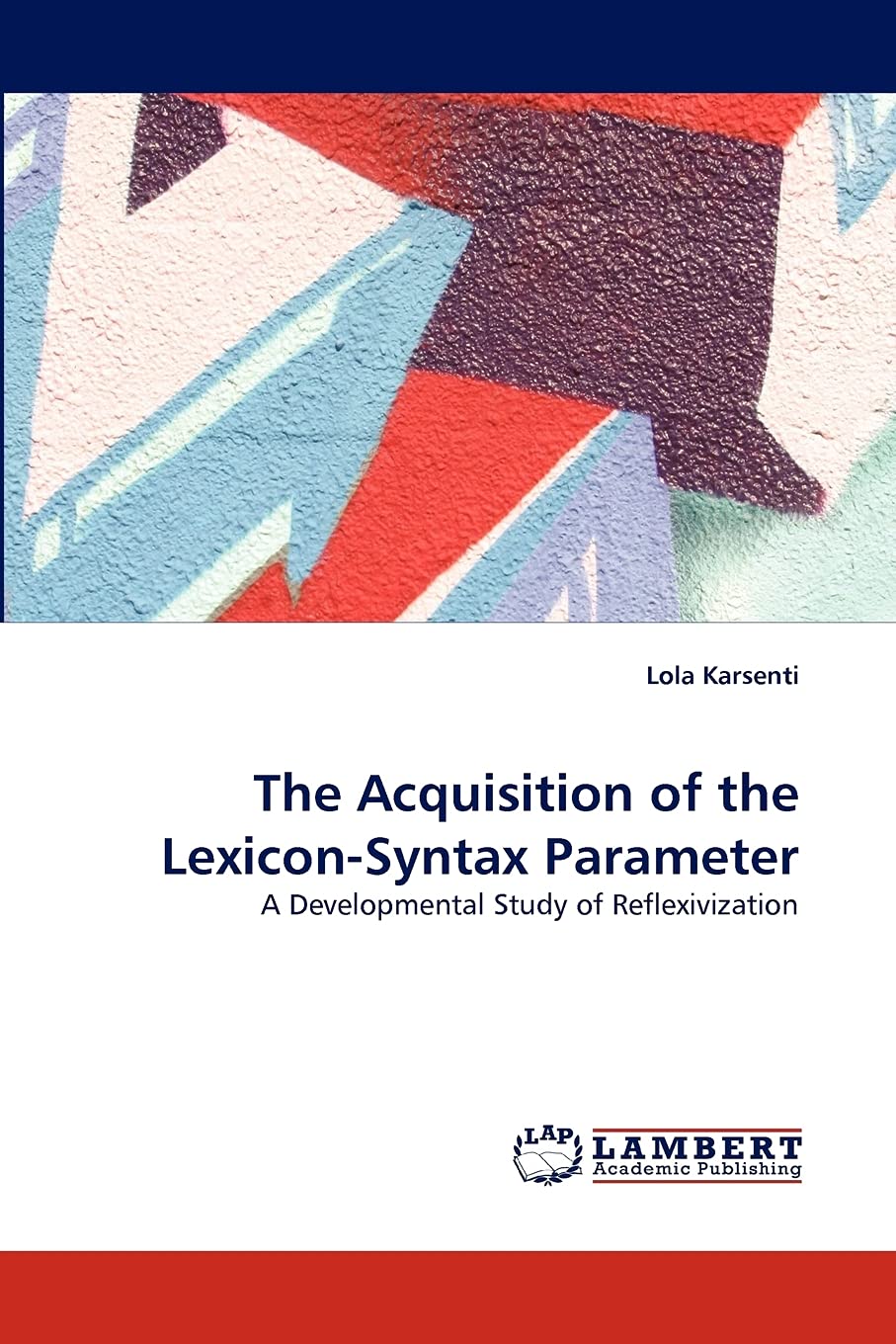
The issue of division of labor between mental lexicon and syntax is still under debate. Following Reinhart and Siloni (2005) and Horvath and Siloni (2006), the various operations deriving the different verbal voices split into three types according to the locus of application: (a) universally in the lexicon (e.g., decausativization), (b) universally in the syntax (e.g., verbal passive formation), (c) parametric choice (e.g., reflexivization). The latter operations are argued to be subject to the recently proposed LexiconSyntax parameter (Reinhart & Siloni, 2005), according to which each language specifies whether arity operations apply in the syntax or in the lexicon in that language. Importantly, the parameter is applicable only if the grammar includes an active lexicon as a computational component. The present study examines the validity of the LexiconSyntax parameter. First, the hypothesis is tested from the angle of acquisition (L1 acquisition of reflexives). Second, the study presents a closer theoretical inspection of reflexive verbs. This book will be useful to students and researchers in syntax, semantics and psycholinguistics.
⚠️ WARNING (California Proposition 65):
This product may contain chemicals known to the State of California to cause cancer,
birth defects, or other reproductive harm.
For MAP (Minimum Advertised Price) violations and Intellectual Property (IP) or Trademark concerns, please contact:
support@ergodebooks.com
⚠️ California Proposition 65 Warning: Some products sold on this website may expose you to chemicals known to the State of California to cause cancer, birth defects, or other reproductive harm. For more information, visit www.P65Warnings.ca.gov.