
Title

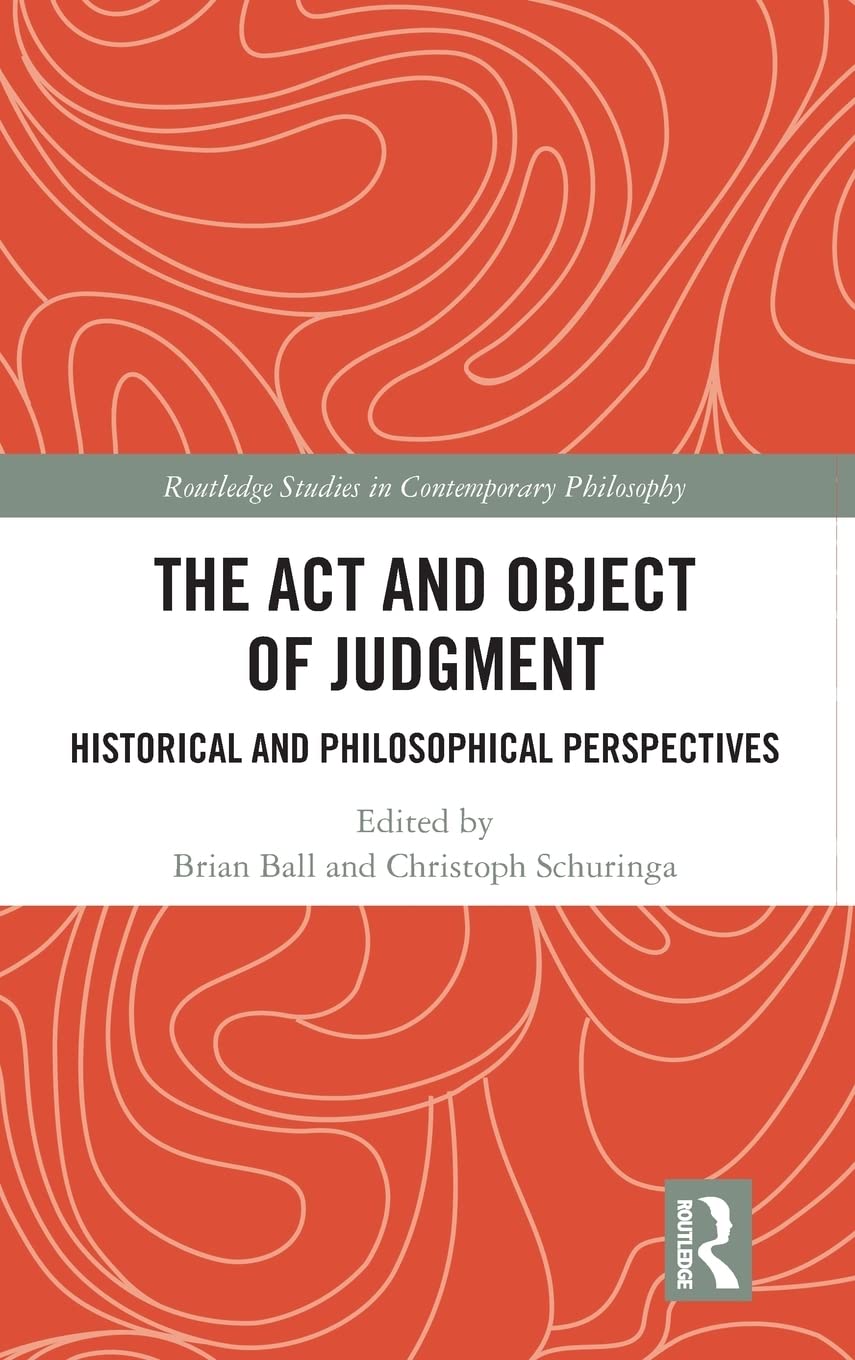
The Act and Object of Judgment: Historical and Philosophical Perspectives (Routledge Studies in Contemporary Philosophy),Used
Sold by Ergodebooks, an authorized reseller.
Returns accepted within 30 days | support@ergodebooks.com
Shipping Information
- Free Standard Shipping — United States only
- Processing Time: 3–5 business days
- Estimated Delivery: 6–10 business days after dispatch
- Double-boxed, fully insured & discreetly packaged
- Tracking number sent via email once dispatched
Returns & Refund
Returns accepted within 30 days of delivery.
Damaged or Defective Item
Free return shipping + replacement or full refund
Wrong Item Received
Free return shipping + replacement or full refund
Change of Mind
Return shipping at customer's expense · 25% restocking fee applies
Payment Option

This book presents 12 original essays on historical and contemporary philosophical discussions of judgment. The central issues explored in this volume can be separated into two groups namely, those concerning the act and object of judgment. What kind of act is judgment? How is it related to a range of other mental acts, states, and dispositions? Where and how does assertive force enter in? Is there a distinct category of negative judgments, or are these simply judgments whose objects are negative? Concerning the object of judgment: How many objects are there of a given judgment? One, as on the dual relation theory of Frege and Moore? Or many as in Russells later multiple relation theory? If there is a single object, is it a proposition? And if so, is it a forceneutral, abstract entity that might equally figure as the object of a range of intentional attitudes? Or is it somehow constitutively tied to the act itself? These and related questions are approached from a variety of historical and contemporary perspectives. This book sheds new light on current controversies by drawing on the details of the distinct intellectual contexts in which previous philosophers positions about the nature of judgment were formulated. In turn, new directions in presentday research promise to raise novel interpretive prospects and challenges in the history of philosophy.
⚠️ WARNING (California Proposition 65):
This product may contain chemicals known to the State of California to cause cancer, birth defects, or other reproductive harm.
For more information, please visit www.P65Warnings.ca.gov.