
Title
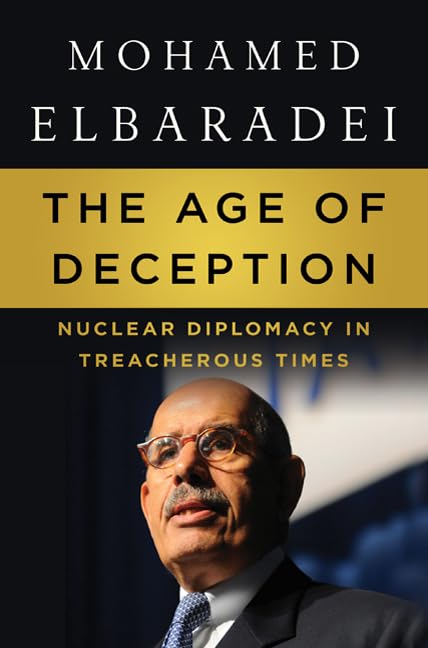
The Age of Deception: Nuclear Diplomacy in Treacherous Times,Used
Sold by Ergodebooks, an authorized reseller.
Returns accepted within 30 days | support@ergodebooks.com
Shipping Information
- Free Standard Shipping — United States only
- Processing Time: 3–5 business days
- Estimated Delivery: 6–10 business days after dispatch
- Double-boxed, fully insured & discreetly packaged
- Tracking number sent via email once dispatched
Returns & Refund
Returns accepted within 30 days of delivery.
Damaged or Defective Item
Free return shipping + replacement or full refund
Wrong Item Received
Free return shipping + replacement or full refund
Change of Mind
Return shipping at customer's expense · 25% restocking fee applies
Payment Option

For the first time, the Nobel Prize laureate and 'man in the middle' of the planet's most explosive confrontations speaks outon his dealings with America, negotiations with Iran, reform and democracy in the Middle East, and the prospects for a future free of nuclear weapons.For the past two decades, Mohamed ElBaradei has played a key role in the most highstakes conflicts of our time. Unique in maintaining credibility in the Arab world and the West alike, ElBaradei has emerged as a singularly independent, uncompromised voice. As the director of the UN's International Atomic Energy Agency, he has contended with the Bush administration's assault on Iraq, the nuclear aspirations of North Korea, and the West's standoff with Iran. For their efforts to control nuclear proliferation, ElBaradei and his agency received the 2005 Nobel Peace Prize.Now, in a vivid and thoughtful account, ElBaradei takes us inside the international fray. Inspector, adviser, and mediator, ElBaradei moves from Baghdad, where Iraqi officials bleakly predict the coming war, to behindthescenes exchanges with Condoleezza Rice, to the streets of Pyongyang and the trail of Pakistani nuclear smugglers. He dissects the possibility of rapprochement with Iran while rejecting hardline ideologies of every kind, decrying an usversusthem approach and insisting on the necessity of relentless diplomacy. Above all, he illustrates that the security of nations is tied to the security of individuals, dependent not only on disarmament but on a universal commitment to human dignity, democratic values, and the freedom from want.Probing and eloquent, The Age of Deception is an unparalleled account of society's struggle to come to grips with the uncertainties of our age.
⚠️ WARNING (California Proposition 65):
This product may contain chemicals known to the State of California to cause cancer, birth defects, or other reproductive harm.
For more information, please visit www.P65Warnings.ca.gov.
- Q: What is the main theme of 'The Age of Deception'? A: 'The Age of Deception' primarily explores the complexities of nuclear diplomacy and the challenges of achieving global security, particularly in the context of Middle Eastern conflicts and the efforts to prevent nuclear proliferation.
- Q: Who is the author of the book? A: The book is authored by Mohamed ElBaradei, a Nobel Prize laureate and former director of the International Atomic Energy Agency.
- Q: What is the book's publication date? A: 'The Age of Deception' was published on April 26, 2011.
- Q: What is the condition of the book? A: The book is listed as a used book in good condition, ensuring it is still readable and usable.
- Q: How many pages does the book have? A: The book contains a total of 352 pages.
- Q: What is the binding type of the book? A: The book is available in hardcover binding, which provides durability and a professional appearance.
- Q: Is there any specific content focus in the book? A: Yes, the book focuses on nuclear diplomacy, international relations, and the importance of human dignity and democracy in global security.
- Q: Does the book discuss specific events or negotiations? A: Yes, it discusses ElBaradei's experiences with significant events, including negotiations with Iran and the Iraq War.
- Q: What audience is this book intended for? A: The book is intended for readers interested in political science, international relations, and nuclear policy.
- Q: Are there any notable accolades associated with the author? A: Yes, Mohamed ElBaradei received the Nobel Peace Prize in 2005 for his efforts in controlling nuclear proliferation.