
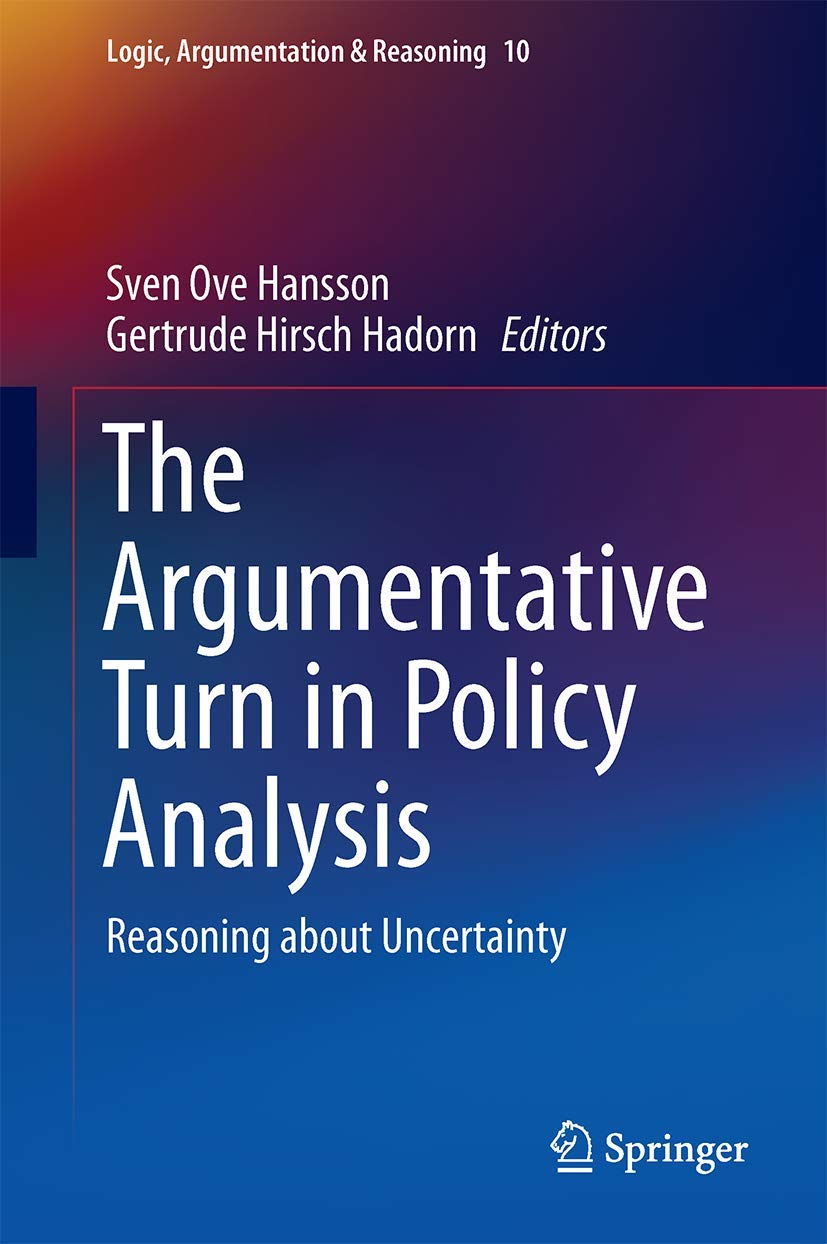
Title
The Argumentative Turn in Policy Analysis: Reasoning about Uncertainty (Logic, Argumentation & Reasoning, 10),Used
Sold by Ergodebooks, an authorized reseller.
Returns accepted within 30 days | support@ergodebooks.com
Shipping Information
- Free Standard Shipping — United States only
- Processing Time: 3–5 business days
- Estimated Delivery: 6–10 business days after dispatch
- Double-boxed, fully insured & discreetly packaged
- Tracking number sent via email once dispatched
Returns & Refund
Returns accepted within 30 days of delivery.
Damaged or Defective Item
Free return shipping + replacement or full refund
Wrong Item Received
Free return shipping + replacement or full refund
Change of Mind
Return shipping at customer's expense · 25% restocking fee applies
Payment Option

This book describes argumentative tools and strategies that can be used to guide policy decisions under conditions of great uncertainty. Contributing authors explore methods from philosophical analysis and in particular argumentation analysis, showing how it can be used to systematize discussions about policy issues involving great uncertainty.The first part of the work explores how to deal in a systematic way with decisionmaking when there may be plural perspectives on the decision problem, along with unknown consequences of what we do. Readers will see how argumentation tools can be used for prioritizing among uncertain dangers, for determining how decisions should be framed, for choosing a suitable time frame for a decision, and for systematically choosing among different decision options. Case studies are presented in the second part of the book, showing argumentation in practice in the areas of climate geoengineering, water governance, synthetic biology, nuclear waste,and financial markets. In one example, argumentation analysis is applied to proposals to solve the climate problem with various technological manipulations of the natural climate system, such as massive dispersion of reflective aerosols into the stratosphere. Even after a thorough investigation of such a proposal, doubt remains as to whether all the potential risks have been identified. In such discussions, conventional risk analysis does not have much to contribute since it presupposes that the risks have been identified, whereas the argumentative approach to uncertainty management can be used to systematize discussions.
⚠️ WARNING (California Proposition 65):
This product may contain chemicals known to the State of California to cause cancer, birth defects, or other reproductive harm.
For more information, please visit www.P65Warnings.ca.gov.