
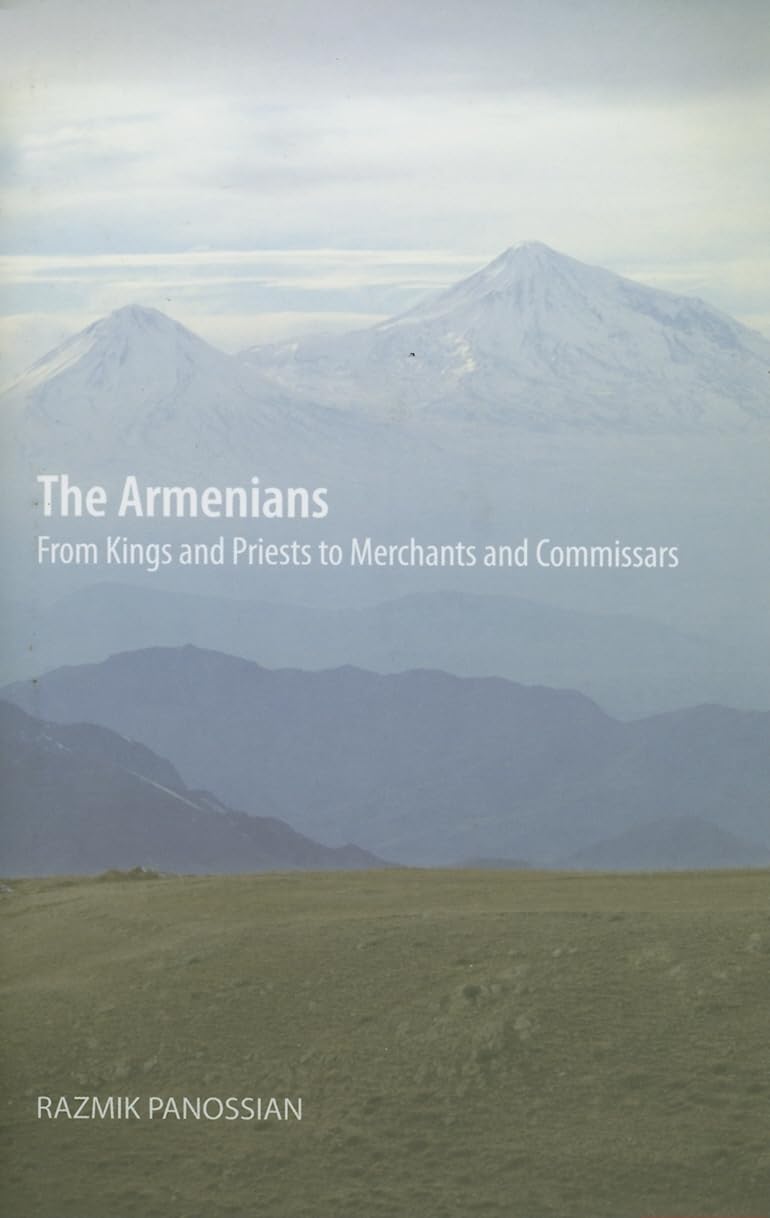
Title
The Armenians: From Kings and Priests to Merchants and Commissars,Used
Processing time: 1-3 days
US Orders Ships in: 3-5 days
International Orders Ships in: 8-12 days
Return Policy: 15-days return on defective items
Payment Option

The Armenians traces the evolution of Armenia and Armenian collective identity from its beginnings to the Armenian nationalist movement over Gharabagh in 1988. Applying theories of nationalidentity formation and nationalism, Razmik Panossian analyzes different elements of Armenian identity construction and argues that national identity is modern, predominantly subjective, and based on a political sense of belonging. Yet he also acknowledges the crucial role of history, art, literature, religious practice, and commerce in preserving the national memory and shaping the cultural identity of the Armenian people.Panossian explores a series of landmark events, among them Armenians' first attempts at liberation, the Armenian renaissance of the nineteenth century, the 1915 genocide of the Ottoman Armenians, and Soviet occupation. He shows how these influences led to a 'multilocal' evolution of Armenian identity in various places in and outside of Armenia, notably in diasporan communities from India to Venice. Today, these numerous identities contribute to deep divisions and tensions within the Armenian nation, the most profound of which is the cultural divide between Armenians residing in their homeland and those who live in the United States, Canada, the Middle East, and elsewhere. Considering the diversity of this single nation, Panossian questions the theoretical assumption that nationalism must be homogenizing.Based on extensive research conducted in Armenia and the diaspora, including interviews and translation of Armenianlanguage sources, The Armenians is an engaging history and an invaluable comparative study.
⚠️ WARNING (California Proposition 65):
This product may contain chemicals known to the State of California to cause cancer, birth defects, or other reproductive harm.
For more information, please visit www.P65Warnings.ca.gov.
- Q: What is the primary focus of 'The Armenians' by Razmik Panossian? A: The book focuses on the evolution of Armenian identity from historical beginnings to contemporary issues, including nationalism and the Armenian diaspora.
- Q: How many pages does 'The Armenians' contain? A: 'The Armenians' has a total of 492 pages.
- Q: What is the condition of the book listed for sale? A: The item's condition is listed as 'Acceptable'.
- Q: Who is the author of 'The Armenians'? A: The author of the book is Razmik Panossian.
- Q: When was 'The Armenians' published? A: 'The Armenians' was published on May 27, 2006.
- Q: What binding type is 'The Armenians'? A: The book is bound in hardcover.
- Q: Is there any specific edition of 'The Armenians' mentioned? A: Yes, it is the first edition of the book.
- Q: What are some key historical events discussed in 'The Armenians'? A: Key events include the Armenian renaissance, the 1915 genocide, and the Armenian nationalist movement over Gharabagh.
- Q: Does 'The Armenians' include research from both Armenia and the diaspora? A: Yes, the book is based on extensive research conducted in Armenia and various diasporan communities.
- Q: What themes are explored in the construction of Armenian identity? A: The book explores themes such as history, art, literature, religious practice, and commerce in shaping Armenian cultural identity.