
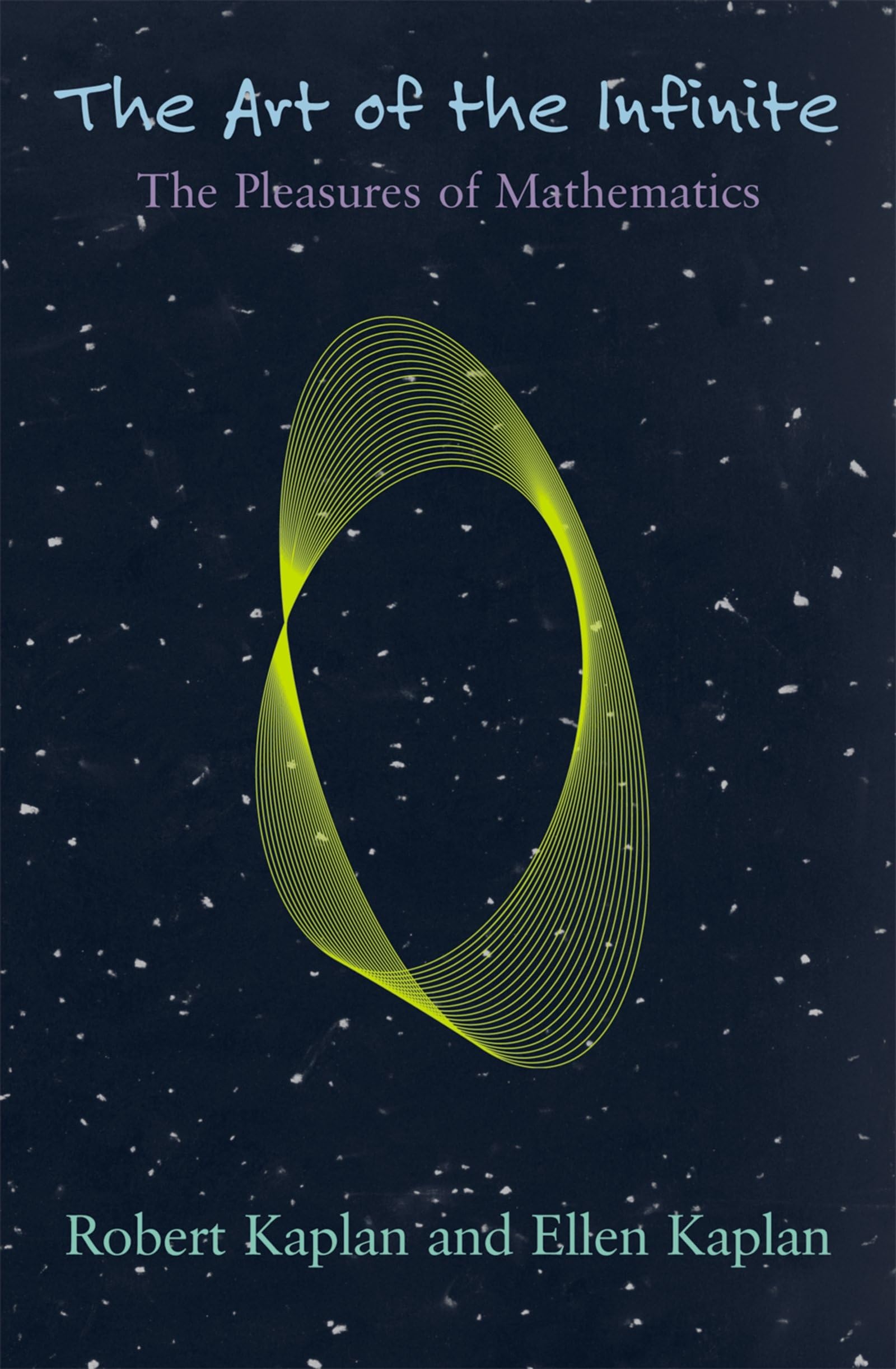
Title
The Art Of The Infinite: The Pleasures Of Mathematics,Used
Sold by Ergodebooks, an authorized reseller.
Returns accepted within 30 days | support@ergodebooks.com
Shipping Information
- Free Standard Shipping — United States only
- Processing Time: 3–5 business days
- Estimated Delivery: 6–10 business days after dispatch
- Double-boxed, fully insured & discreetly packaged
- Tracking number sent via email once dispatched
Returns & Refund
Returns accepted within 30 days of delivery.
Damaged or Defective Item
Free return shipping + replacement or full refund
Wrong Item Received
Free return shipping + replacement or full refund
Change of Mind
Return shipping at customer's expense · 25% restocking fee applies
Payment Option

Robert Kaplans The Nothing That Is: A Natural History Of Zero Was An International Bestseller, Translated Into Eight Languages. The Times Called It 'Elegant, Discursive, And Littered With Quotes And Allusions From Aquinas Via Gershwin To Woolf' And The Philadelphia Inquirer Praised It As 'Absolutely Scintillating.'In This Delightful New Book, Robert Kaplan, Writing Together With His Wife Ellen Kaplan, Once Again Takes Us On A Witty, Literate, And Accessible Tour Of The World Of Mathematics. Where The Nothing That Is Looked At Math Through The Lens Of Zero, The Art Of The Infinite Takes Infinity, In Its Countless Guises, As A Touchstone For Understanding Mathematical Thinking. Tracing A Path From Pythagoras, Whose Great Theorem Led Inexorably To A Discovery That His Followers Tried In Vain To Keep Secret (The Existence Of Irrational Numbers); Through Descartes And Leibniz; To The Brilliant, Haunted Georg Cantor, Who Proved That Infinity Can Come In Different Sizes, The Kaplans Show How The Attempt To Grasp The Ungraspable Embodies The Essence Of Mathematics. The Kaplans Guide Us Through The 'Republic Of Numbers,' Where We Meet Both Its Upstanding Citizens And More Shadowy Dwellers; And We Travel Across The Plane Of Geometry Into The Unlikely Realm Where Parallel Lines Meet. Along The Way, Deft Character Studies Of Great Mathematicians (And Equally Colorful Lesser Ones) Illustrate The Opposed Yet Intertwined Modes Of Mathematical Thinking: The Intutionist Notion That We Discover Mathematical Truth As It Exists, And The Formalist Belief That Math Is True Because We Invent Consistent Rules For It.'Less Than All,' Wrote William Blake, 'Cannot Satisfy Man.' The Art Of The Infinite Shows Us Some Of The Ways That Man Has Grappled With All, And Reveals Mathematics As One Of The Most Exhilarating Expressions Of The Human Imagination.
⚠️ WARNING (California Proposition 65):
This product may contain chemicals known to the State of California to cause cancer, birth defects, or other reproductive harm.
For more information, please visit www.P65Warnings.ca.gov.
- Q: What is the page count of 'The Art of the Infinite'? A: This book contains three hundred thirty-six pages. It offers an in-depth exploration of mathematical concepts through engaging narratives.
- Q: What are the dimensions of 'The Art of the Infinite'? A: The book measures nine point two one inches in length, six point one four inches in width, and zero point seven one inches in height. These dimensions make it a portable choice for reading.
- Q: What type of binding does 'The Art of the Infinite' have? A: It features a paperback binding. This makes it lightweight and flexible, ideal for casual reading.
- Q: How do I read 'The Art of the Infinite'? A: You can read this book at your own pace, as it is designed for general audiences. It employs an accessible writing style that caters to various levels of mathematical understanding.
- Q: Is 'The Art of the Infinite' suitable for beginners in mathematics? A: Yes, it is suitable for beginners. The authors present complex ideas in a witty and engaging manner that is easy to follow.
- Q: Can I use 'The Art of the Infinite' for educational purposes? A: Yes, it can be used for educational purposes. Its rich content makes it a valuable resource for learning about mathematical concepts.
- Q: How should I store 'The Art of the Infinite'? A: Store this book in a cool, dry place away from direct sunlight. This will help preserve its quality and prevent damage.
- Q: Is there any special care needed for 'The Art of the Infinite'? A: No special care is required. Just keep it in good condition by avoiding spills and excessive bending of the pages.
- Q: What if 'The Art of the Infinite' arrives damaged? A: If the book arrives damaged, you should contact the seller for a return or exchange. Most sellers have a return policy for damaged items.
- Q: How does 'The Art of the Infinite' compare to other math books? A: It stands out for its engaging narrative style and accessibility. Unlike many technical textbooks, it offers a more literary approach to mathematics.
- Q: Is 'The Art of the Infinite' appropriate for children? A: Yes, it is appropriate for older children and teens interested in mathematics. However, adult guidance may enhance their understanding of complex themes.
- Q: What themes are explored in 'The Art of the Infinite'? A: The book explores themes of infinity, the history of mathematical thought, and the interplay between intuition and formalism in mathematics.
- Q: Who are the authors of 'The Art of the Infinite'? A: The authors are Robert Kaplan and Ellen Kaplan. They are known for their engaging writing style and deep understanding of mathematics.
- Q: What genre does 'The Art of the Infinite' belong to? A: This book belongs to the genre of mathematics and educational literature. It aims to demystify mathematical concepts for a wider audience.
- Q: Can I gift 'The Art of the Infinite' to a math enthusiast? A: Yes, it makes an excellent gift for math enthusiasts. Its unique approach and insightful content will appeal to anyone interested in the subject.
- Q: What is the main focus of 'The Art of the Infinite'? A: The main focus is on understanding infinity and its implications in mathematical thought. It encourages readers to explore the concept in depth.