
Title
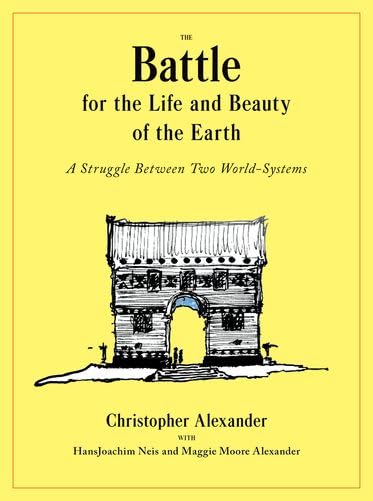
The Battle for the Life and Beauty of the Earth: A Struggle Between Two WorldSystems (Center for Environmental Structure, 16),Used
Sold by Ergodebooks, an authorized reseller.
Returns accepted within 30 days | support@ergodebooks.com
Shipping Information
- Free Standard Shipping — United States only
- Processing Time: 3–5 business days
- Estimated Delivery: 6–10 business days after dispatch
- Double-boxed, fully insured & discreetly packaged
- Tracking number sent via email once dispatched
Returns & Refund
Returns accepted within 30 days of delivery.
Damaged or Defective Item
Free return shipping + replacement or full refund
Wrong Item Received
Free return shipping + replacement or full refund
Change of Mind
Return shipping at customer's expense · 25% restocking fee applies
Payment Option

The purpose of all architecture, writes Christopher Alexander, is to encourage and support lifegiving activity, dreams, and playfulness. But in recent decades, while our buildings are technically bettermore sturdy, more waterproof, more energy efficient they have also became progressively more sterile, rarely providing the kind of environment in which people are emotionally nourished, genuinely happy, and deeply contented.Using the example of his building of the Eishin Campus in Japan, Christopher Alexander and his collaborators reveal an ongoing dispute between two fundamentally different ways of shaping our world. One system places emphasis on subtleties, on finesse, on the structure of adaptation that makes each tiny part fit into the larger context. The other system is concerned with efficiency, with money, power and control, stressing the more gross aspects of size, speed, and profit. This second, 'businessasusual' system, Alexander argues, is incapable of creating the kind of environment that is able to genuinely support the emotional, wholemaking side of human life. To confront this sterile system, the book presents a new architecture that weboth as a worldwide civilization, and as individual people and culturescan create, using new processes that allow us to build places of human energy and beauty. The book outlines nine ways of working, each one fully dedicated to wholeness, and able to support daytoday activities that will make planning, design and construction possible in an entirely new way, and in more humane ways.An innovative thinker about building techniques and planning, Christopher Alexander has attracted a devoted following. Here he introduces a way of building that includes the best current practices, enriched by a range of new processes that support the houses, communities, and health of all who inhabit the Earth.
⚠️ WARNING (California Proposition 65):
This product may contain chemicals known to the State of California to cause cancer, birth defects, or other reproductive harm.
For more information, please visit www.P65Warnings.ca.gov.
- Q: How many pages are in this book? A: This book has five hundred twenty pages. It offers a comprehensive exploration of architecture and environmental design.
- Q: What is the binding type of this book? A: This book is hardcover. This ensures durability and longevity for readers who value quality.
- Q: What are the dimensions of this book? A: The book measures nine point one inches in length, seven point one inches in width, and one point one inches in height. These dimensions make it suitable for easy handling.
- Q: Who is the author of this book? A: The author is Christopher Alexander. He is known for his influential ideas on architecture and design.
- Q: What is the main theme of this book? A: The main theme is the conflict between two world-systems in architecture. It discusses how one system fosters emotional well-being and human energy.
- Q: What kind of architecture does this book promote? A: The book promotes an architecture that supports life-giving activities. It emphasizes wholeness and the emotional aspects of living environments.
- Q: Is this book suitable for beginners in architecture? A: Yes, this book is suitable for beginners. It introduces fundamental concepts in architecture and environmental design.
- Q: Can I use this book for academic purposes? A: Yes, this book is appropriate for academic study. It provides deep insights into architectural practices and environmental issues.
- Q: What kind of reader would benefit from this book? A: Anyone interested in architecture, environmental design, or urban planning would benefit from this book. It caters to both professionals and enthusiasts.
- Q: How should I store this book? A: Store this book in a cool, dry place away from direct sunlight. This will help preserve its condition and prevent fading.
- Q: Is this book safe for children to read? A: Yes, the content of this book is safe for older children. However, it is more suited for teens and adults due to its complex themes.
- Q: What is the target audience for this book? A: The target audience includes architecture students, professionals, and anyone interested in environmental design. It offers valuable insights for all.
- Q: How do I clean the cover of this book? A: To clean the cover, use a soft, dry cloth. Avoid using water or cleaners that could damage the hardcover.
- Q: What if my book arrives damaged? A: If your book arrives damaged, contact the seller for a return or replacement. Most sellers have policies in place for such issues.
- Q: What makes this book different from other architecture books? A: This book emphasizes the emotional and life-affirming aspects of architecture. It contrasts traditional design methods with more holistic approaches.