
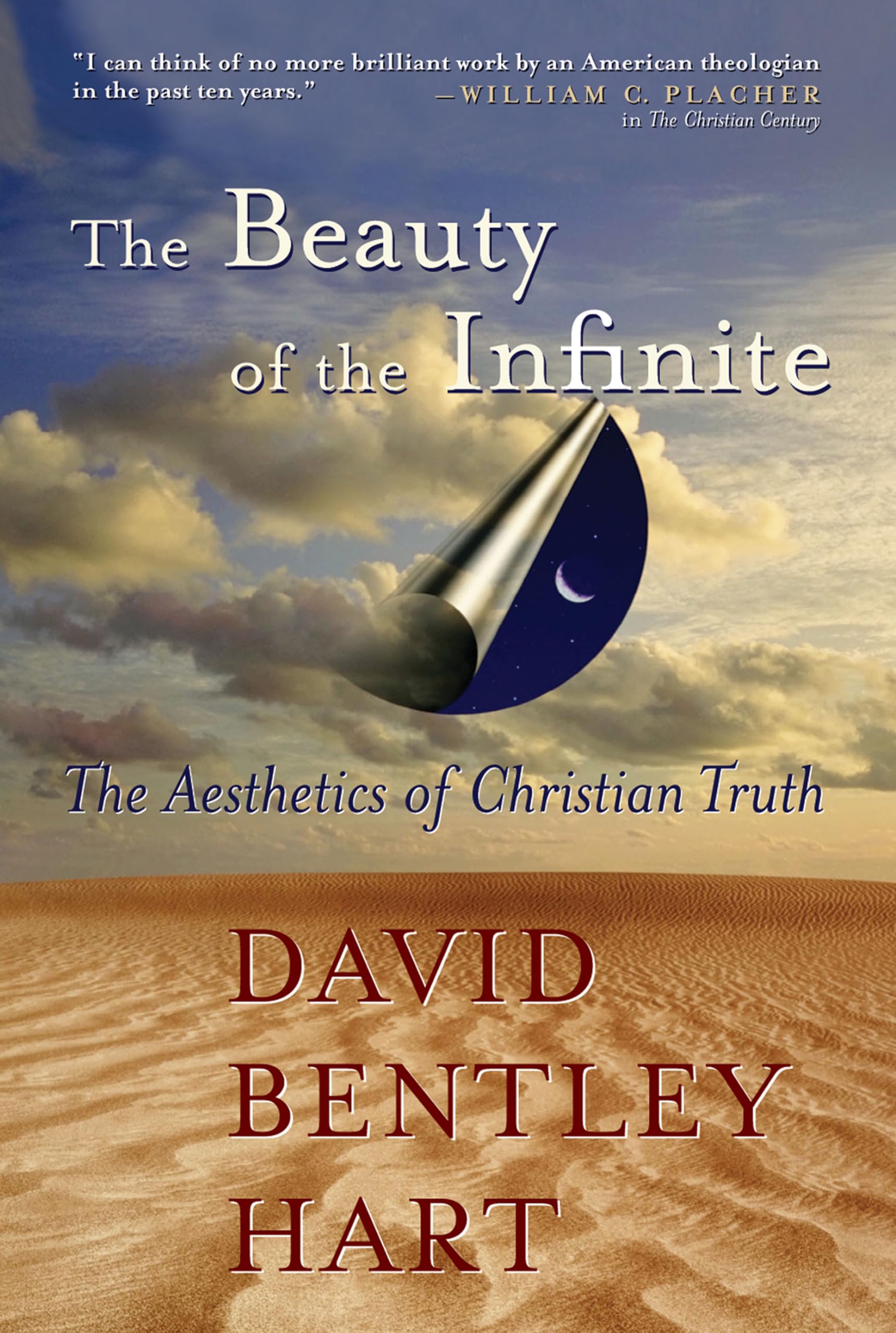
Title
The Beauty of the Infinite: The Aesthetics of Christian Truth,Used
Sold by Ergodebooks, an authorized reseller.
Returns accepted within 30 days | support@ergodebooks.com
Shipping Information
- Free Standard Shipping — United States only
- Processing Time: 3–5 business days
- Estimated Delivery: 6–10 business days after dispatch
- Double-boxed, fully insured & discreetly packaged
- Tracking number sent via email once dispatched
Returns & Refund
Returns accepted within 30 days of delivery.
Damaged or Defective Item
Free return shipping + replacement or full refund
Wrong Item Received
Free return shipping + replacement or full refund
Change of Mind
Return shipping at customer's expense · 25% restocking fee applies
Payment Option

The Beauty of the Infinite is a splendid extended essay in 'theological aesthetics.' David Bentley Hart here meditates on the power of a Christian understanding of beauty and sublimity to rise above the violence both philosophical and literal characteristic of the postmodern world.The book begins by tracing the shifting use and nature of metaphysics in the thought of Kant, Hegel, Nietzsche, Heidegger, Lyotard, Derrida, Deleuze, Nancy, Levinas, and others. Hart pays special attention to Nietzsche's famous narrative of the 'will to power' a narrative largely adopted by the world today and he offers an engaging revision (though not rejection) of the genealogy of nihilism, thereby highlighting the significant 'interruption' that Christian thought introduced into the history of metaphysics.This discussion sets the stage for a retrieval of the classic Christian account of beauty and sublimity, and of the relation of both to the question of being. Written in the form of a dogmatica minora, this main section of the book offers a pointed reading of the Christian story in four moments, or parts: Trinity, creation, salvation, and eschaton. Through a combination of narrative and argument throughout, Hart ends up demonstrating the power of Christian metaphysics not only to withstand the critiques of modern and postmodern thought but also to move well beyond them.Strikingly original and deeply rewarding, The Beauty of the Infinite is both a constructively critical account of the history of metaphysics and a compelling contribution to it.
⚠️ WARNING (California Proposition 65):
This product may contain chemicals known to the State of California to cause cancer, birth defects, or other reproductive harm.
For more information, please visit www.P65Warnings.ca.gov.
- Q: What is the main theme of 'The Beauty of the Infinite'? A: The main theme of 'The Beauty of the Infinite' is the exploration of Christian aesthetics and the transformative power of beauty and sublimity in contrast to the violence of postmodern thought.
- Q: Who is the author of 'The Beauty of the Infinite'? A: 'The Beauty of the Infinite' is authored by David Bentley Hart, a noted theologian and philosopher.
- Q: How many pages does 'The Beauty of the Infinite' have? A: 'The Beauty of the Infinite' contains 462 pages, offering a comprehensive exploration of its themes.
- Q: What is the binding type of this book? A: This book is available in paperback binding, making it accessible and easy to handle.
- Q: When was 'The Beauty of the Infinite' published? A: 'The Beauty of the Infinite' was published on October 29, 2004.
- Q: Is 'The Beauty of the Infinite' suitable for academic study? A: Yes, 'The Beauty of the Infinite' is suitable for academic study, particularly in theology, philosophy, and aesthetics, due to its in-depth analysis and scholarly insights.
- Q: What philosophical figures are discussed in 'The Beauty of the Infinite'? A: 'The Beauty of the Infinite' discusses various philosophical figures including Kant, Hegel, Nietzsche, Heidegger, and Derrida, among others, in relation to the concept of metaphysics.
- Q: Does 'The Beauty of the Infinite' address modern philosophical critiques? A: Yes, the book engages with modern and postmodern philosophical critiques, particularly focusing on the narrative of nihilism and the role of Christian thought in metaphysics.
- Q: What are the four main parts of 'The Beauty of the Infinite'? A: The four main parts of 'The Beauty of the Infinite' are Trinity, creation, salvation, and eschaton, which structure Hart's examination of Christian aesthetics.
- Q: Is this book appropriate for general readers or only for scholars? A: 'The Beauty of the Infinite' is written to appeal to both general readers interested in theology and philosophy, as well as scholars seeking a critical account of metaphysical history.