
Title
The Best of All Possible Worlds: Mathematics and Destiny,New
Sold by Ergodebooks, an authorized reseller.
Returns accepted within 30 days | support@ergodebooks.com
Shipping Information
- Free Standard Shipping — United States only
- Processing Time: 3–5 business days
- Estimated Delivery: 6–10 business days after dispatch
- Double-boxed, fully insured & discreetly packaged
- Tracking number sent via email once dispatched
Returns & Refund
Returns accepted within 30 days of delivery.
Damaged or Defective Item
Free return shipping + replacement or full refund
Wrong Item Received
Free return shipping + replacement or full refund
Change of Mind
Return shipping at customer's expense · 25% restocking fee applies
Payment Option

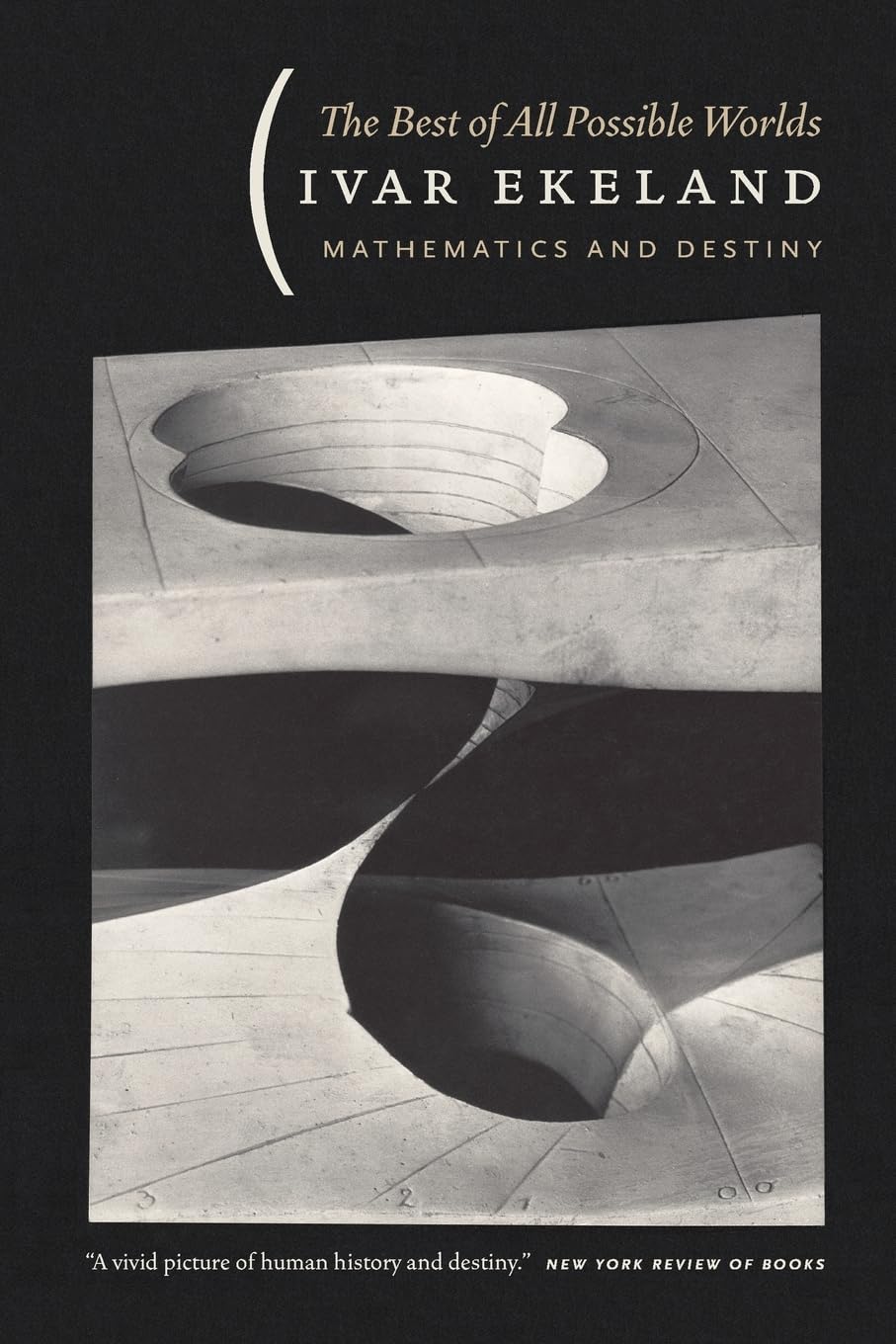
Optimists believe this is the best of all possible worlds. And pessimists fear that might really be the case. But what is the best of all possible worlds? How do we define it? Is it the world that operates the most efficiently? Or the one in which most people are comfortable and content? Questions such as these have preoccupied philosophers and theologians for ages, but there was a time, during the seventeenth and eighteenth centuries, when scientists and mathematicians felt they could provide the answer.This book is their story. Ivar Ekeland here takes the reader on a journey through scientific attempts to envision the best of all possible worlds. He begins with the French physicist Maupertuis, whose least action principle asserted that everything in nature occurs in the way that requires the least possible action. This idea, Ekeland shows, was a pivotal breakthrough in mathematics, because it was the first expression of the concept of optimization, or the creation of systems that are the most efficient or functional. Although the least action principle was later elaborated on and overshadowed by the theories of Leonhard Euler and Gottfried Leibniz, the concept of optimization that emerged from it is an important one that touches virtually every scientific discipline today.Tracing the profound impact of optimization and the unexpected ways in which it has influenced the study of mathematics, biology, economics, and even politics, Ekeland reveals throughout how the idea of optimization has driven some of our greatest intellectual breakthroughs. The result is a dazzling display of eruditionone that will be essential reading for popularscience buffs and historians of science alike.
⚠️ WARNING (California Proposition 65):
This product may contain chemicals known to the State of California to cause cancer, birth defects, or other reproductive harm.
For more information, please visit www.P65Warnings.ca.gov.