

Title


The Black Atlantic: Modernity and DoubleConsciousness,Used
Sold by Ergodebooks, an authorized reseller.
Returns accepted within 30 days | support@ergodebooks.com
Shipping Information
- Free Standard Shipping — United States only
- Processing Time: 3–5 business days
- Estimated Delivery: 6–10 business days after dispatch
- Double-boxed, fully insured & discreetly packaged
- Tracking number sent via email once dispatched
Returns & Refund
Returns accepted within 30 days of delivery.
Damaged or Defective Item
Free return shipping + replacement or full refund
Wrong Item Received
Free return shipping + replacement or full refund
Change of Mind
Return shipping at customer's expense · 25% restocking fee applies
Payment Option

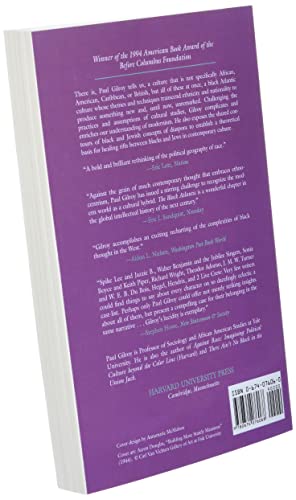
Afrocentrism. Eurocentrism. Caribbean Studies. British Studies. To the forces of cultural nationalism hunkered down in their camps, this bold hook sounds a liberating call. There is, Paul Gilroy tells us, a culture that is not specifically African, American, Caribbean, or British, but all of these at once, a black Atlantic culture whose themes and techniques transcend ethnicity and nationality to produce something new and, until now, unremarked. Challenging the practices and assumptions of cultural studies, The Black Atlantic also complicates and enriches our understanding of modernism.Debates about postmodernism have cast an unfashionable pall over questions of historical periodization. Gilroy bucks this trend by arguing that the development of black culture in the Americas arid Europe is a historical experience which can be called modern for a number of clear and specific reasons. For Hegel, the dialectic of master and slave was integral to modernity, and Gilroy considers the implications of this idea for a transatlantic culture. In search of a poetics reflecting the politics and history of this culture, he takes us on a transatlantic tour of the music that, for centuries, has transmitted racial messages and feeling around the world, from the Jubilee Singers in the nineteenth century to Jimi Hendrix to rap. He also explores this internationalism as it is manifested in black writing from the double consciousness of W. E. B. Du Bois to the double vision of Richard Wright to the compelling voice of Toni Morrison.In a final tour de force, Gilroy exposes the shared contours of black and Jewish concepts of diaspora in order both to establish a theoretical basis for healing rifts between blacks and Jews in contemporary culture and to further define the central theme of his book: that blacks have shaped a nationalism, if not a nation, within the shared culture of the black Atlantic.
⚠️ WARNING (California Proposition 65):
This product may contain chemicals known to the State of California to cause cancer, birth defects, or other reproductive harm.
For more information, please visit www.P65Warnings.ca.gov.
- Q: What is the main theme of 'The Black Atlantic: Modernity and Double-Consciousness'? A: The main theme revolves around the concept of a shared black Atlantic culture that transcends geographical boundaries, exploring the interplay between black and Jewish diaspora experiences.
- Q: Who is the author of this book? A: The author of 'The Black Atlantic: Modernity and Double-Consciousness' is Paul Gilroy.
- Q: What are the key topics covered in this book? A: Key topics include Afrocentrism, Eurocentrism, cultural nationalism, modernism, and the historical development of black culture in the Americas and Europe.
- Q: When was 'The Black Atlantic' published? A: The book was published on March 8, 1993.
- Q: What type of binding does this book have? A: This edition of 'The Black Atlantic' is a paperback binding.
- Q: How many pages does the book contain? A: The book contains 280 pages.
- Q: Is this book suitable for academic study? A: Yes, 'The Black Atlantic' is suitable for academic study, particularly in cultural studies, history, and literature.
- Q: What edition of the book is available? A: The available edition is a reissue.
- Q: What condition is the book in? A: The book is in new condition.
- Q: Does this book discuss the influence of music on black culture? A: Yes, it explores the role of music in transmitting racial messages and feelings, highlighting its historical significance in black culture.