
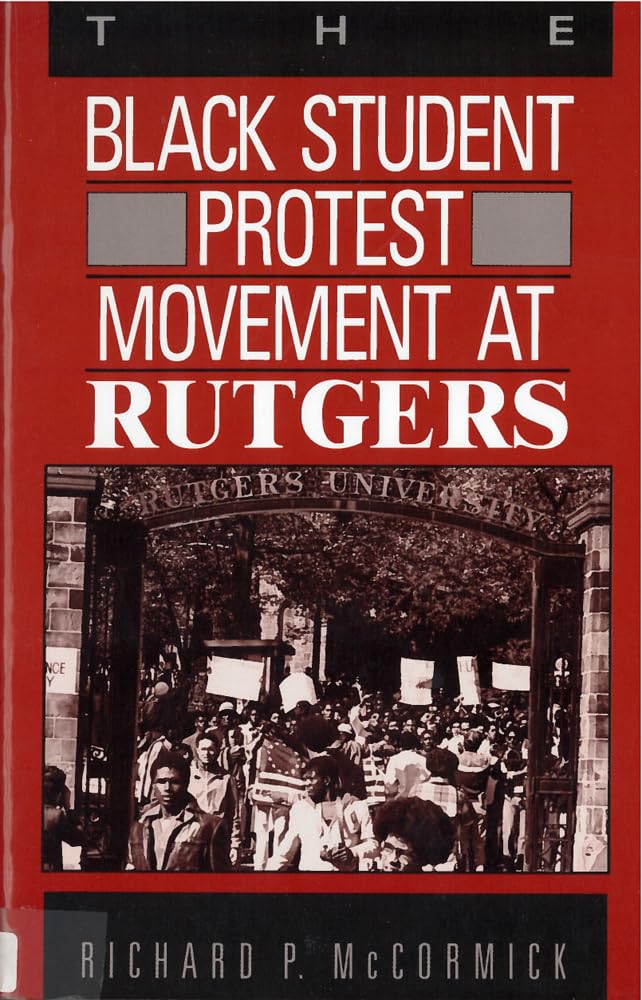
Title
The Black Student Protest Movement At Rutgers,Used
Sold by Ergodebooks, an authorized reseller.
Returns accepted within 30 days | support@ergodebooks.com
Shipping Information
- Free Standard Shipping — United States only
- Processing Time: 3–5 business days
- Estimated Delivery: 6–10 business days after dispatch
- Double-boxed, fully insured & discreetly packaged
- Tracking number sent via email once dispatched
Returns & Refund
Returns accepted within 30 days of delivery.
Damaged or Defective Item
Free return shipping + replacement or full refund
Wrong Item Received
Free return shipping + replacement or full refund
Change of Mind
Return shipping at customer's expense · 25% restocking fee applies
Payment Option

Richard P. McCormick has chronicled the black student protest movement at Rutgers University, from the 1960s to today. He examines the forces that produced the protest movement, the tactics that were employed, and the qualified gains that were achieved. He tells us about demonstrations, building occupations, committee hearings, and countless meetings, but he also paints portraits of the many student leaders who mobilized protest. This is the story of a lot of pain, some blunders, and some successes.In the midsixties, the University established committees to recruit black students and to add more blacks to the faculty. These efforts produced only modest results. By 1968, there were still not enough black students on campus, but there were enough to create a political presence for the first time. They were committed to acting against the racism they perceived within the University. To respond to their protests, in March 1969 the Board of Governors passed a dramatically new and controversial policy to encourage disadvantaged students who lived in Camden, Newark, and New Brunswick to apply to Rutgers, where they would take collegepreparatory classes as unmatriculated students, and then enter Rutgers as matriculated students. This program, never very successful, lasted only two years.Unrest did not end with the sixties. During the seventies, black students sporadically voiced protests against what they perceived to be an unsupportive environment. During the eighties, black enrollment actually declined, as did the black graduation rate. In conclusion, McCormick points to the effort that has been made but even more to the effort that still needs to be made and the social cost of ignoring the problem.
⚠️ WARNING (California Proposition 65):
This product may contain chemicals known to the State of California to cause cancer, birth defects, or other reproductive harm.
For more information, please visit www.P65Warnings.ca.gov.