
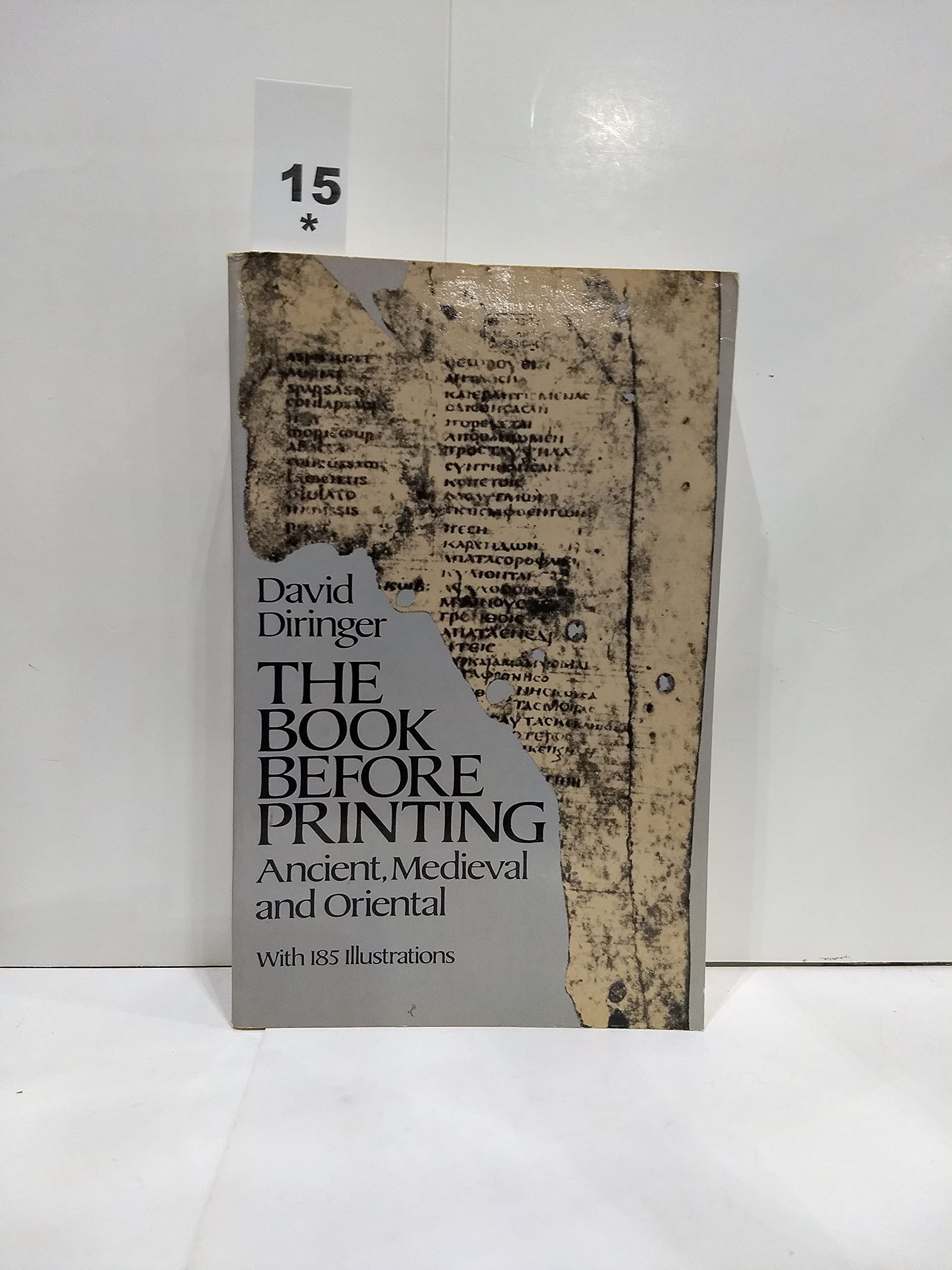
Title
The Book Before Printing: Ancient, Medieval And Oriental (Lettering, Calligraphy, Typography),New
Sold by Ergodebooks, an authorized reseller.
Returns accepted within 30 days | support@ergodebooks.com
Shipping Information
- Free Standard Shipping — United States only
- Processing Time: 3–5 business days
- Estimated Delivery: 6–10 business days after dispatch
- Double-boxed, fully insured & discreetly packaged
- Tracking number sent via email once dispatched
Returns & Refund
Returns accepted within 30 days of delivery.
Damaged or Defective Item
Free return shipping + replacement or full refund
Wrong Item Received
Free return shipping + replacement or full refund
Change of Mind
Return shipping at customer's expense · 25% restocking fee applies
Payment Option

A Remarkable Work. . . . For Sheer Weight Of Information There Is No Equal To It.' The Spectator.It Is Probable That The Earliest 'Books' Were Written On Wood Or Leaves As Early As The Fourth Millennium B.C. These Fragile Materials, Unfortunately, Have Not Come Down To Us. In Their Absence, The Earliest Surviving Books Are The Clay Tablets Of Mesopotamia, The Oldest Attributed To C. 3500 B.C. On These Ancient Clay Shards, Dense Rows Of Cuneiform Script Record The Seminal Writings Of Mankind: The Gilgamesh Epic, Sumerian Literary Catalogues, Babylonian Astrology, Assyrian Accounts Of The Creation And The Flood, And The Lipitishtar Lawcode (C. 2000 B.C.), Predating Hammurabi And The Oldest Law Code In Human History.Probably As Ancient As The Mesopotamian Writings, Or Nearly So, Are Egyptian Hieroglyphics. In A Sense, It Is The Papyrus Scrolls Of The Egyptians Preserved By That Country'S Hot, Dry Climate That Represent The True Ancestors Of The Modern Book. As The Centuries Passed, Papyrus Slowly Gave Way To Parchment (The Prepared Skins Of Animals) As Writing Material. Indeed, The Handwritten Parchment Or Vellum Codex Is 'The Book' Par Excellence Of The Middle Ages. Western European Book Production Is Only Part Of The Story, And The Author Is At Pains To Illuminate The Bibliographic Contributions Of Numerous Peoples And Cultures: Greek And Roman Book Production, Books Made In Central And Southern Asia, The Books Of Africa, Precolumbian America, And The Far East Material That Is Often Not Mentioned In Western Histories Of The Book.Based On Years Of Painstaking Research And Incorporating A Wealth Of New Material And Conclusions, The Text Is Enhanced Throughout By Abundant Illustrations Nearly 200 Photographic Facsimiles Of Priceless Manuscripts In Museums And Libraries Around The World.
⚠️ WARNING (California Proposition 65):
This product may contain chemicals known to the State of California to cause cancer, birth defects, or other reproductive harm.
For more information, please visit www.P65Warnings.ca.gov.
- Q: How many pages does this book have? A: This book has six hundred twenty-four pages. It provides an extensive exploration of the history of books before printing.
- Q: What are the dimensions of the book? A: The dimensions of the book are five point five one inches in length, one point two six inches in width, and eight point five inches in height.
- Q: What type of binding does this book have? A: This book has a paperback binding. This makes it lightweight and easy to handle.
- Q: Who is the author of this book? A: The author of this book is David Diringer. He is known for his extensive research on the history of writing and books.
- Q: What is the main subject of this book? A: The main subject of this book is the history of books prior to printing. It covers ancient, medieval, and oriental writings.
- Q: Is this book suitable for beginners in calligraphy? A: Yes, this book is suitable for beginners. It provides historical context that can enhance understanding of calligraphy.
- Q: How can I best utilize this book for learning? A: You can use this book as a reference for understanding the evolution of writing and bookmaking. It includes illustrations that enhance the learning experience.
- Q: Is this book appropriate for children? A: While this book contains valuable information, it is more suited for older children and adults due to its complex themes and historical content.
- Q: What is the best way to store this book? A: The best way to store this book is in a cool, dry place. Avoid direct sunlight to preserve its condition.
- Q: How do I clean the book if it gets dirty? A: To clean the book, gently wipe the cover with a soft, dry cloth. Avoid using water or cleaning solutions that may damage the pages.
- Q: Can I return this book if I'm not satisfied? A: Yes, you can return the book if you are not satisfied. Please check the retailer's return policy for specific details.
- Q: What if the book arrives damaged? A: If the book arrives damaged, you should contact the seller for a replacement or refund. Document the damage with photos if necessary.
- Q: Is this book good for research purposes? A: Yes, this book is excellent for research purposes. It is based on years of research and includes numerous illustrations and references.
- Q: How does this book compare to other history books on writing? A: This book is unique due to its comprehensive coverage of various cultures and their contributions to writing. It goes beyond Western narratives.
- Q: Are there illustrations included in the book? A: Yes, the book includes nearly two hundred photographic facsimiles of priceless manuscripts. These visuals enhance the historical context.
- Q: Does the book cover non-Western book production? A: Yes, the book covers non-Western book production extensively. It discusses contributions from Asia, Africa, and pre-Columbian America.