
Title
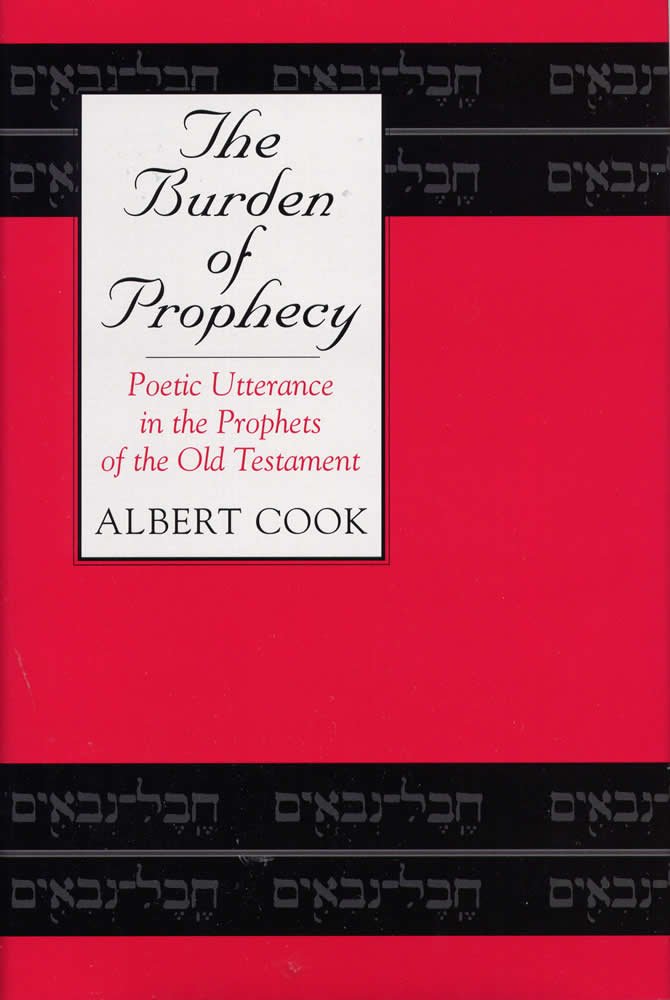
The Burden Of Prophecy: Poetic Utterance In The Prophets Of The Old Testament,Used
Sold by Ergodebooks, an authorized reseller.
Returns accepted within 30 days | support@ergodebooks.com
Shipping Information
- Free Standard Shipping — United States only
- Processing Time: 3–5 business days
- Estimated Delivery: 6–10 business days after dispatch
- Double-boxed, fully insured & discreetly packaged
- Tracking number sent via email once dispatched
Returns & Refund
Returns accepted within 30 days of delivery.
Damaged or Defective Item
Free return shipping + replacement or full refund
Wrong Item Received
Free return shipping + replacement or full refund
Change of Mind
Return shipping at customer's expense · 25% restocking fee applies
Payment Option

Albert Cook examines the poetic and scriptural thinking of the Hebrew prophets and wisdom writers, focusing on the details of their thematic concentrations and on the posture they assume to orient themselves in their utterances.Homer, Confucius, the poets of the Confucian anthology, and the authors of the Zend Avesta and the Rig Veda are variously endowed with an authority empowered by the instituted religious thought of their times. Each writer, Cook contends, rests firmly in the reassurances provided by the particular context.Cook argues, however, that the Hebrew prophet comes forward and presents himself as open to the momentary utterances of God. This God is not primarily an image or a symbol; the Hebrew Yahweh is a force that manifests Himself in developing history. In that dangerous situation, the prophet remains open directly to God and gets a continually renewed verbal authority and power from that flow.Since, as Cook demonstrates, the prophet is commenting on the constantly changing flow between God and people, every utterance is essentially a progress report rather than a finally poised formulation, even though the utterance is formulated in reference to the basic values of righteousness and the law and in measured analogy to such defining tribal experiences as the Exodus. Radically distinct from other religious poetry, therefore, Hebrew prophecy rises from and refers to a complex and specific occasion.Most poetry looks toward the past. Keats, Li Po, and Pindar, for example, all offer the profundity of a stocktaking. The poetry of the Hebrew prophet, however, is oriented toward the future. At worst, the prophet s perception and goal can lead to an informed readiness for the future; at best, they can lead to a restoration of the people's covenant with God. In any case, they will lead to a future whose features are compassed in the articulated vision.In The Burden of Prophecy, Cook explores the implications of these conditions as he examines the Old Testament books of the prophets and their successors: Amos, Isaiah, Jeremiah, Ezekiel, Psalms, Ecclesiastes, Zechariah, and Daniel.
⚠️ WARNING (California Proposition 65):
This product may contain chemicals known to the State of California to cause cancer, birth defects, or other reproductive harm.
For more information, please visit www.P65Warnings.ca.gov.