
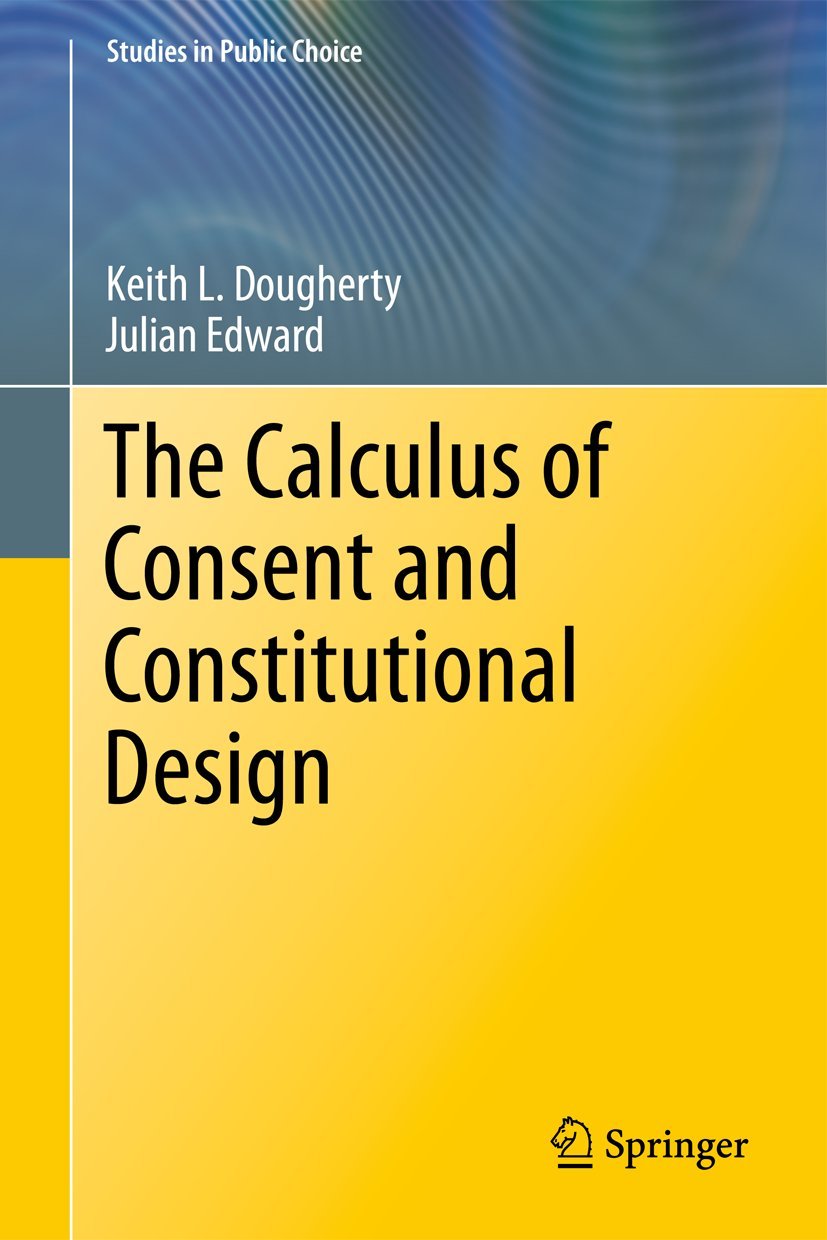
Title
The Calculus Of Consent And Constitutional Design (Studies In Public Choice, 20)
Sold by Ergodebooks, an authorized reseller.
Returns accepted within 30 days | support@ergodebooks.com
Shipping Information
- Free Standard Shipping — United States only
- Processing Time: 3–5 business days
- Estimated Delivery: 6–10 business days after dispatch
- Double-boxed, fully insured & discreetly packaged
- Tracking number sent via email once dispatched
Returns & Refund
Returns accepted within 30 days of delivery.
Damaged or Defective Item
Free return shipping + replacement or full refund
Wrong Item Received
Free return shipping + replacement or full refund
Change of Mind
Return shipping at customer's expense · 25% restocking fee applies
Payment Option

Buchanan and Tullocks seminal work, The Calculus of Consent, linked economic methodology to substantive questions in political science. Among the major contributions of their book is a connection between constitutional decision making and contractarianism, a philosophical tradition that proponents believe can give institutions legitimacy. In other words, a major contribution of their book is a clear connection between empirical decision making and normative principles. The current book formalizes and extends their foundational ideas as it attempts to show how economic and philosophical arguments about the 'best' voting rules can be used to improve constitutional design. It informs debates about constitutional political economy in comparative politics, democratic theory, and public choice. Political scientists often ask questions about what causes a nation to seek a new constitution, how constitutions are made, and what factors allow for corrupt decision making. The Calculus of Consent and Constitutional Design bridges the gap between normative questions about which institutions are most efficient and fair and empirical questions about how constitutions are formed. This provides a benchmark to help create better constitutions and informs empirical research about what institutions are most likely to succeed.The book begins by showing how contractarian ideals can be used to justify choices about decisionmaking. It then carefully defines several concepts employed by Buchanan and Tullock and shows why the relationships between these concepts may not be as closely linked as Buchanan and Tullock first thought. This provides a backdrop for analyzing the three phases of constitutional decisionmaking: 1) the constitutional phase, where rules for constitutional decision making must be justified; 2) the legislative phase, where the optimal kmajority rule is analyzed; and 3) the electoral phase, where the optimal voting rule for largeelectorates and open alternatives are determined. These phases differ by context and sources of legitimacy. Computational models and analytic techniques are introduced in each of these chapters. Finally, the book concludes with statements about the significance of the research for the creation of constitutions more broadly.
⚠️ WARNING (California Proposition 65):
This product may contain chemicals known to the State of California to cause cancer, birth defects, or other reproductive harm.
For more information, please visit www.P65Warnings.ca.gov.