
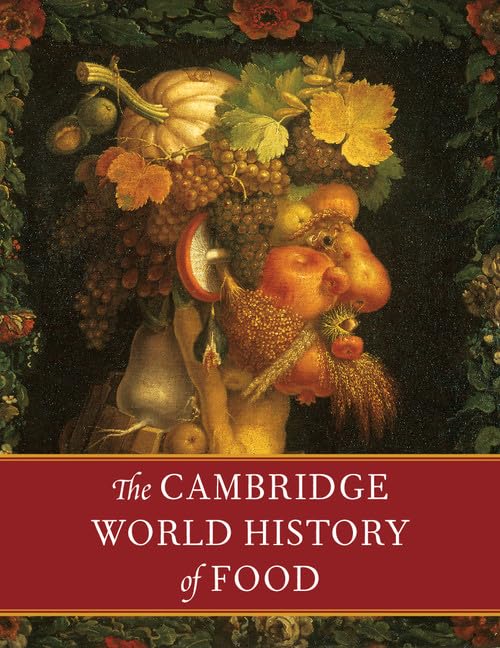
Title
The Cambridge World History of Food (2Volume Set),Used
Sold by Ergodebooks, an authorized reseller.
Returns accepted within 30 days | support@ergodebooks.com
Shipping Information
- Free Standard Shipping — United States only
- Processing Time: 3–5 business days
- Estimated Delivery: 6–10 business days after dispatch
- Double-boxed, fully insured & discreetly packaged
- Tracking number sent via email once dispatched
Returns & Refund
Returns accepted within 30 days of delivery.
Damaged or Defective Item
Free return shipping + replacement or full refund
Wrong Item Received
Free return shipping + replacement or full refund
Change of Mind
Return shipping at customer's expense · 25% restocking fee applies
Payment Option

An undertaking without parallel or precedent, this monumental twovolume work encapsulates much of what is known of the history of food and nutrition throughout the span of human life on earth. It constitutes a vast and essential chapter in the history of human health and culture. Ranging from the eating habits of our prehistoric ancestors to foodrelated policy issues we face today, this work covers the full spectrum of foods that have been hunted, gathered, cultivated, and domesticated; their nutritional makeup and uses; and their impact on cultures and demography. It offers a geographical perspective on the history and culture of food and drink and takes up subjects from food fads, prejudices, and taboos to questions of food toxins, additives, labeling, and entitlements. It culminates in a dictionary that identifies and sketches out brief histories of plant foods mentioned in the textover 1,000 in alland additionally supplies thousands of common names and synonyms for those foods. The essays in this volume are the work of 220 experts in fifteen countries, in fields from agronomy to zoology. Every chapter is accompanied by bibliographical references. The volumes are organized in the following sections: 1. A determination of what our Paleolithic ancestors ate during their stay on the planet (over 99 percent of the time humankind has lived on earth). 6 chapters 2. An extensive treatment of the domestication and development of each of humankind's staple foods. 60 chapters 3. The history of our dietary liquids from beer through soft drinks to water. 13 chapters 4. Studies on the discovery of vitamins, minerals, proteins, fats, and the essential fatty acids along with a look at what they do for us. 37 chapters 5. A history of food and drink for all of the countries in the world. In addition there is a chapter on culinary history. 23 chapters 6. Historical issues involving human health, such as nutrition and mortality decline, height and nutrition, infection and nutrition. 18 chapters 7. Contemporary foodrelated policy issues are treated in this penultimate section of the work. Examples include chapters on food labeling, food biotechnology and the RDAs. 13 chapters 8. The last section of the work is a foodplant dictionary with over 1,000 entries that emphasize history and usage. The dictionary also includes over 4,000 synonyms for the names of plant food. Here readers wellinformed about potatoes or asparagus can learn about lesserknown or strictly regional foods such as ackee or zamia andamong the thousands of synonyms providedcan discover that an aubergine is an eggplant, that 'swedes' are rutabagas, and that 'bulgar' comes from bulghur, which means 'bruised grain.'
⚠️ WARNING (California Proposition 65):
This product may contain chemicals known to the State of California to cause cancer, birth defects, or other reproductive harm.
For more information, please visit www.P65Warnings.ca.gov.
- Q: What is the size of 'The Cambridge World History of Food'? A: This two-volume set measures eight point nine eight inches in length, five point five nine inches in width, and eleven point four two inches in height.
- Q: How many pages does this book have? A: The total page count is two thousand one hundred fifty-three pages, providing an extensive overview of food history.
- Q: What type of binding does this book have? A: This book is bound in hardcover, ensuring durability and a premium feel.
- Q: Who is the author of this book? A: The author is Kenneth F. Kiple, who has compiled contributions from 220 experts in the field.
- Q: What subjects does this book cover? A: The book covers a wide range of subjects including prehistoric diets, food domestication, and contemporary food policies.
- Q: Is this book suitable for academic reference? A: Yes, it is suitable for academic reference, with bibliographical references included in every chapter.
- Q: How do I use this book for research? A: You can use this book as a comprehensive reference for historical and cultural studies related to food and nutrition.
- Q: Is there a specific reading level for this book? A: This book is suitable for college-level readers and above, due to its scholarly content and depth.
- Q: Can I use this book for culinary history studies? A: Yes, it is an excellent resource for culinary history, providing insights into the historical context of various foods.
- Q: How should I store this book to maintain its condition? A: Store this book in a cool, dry place, upright on a shelf to prevent warping and damage.
- Q: Is there any special care needed for the hardcover binding? A: No special care is needed, but avoid exposing it to moisture and extreme temperatures.
- Q: What if the book arrives damaged? A: If the book arrives damaged, contact the retailer within the return policy timeframe for a replacement or refund.
- Q: Can I return this book if I don't like it? A: Yes, you can return the book according to the retailer's return policy, usually within a specified period.
- Q: Are there any common issues with this book? A: Common issues may include misprints or damage during shipping; check the book upon arrival.
- Q: Is there an index or glossary in the book? A: Yes, the book includes a dictionary of over one thousand plant foods mentioned in the text.
- Q: How is the book organized? A: The book is organized into eight sections covering various historical and contemporary food topics.