If you have any questions, you are always welcome to contact us. We'll get back to you as soon as possible, withing 24 hours on weekdays.
Customer service
All questions about your order, return and delivery must be sent to our customer service team by e-mail at yourstore@yourdomain.com
Sale & Press
If you are interested in selling our products, need more information about our brand or wish to make a collaboration, please contact us at press@yourdomain.com
Help
If you have any questions, you are always welcome to contact us. We'll get back to you as soon as possible, withing 24 hours on weekdays.
Customer service
All questions about your order, return and delivery must be sent to our customer service team by e-mail at yourstore@yourdomain.com
Sale & Press
If you are interested in selling our products, need more information about our brand or wish to make a collaboration, please contact us at press@yourdomain.com
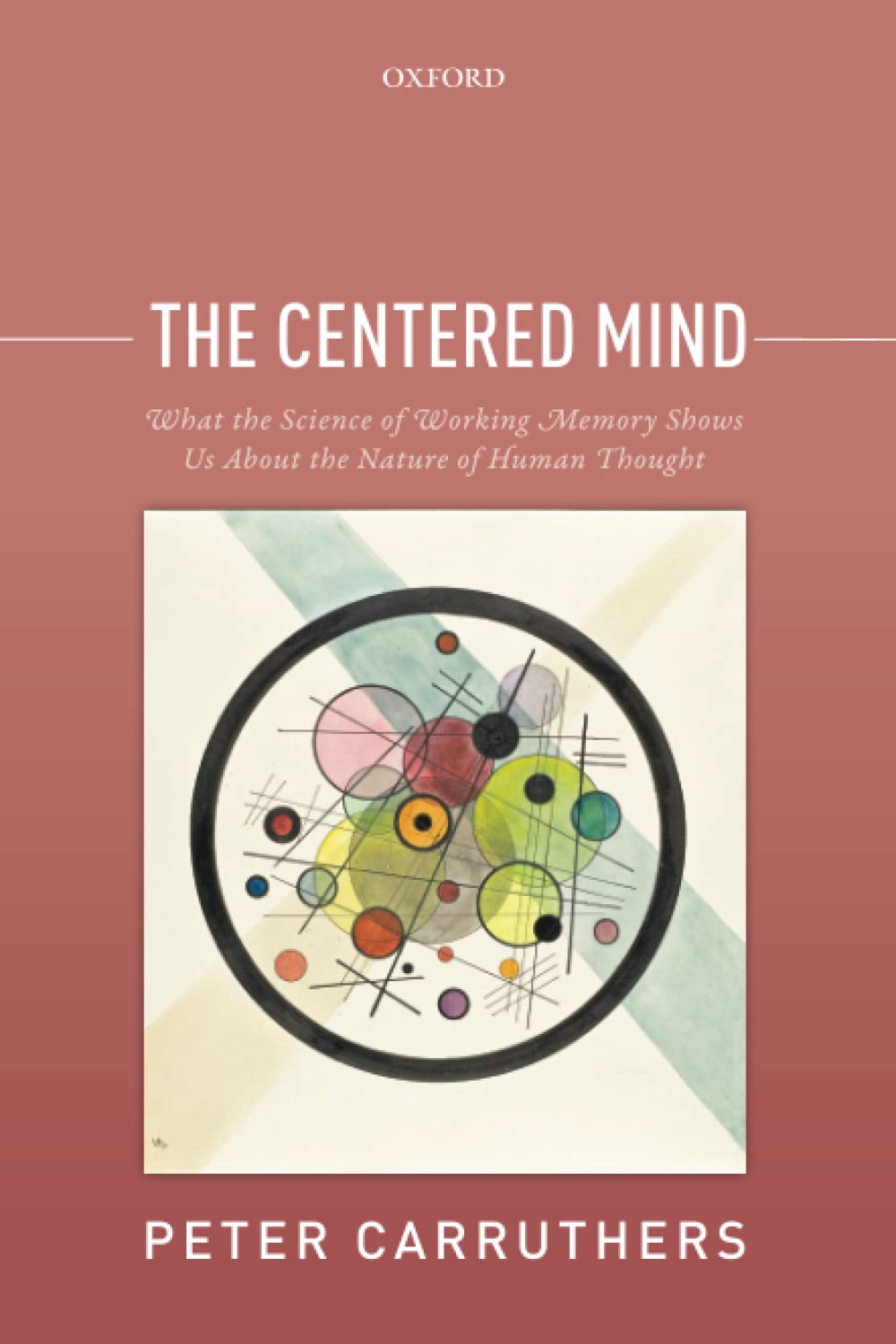
The Centered Mind offers a new view of the nature and causal determinants of both reflective thinking and, more generally, the stream of consciousness. Peter Carruthers argues that conscious thought is always sensorybased, relying on the resources of the workingmemory system. This system has been much studied by cognitive scientists. It enables sensory images to be sustained and manipulated through attentional signals directed at midlevel sensory areas of the brain. When abstract conceptual representations are bound into these images, we consciously experience ourselves as making judgments or arriving at decisions. Thus one might hear oneself as judging, in inner speech, that it is time to go home, for example. However, our amodal (nonsensory) propositional attitudes are never actually among the contents of this stream of conscious reflection. Our beliefs, goals, and decisions are only ever active in the background of consciousness, working behind the scenes to select the sensorybased imagery that occurs in working memory. They are never themselves conscious.Drawing on extensive knowledge of the scientific literature on working memory and related topics, Carruthers builds an argument that challenges the central assumptions of many philosophers. In addition to arguing that nonsensory propositional attitudes are never conscious, he also shows that they are never under direct intentional control. Written with his usual clarity and directness, The Centered Mind will be essential reading for all philosophers and cognitive scientists interested in the nature of human thought processes.
⚠️ WARNING (California Proposition 65):
This product may contain chemicals known to the State of California to cause cancer,
birth defects, or other reproductive harm.
For MAP (Minimum Advertised Price) violations and Intellectual Property (IP) or Trademark concerns, please contact:
support@ergodebooks.com
⚠️ California Proposition 65 Warning: Some products sold on this website may expose you to chemicals known to the State of California to cause cancer, birth defects, or other reproductive harm. For more information, visit www.P65Warnings.ca.gov.