
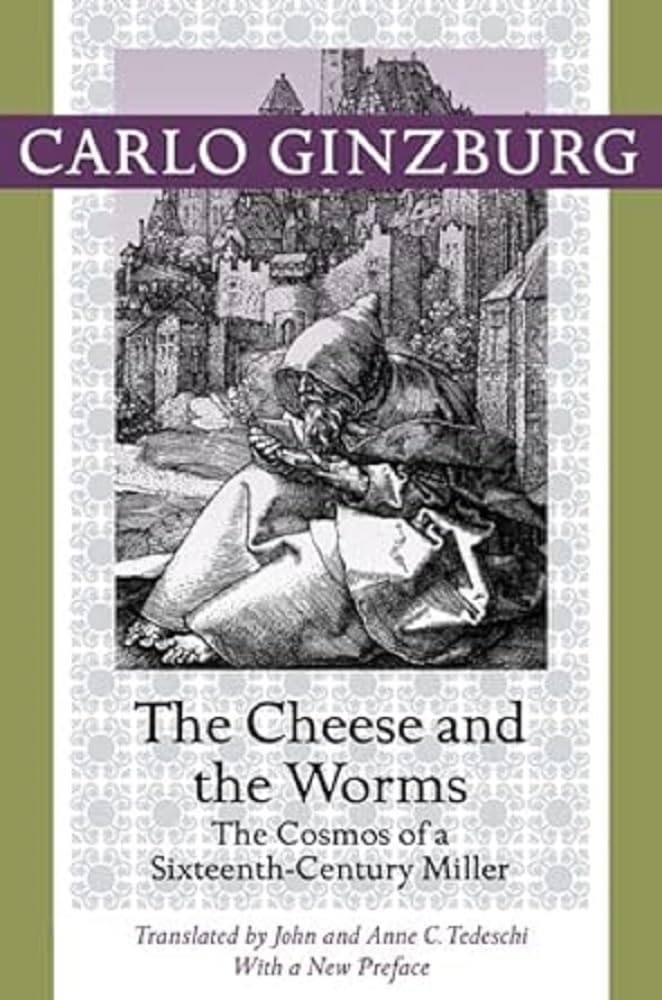
Title
The Cheese and the Worms: The Cosmos of a SixteenthCentury Miller,New
Sold by Ergodebooks, an authorized reseller.
Returns accepted within 30 days | support@ergodebooks.com
Shipping Information
- Free Standard Shipping — United States only
- Processing Time: 3–5 business days
- Estimated Delivery: 6–10 business days after dispatch
- Double-boxed, fully insured & discreetly packaged
- Tracking number sent via email once dispatched
Returns & Refund
Returns accepted within 30 days of delivery.
Damaged or Defective Item
Free return shipping + replacement or full refund
Wrong Item Received
Free return shipping + replacement or full refund
Change of Mind
Return shipping at customer's expense · 25% restocking fee applies
Payment Option

The nowclassic tale of a sixteenthcentury miller facing the Roman Inquisition.The Cheese and the Worms is an incisive study of popular culture in the sixteenth century as seen through the eyes of one man, the miller known as Menocchio, who was accused of heresy during the Inquisition and sentenced to death. Carlo Ginzburg uses the trial records to illustrate the religious and social conflicts of the society Menocchio lived in.For a common miller, Menocchio was surprisingly literate. In his trial testimony he made references to more than a dozen books, including the Bible, Boccaccio's Decameron, Mandeville's Travels, and a 'mysterious' book that may have been the Koran. And what he read he recast in terms familiar to him, as in his own version of the creation: 'All was chaos, that is earth, air, water, and fire were mixed together; and of that bulk a mass formedjust as cheese is made out of milkand worms appeared in it, and these were the angels.'Ginzburg?s influential book has been widely regarded as an early example of the analytic, caseoriented approach known as microhistory. In a thoughtful new preface, Ginzburg offers his own corollary to Menocchio?s story as he considers the discrepancy between the intentions of the writer and what gets written. The Italian miller?s story and Ginzburg?s work continue to resonate with modern readers because they focus on how oral and written culture are inextricably linked. Menocchio?s 500yearold challenge to authority remains evocative and vital today.
⚠️ WARNING (California Proposition 65):
This product may contain chemicals known to the State of California to cause cancer, birth defects, or other reproductive harm.
For more information, please visit www.P65Warnings.ca.gov.
- Q: What is the main theme of 'The Cheese and the Worms'? A: 'The Cheese and the Worms' explores the conflict between popular culture and the authority of the Roman Inquisition through the story of Menocchio, a miller accused of heresy.
- Q: Who is the author of this book? A: The book is authored by Carlo Ginzburg, a prominent Italian historian known for his work in microhistory.
- Q: What type of binding does this book have? A: 'The Cheese and the Worms' is available in a paperback binding.
- Q: How many pages are in the book? A: The book contains a total of 224 pages.
- Q: When was 'The Cheese and the Worms' published? A: The book was published on October 15, 2013, as a reprint.
- Q: Is this book suitable for academic study? A: Yes, 'The Cheese and the Worms' is considered an influential work in the field of microhistory and is often used in academic settings.
- Q: What historical period does the book focus on? A: The book focuses on the sixteenth century, particularly during the time of the Roman Inquisition.
- Q: What unique perspective does Ginzburg offer in this book? A: Ginzburg presents a unique perspective by analyzing trial records to illustrate the religious and social conflicts of Menocchio's time.
- Q: Is 'The Cheese and the Worms' a fictional or non-fictional work? A: 'The Cheese and the Worms' is a non-fictional work based on historical records and analysis.
- Q: What makes Menocchio's story relevant today? A: Menocchio's challenge to authority and his reflections on culture resonate with modern discussions about power, literacy, and belief.