

Title
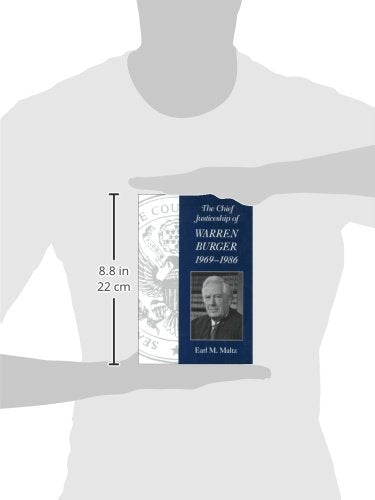
The Chief Justiceship of Warren Burger, 19691986 (Chief Justiceships of the United States Supreme Court),New
Sold by Ergodebooks, an authorized reseller.
Returns accepted within 30 days | support@ergodebooks.com
Shipping Information
- Free Standard Shipping — United States only
- Processing Time: 3–5 business days
- Estimated Delivery: 6–10 business days after dispatch
- Double-boxed, fully insured & discreetly packaged
- Tracking number sent via email once dispatched
Returns & Refund
Returns accepted within 30 days of delivery.
Damaged or Defective Item
Free return shipping + replacement or full refund
Wrong Item Received
Free return shipping + replacement or full refund
Change of Mind
Return shipping at customer's expense · 25% restocking fee applies
Payment Option

A provocative interpretation of the Burger CourtIn The Chief Justiceship of Warren Burger, 19691986, Earl M. Maltz offers a comprehensive summary and analysis of the Supreme Court's impact on American law and government during Burger's tenure. Undoubtedly one of the most interesting periods in Supreme Court history, the Burger Court generally holds a place in America's judicial memory as a centrist or mildly conservative institution that followed the liberal constitutionalism of the Warren Court and preceded the conservative ideology of the Rehnquist Court. Maltz demonstrates, however, that under Burger the Court's ideological transition was far from immediate and certainly not regular or universal in process. Maltz contends that in many areas of constitutional law the Burger Court produced the most liberal jurisprudence in historyeven more liberal than that of its predecessor.Acknowledging that the decisionmaking complexities of Burger's era have spawned widely varied interpretations of the Court, Maltz insists that discernible patterns explain the doctrinal positions adopted by the majority of justices in any given case. He advances the controversial thesis that Burger Court activism occurred almost entirely in a liberal direction, even after the appointment of Justices Harry A. Blackmun, Lewis F. Powell, Jr., and William H. Rehnquist. Maltz demonstrates that in cases involving issues such as religion and nonracial discrimination, the Court moved in a liberal direction.Looking beyond the delineation of doctrinal positions, Maltz considers the personalities and complex political attitudes of the justices, the inability of conservative justices to institutionalize their ideology because of their rejection of judicial activism, and Burger's leadership of the Supreme Court.
⚠️ WARNING (California Proposition 65):
This product may contain chemicals known to the State of California to cause cancer, birth defects, or other reproductive harm.
For more information, please visit www.P65Warnings.ca.gov.