
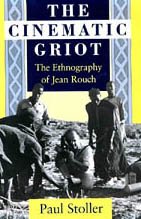
Title
The Cinematic Griot: The Ethnography of Jean Rouch,Used
Sold by Ergodebooks, an authorized reseller.
Returns accepted within 30 days | support@ergodebooks.com
Shipping Information
- Free Standard Shipping — United States only
- Processing Time: 3–5 business days
- Estimated Delivery: 6–10 business days after dispatch
- Double-boxed, fully insured & discreetly packaged
- Tracking number sent via email once dispatched
Returns & Refund
Returns accepted within 30 days of delivery.
Damaged or Defective Item
Free return shipping + replacement or full refund
Wrong Item Received
Free return shipping + replacement or full refund
Change of Mind
Return shipping at customer's expense · 25% restocking fee applies
Payment Option

Product Description The most prolific ethnographic filmmaker in the world, a pioneer of cinma vrit and one of the earliest ethnographers of African societies, Jean Rouch (1917) remains a controversial and often misunderstood figure in histories of anthropology and film. By examining Rouch's neglected ethnographic writings, Paul Stoller seeks to clarify the filmmaker's true place in anthropology.A brief account of Rouch's background, revealing the ethnographic foundations and intellectual assumptions underlying his fieldwork among the Songhay of Niger in the 1940s and 1950s, sets the stage for his emergence as a cinematic griot, a peripatetic bard who "recites" the story of a people through provocative imagery. Against this backdrop, Stoller considers Rouch's writings on Songhay history, myth, magic and possession, migration, and social change. By analyzing in depth some of Rouch's most important films and assessing Rouch's ethnography in terms of his own expertise in Songhay culture, Stoller demonstrates the inner connection between these two modes of representation.Stoller, who has done more fieldwork among the Songhay than anyone other than Rouch himself, here gives the first full account of Rouch the griot, whose own story scintillates with important implications for anthropology, ethnography, African studies, and film. About the Author Paul Stoller is a professor of anthropology at West Chester University of Pennsylvania. He is the author of many books, including ethnographies, biographies, and memoirs. In 1994 he was awarded a prestigious Guggenheim Fellowship. In 2002, the American Anthropological Association named him the recipient of the Robert B. Textor Award for Excellence in Anthropology. He lectures frequently both in the United States and Europe and has appeared on various NPR programs as well as on the National Geographic Television Network.
⚠️ WARNING (California Proposition 65):
This product may contain chemicals known to the State of California to cause cancer, birth defects, or other reproductive harm.
For more information, please visit www.P65Warnings.ca.gov.