
Title
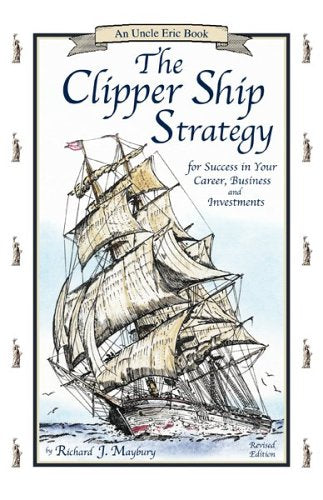
The Clipper Ship Strategy: For Success In Your Career, Business, And Investments (An Uncle Eric Book)
Sold by Ergodebooks, an authorized reseller.
Returns accepted within 30 days | support@ergodebooks.com
Shipping Information
- Free Standard Shipping — United States only
- Processing Time: 3–5 business days
- Estimated Delivery: 6–10 business days after dispatch
- Double-boxed, fully insured & discreetly packaged
- Tracking number sent via email once dispatched
Returns & Refund
Returns accepted within 30 days of delivery.
Damaged or Defective Item
Free return shipping + replacement or full refund
Wrong Item Received
Free return shipping + replacement or full refund
Change of Mind
Return shipping at customer's expense · 25% restocking fee applies
Payment Option

Conventional Wisdom Says That When The Government Expands The Money Supply, The Money Descends On The Economy In A Uniform Blanket. This Is Incorrect. The Money Is Injected Into Specific Locations Causing Hot Spots Or Cones. Mr. Maybury Explains A System For Tracking And Profiting From These Cones, For Locating Genuine Moneymaking Opportunities, And For Avoiding Those Which Are False Or Dangerous. The Clipper Ship Strategy Includes Stepbystep Instructions, And Clever Illustrations That Make The System Easy To Understand. Explains How To Cope With Recessions And Avoid Unemployment. This Book Is The Second Sequel To Whatever Happened To Penny Candy? And Should Be Read After The Money Mystery Also Available For Purchase Through Amazon.Can Be Used For Courses In Economics, Business, Finance, Government And History.To Improve The Student'S Learning Experience, Also Purchase The Student Study Guide For The Clipper Ship Strategy Titled A Bluestocking Guide: Applying The Clipper Ship Strategy Also Available Through Amazon.Contents For The Clipper Ship StrategyUncle Eric'S Model Of How The World Worksauthor'S Disclosurepart 1: Sales Strategy1. A Strategy For Success2. Ethics And The Flood Of Data3. Hot Spots And Evidence4. Austrian Economics5. Line And Staff6. The Clipper Ship Strategy7. Piles Of Money8. The Money Spreads9. Cones And Sales10. Scooping And Pouring11. All Roads12. Cone Creation13. The Super Clipper14. Do Cones Really Exist?15. The Biggest, Most Stable Cone16. Accidental Cones17. Houston: Portrait Of An Accidental Cone18. Other Accidental Cones19. Hollow Cones20. An Ecosystem In Chaos21. Outside Sales22. Benefits Of This Understanding23. Tax & Regulatory Cones24. Marginality25. Marketing Managers26. The Automobile27. How To Follow The Cones28. A Case Study: Sacramento29. Hot Spots And Zips30. The Importance Of A Model For Sorting Your Data31. Cone Classification32. Is Pinpoint Accuracy Necessary?33. How To Classify Cones34. Precision And Size Of Firm35. Split Cones36. An Eerie Feeling37. Gathering More Information38. Specialized Organizations And Publications39. External Information A D.E.W. Line40. S.I.C. Codes41. List Companies And Marketing Data42. Importance Of Real Estate43. Learn By Example44. Sales Side Summarypart 2: Production Strategy45. Stomping The Town46. Your Factors Of Production47. Streamlining48. Cyclical Problems49. Breakeven Analysis50. Mrs. Garcia51. A New Industry52. Breakeven Solutions53. The Most Risky Investment54. Specialization55. Payback Analysis56. Startup Firms: An Example57. Careers In Bcm58. Investment Strategy59. Two Types Of Investment Cones60. Summaryappendixbibliographybookstoresglossaryabout The Authorindex
⚠️ WARNING (California Proposition 65):
This product may contain chemicals known to the State of California to cause cancer, birth defects, or other reproductive harm.
For more information, please visit www.P65Warnings.ca.gov.
- Q: How many pages does this book have? A: This book has two hundred sixty-nine pages. It provides an in-depth analysis of economic strategies and concepts.
- Q: What is the binding type of this book? A: The binding type is paperback. This makes it lightweight and easy to handle for reading.
- Q: What are the dimensions of the book? A: The book measures five point seventy-five inches in length, zero point seventy-five inches in width, and eight point five inches in height.
- Q: Who is the author of 'The Clipper Ship Strategy'? A: The author is Richard J. Maybury. He is known for his insights into economics and business strategies.
- Q: What is the main subject of the book? A: The book focuses on economics, business strategies, and investment opportunities. It is designed to help readers understand market behaviors.
- Q: How should I use this book for studying? A: You can use this book as a resource for courses in economics, business, finance, government, and history. It's recommended to follow it with the related study guide.
- Q: Is this book suitable for beginners in economics? A: Yes, this book is suitable for beginners. It provides step-by-step instructions and illustrations to facilitate understanding.
- Q: What age group is this book appropriate for? A: This book is appropriate for high school students and adults. It covers complex economic concepts in an accessible manner.
- Q: What should I do to keep this book in good condition? A: To keep the book in good condition, store it in a cool, dry place and avoid exposure to direct sunlight. Handling it gently will also help preserve its quality.
- Q: Are there any special care instructions for this book? A: No special care instructions are needed. Just avoid bending the pages and keep it away from moisture.
- Q: What if the book arrives damaged? A: If the book arrives damaged, you should contact the seller for a return or exchange. Most sellers have a policy for handling damaged items.
- Q: Can I return the book if I am not satisfied? A: Yes, you can return the book if you are not satisfied, provided you follow the seller's return policy.
- Q: What topics does this book cover in detail? A: The book covers sales strategy, production strategy, and various economic models. It also discusses investment strategies and market analysis.
- Q: Is this book part of a series? A: Yes, this book is part of a series. It is the second sequel to 'Whatever Happened to Penny Candy?' and follows 'The Money Mystery'.
- Q: Are there illustrations in the book? A: Yes, the book includes clever illustrations that make the economic concepts easier to understand.
- Q: Does this book offer practical advice? A: Yes, it offers practical advice on how to track and profit from economic 'cones' and avoid dangerous opportunities.