
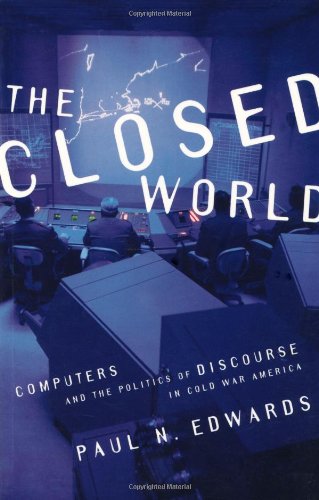
Title
The Closed World: Computers And The Politics Of Discourse In Cold War America (Inside Technology)
Sold by Ergodebooks, an authorized reseller.
Returns accepted within 30 days | support@ergodebooks.com
Shipping Information
- Free Standard Shipping — United States only
- Processing Time: 3–5 business days
- Estimated Delivery: 6–10 business days after dispatch
- Double-boxed, fully insured & discreetly packaged
- Tracking number sent via email once dispatched
Returns & Refund
Returns accepted within 30 days of delivery.
Damaged or Defective Item
Free return shipping + replacement or full refund
Wrong Item Received
Free return shipping + replacement or full refund
Change of Mind
Return shipping at customer's expense · 25% restocking fee applies
Payment Option

The Closed World Offers A Radically New Alternative To The Canonical Histories Of Computers And Cognitive Science. Arguing That We Can Make Sense Of Computers As Tools Only When We Simultaneously Grasp Their Roles As Metaphors And Political Icons, Paul Edwards Shows How Cold War Social And Cultural Contexts Shaped Emerging Computer Technologyand Were Transformed, In Turn, By Information Machines.The Closed World Explores Three Apparently Disparate Historiesthe History Of American Global Power, The History Of Computing Machines, And The History Of Subjectivity In Science And Culturethrough The Lens Of The American Political Imagination. In The Process, It Reveals Intimate Links Between The Military Projects Of The Cold War, The Evolution Of Digital Computers, And The Origins Of Cybernetics, Cognitive Psychology, And Artificial Intelligence.Edwards Begins By Describing The Emergence Of A Closedworld Discourse Of Global Surveillance And Control Through Hightechnology Military Power. The Cold War Political Goal Of Containment Led To The Sage Continental Air Defense System, Rand Corporation Studies Of Nuclear Strategy, And The Advanced Technologies Of The Vietnam War. These And Other Centralized, Computerized Military Command And Control Projectsfor Containing Worldscale Conflictshelped Closedworld Discourse Dominate Cold War Political Decisions. Their Apotheosis Was The Reaganera Plan For A Star Wars Spacebased Ballistic Missile Defense.Edwards Then Shows How These Military Projects Helped Computers Become Axial Metaphors In Psychological Theory. Analyzing The Macy Conferences On Cybernetics, The Harvard Psychoacoustic Laboratory, And The Early History Of Artificial Intelligence, He Describes The Formation Of A Cyborg Discourse. By Constructing Both Human Minds And Artificial Intelligences As Information Machines, Cyborg Discourse Assisted In Integrating People Into The Hypercomplex Technological Systems Of The Closed World.Finally, Edwards Explores The Cyborg As Political Identity In Science Fictionfrom The Disembodied, Panoptic Ai Of 2001: A Space Odyssey, To The Mechanical Robots Of Star Wars And The Engineered Biological Androids Of Blade Runnerwhere Information Age Culture And Subjectivity Were Both Reflected And Constructed.Inside Technology Series
⚠️ WARNING (California Proposition 65):
This product may contain chemicals known to the State of California to cause cancer, birth defects, or other reproductive harm.
For more information, please visit www.P65Warnings.ca.gov.
- Q: What is the page count of 'The Closed World'? A: This book has four hundred sixty-two pages. It provides an in-depth exploration of computers and their political implications during the Cold War.
- Q: What are the dimensions of 'The Closed World'? A: The dimensions are eight point nine eight inches in length, five point nine eight inches in width, and one point zero two inches in height. These measurements make it a convenient size for reading.
- Q: What type of binding does 'The Closed World' have? A: This book is published in paperback binding. This format is typically lightweight and flexible, making it easy to handle.
- Q: How do I read 'The Closed World' effectively? A: To read this book effectively, consider setting aside time for focused reading. The content is rich and may require deeper thought and reflection on its themes.
- Q: Is 'The Closed World' suitable for beginners in technology studies? A: Yes, this book is suitable for beginners. It presents complex ideas in an accessible manner, making it a good introduction to the intersection of technology and politics.
- Q: What age group is 'The Closed World' appropriate for? A: This book is appropriate for mature teens and adults. Its themes of politics and technology are best suited for readers who can engage with complex topics.
- Q: How should I store 'The Closed World' to keep it in good condition? A: Store this book in a cool, dry place away from direct sunlight. Keeping it on a bookshelf will help maintain its condition over time.
- Q: Can I clean the cover of 'The Closed World'? A: Yes, you can clean the cover gently with a soft, dry cloth. Avoid using water or cleaning solutions that may damage the paper.
- Q: Does 'The Closed World' have a warranty or return policy? A: Return policies depend on the retailer. Generally, if the book arrives damaged or defective, you can return it for a replacement or refund.
- Q: What if I receive a damaged copy of 'The Closed World'? A: If you receive a damaged copy, contact the retailer's customer service for assistance. They typically provide options for returns or exchanges.
- Q: How does 'The Closed World' compare to other technology history books? A: This book offers a unique perspective by linking computers to Cold War politics, setting it apart from traditional technology histories that focus solely on technical advancements.
- Q: Is 'The Closed World' focused solely on computers? A: No, it also discusses the broader implications of technology in politics and culture. The book connects computing history with societal changes during the Cold War.
- Q: What themes are explored in 'The Closed World'? A: Major themes include the relationship between technology and power, the evolution of digital computers, and the cultural implications of cybernetics and artificial intelligence.
- Q: Who is the author of 'The Closed World'? A: The author is Paul N. Edwards. He is known for his work on the history of technology and its impact on society.
- Q: Is 'The Closed World' part of a series? A: Yes, it is part of the Inside Technology series. This series explores various aspects of technology and its effects on society.
- Q: What is the main argument of 'The Closed World'? A: The main argument is that understanding computers as tools requires recognizing their roles as political icons and metaphors shaped by Cold War contexts.