
Title
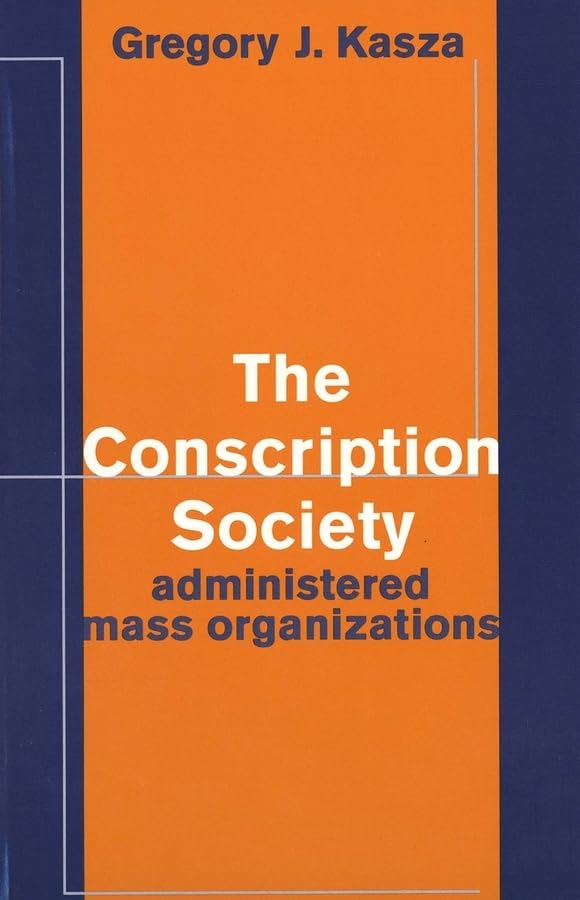
The Conscription Society: Administered Mass Organizations
Sold by Ergodebooks, an authorized reseller.
Returns accepted within 30 days | support@ergodebooks.com
Shipping Information
- Free Standard Shipping — United States only
- Processing Time: 3–5 business days
- Estimated Delivery: 6–10 business days after dispatch
- Double-boxed, fully insured & discreetly packaged
- Tracking number sent via email once dispatched
Returns & Refund
Returns accepted within 30 days of delivery.
Damaged or Defective Item
Free return shipping + replacement or full refund
Wrong Item Received
Free return shipping + replacement or full refund
Change of Mind
Return shipping at customer's expense · 25% restocking fee applies
Payment Option

The Ability To Organize Millions Of People For Political Purposes Is A Potent And Relatively Recent Weapon In The Struggle For Power. Political Scientists Have Studied Two Types Of Mass Organization, The Political Party And The Interest Group. In This Book Gregory Kasza Examines A Third Type, Which He Calls The Administered Mass Organization. Amos Are Mass Civilian Bodies Created By Authoritarian Regimes To Implement Public Policy. Officials Use Them To Organize Youths, Workers, Women, Or Members Of Other Social Sectors Into Bodies Resembling The Mass Conscript Army. A Network Of Amos Produces A Conscription Society, A Major Force In Twentiethcentury Politics In Over 45 Countries.Using Comparative History And Organization Theory, Kasza Analyzes The Politics Of The Conscription Society In Both Military And Singleparty Regimes. He Discusses The Origins Of Amos In Japan, The Soviet Union, And Fascist Italy And Their Subsequent Spread To China, Egypt, Nazi Germany, Peru, Poland, And Yugoslavia. He Focuses On The Use Of Amos To Curb Political Opposition, To Mobilize For War, And To Shift Control Over The Means Of Production. Kasza Shows How, In The Hands Of Despotic Rulers, Amos Have Contributed To The Extremes Of Political Barbarism Characteristic Of The Twentieth Century.
⚠️ WARNING (California Proposition 65):
This product may contain chemicals known to the State of California to cause cancer, birth defects, or other reproductive harm.
For more information, please visit www.P65Warnings.ca.gov.
- Q: How many pages does the book have? A: This book contains two hundred thirty-two pages. It provides a comprehensive exploration of administered mass organizations in political contexts.
- Q: What is the binding type of this book? A: The book is a hardcover edition. This type of binding offers durability and a more premium feel.
- Q: What are the dimensions of the book? A: The book measures six point two seven inches in length, zero point seven five inches in width, and nine point four nine inches in height.
- Q: Who is the author of this book? A: The author of this book is Gregory J. Kasza. He explores the role of administered mass organizations in political systems.
- Q: What is the main topic of the book? A: The book examines administered mass organizations as a form of political power. It discusses their impact on authoritarian regimes and public policy.
- Q: Is this book suitable for academic research? A: Yes, this book is suitable for academic research. It utilizes comparative history and organization theory, making it a valuable resource for political science.
- Q: How does the author analyze mass organizations? A: The author analyzes mass organizations through comparative history and organization theory. He focuses on their origins and political implications.
- Q: What political regimes does this book cover? A: The book covers military and single-party regimes. It discusses the use of administered mass organizations in various countries.
- Q: Does this book discuss historical examples? A: Yes, it discusses historical examples from countries like Japan, the Soviet Union, and Fascist Italy. These examples illustrate the spread of administered mass organizations.
- Q: What themes are explored in the book? A: Themes include political mobilization, control over production, and the repression of opposition. The book delves into the extremes of political actions in the twentieth century.
- Q: How can I keep this book in good condition? A: To keep this book in good condition, store it upright in a cool, dry place. Avoid exposure to direct sunlight to prevent fading.
- Q: Are there any special care instructions for the book? A: No special care instructions are needed, but handle the book gently to avoid damage. Avoid placing heavy items on top of it.
- Q: What should I do if the book arrives damaged? A: If the book arrives damaged, contact the seller immediately. They will provide instructions for returns or exchanges.
- Q: Can I return the book if I don't like it? A: Yes, you can typically return the book if you find it unsatisfactory. Check the seller's return policy for specific guidelines.
- Q: Is this book recommended for beginners in political science? A: Yes, this book is accessible to beginners. Its clear analysis of mass organizations makes it a good starting point for understanding political dynamics.
- Q: Does this book include references or a bibliography? A: Yes, the book includes references and a bibliography. This enhances its credibility and provides further reading resources.