
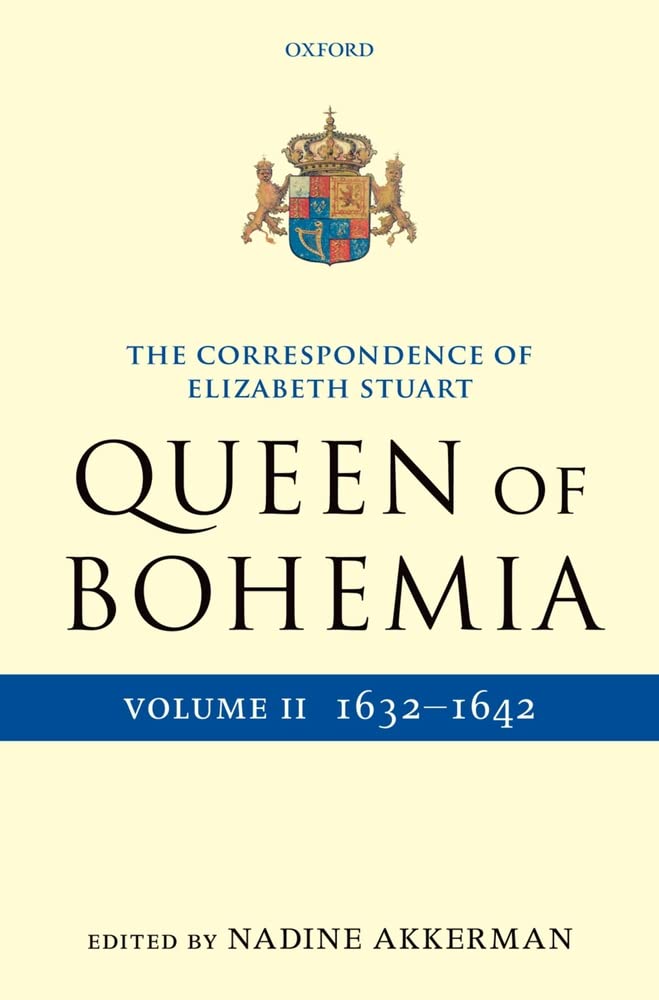
Title
The Correspondence of Elizabeth Stuart, Queen of Bohemia, Volume II (Letters of Elizabeth Stuart, Queen of Bohemia),Used
Sold by Ergodebooks, an authorized reseller.
Returns accepted within 30 days | support@ergodebooks.com
Shipping Information
- Free Standard Shipping — United States only
- Processing Time: 3–5 business days
- Estimated Delivery: 6–10 business days after dispatch
- Double-boxed, fully insured & discreetly packaged
- Tracking number sent via email once dispatched
Returns & Refund
Returns accepted within 30 days of delivery.
Damaged or Defective Item
Free return shipping + replacement or full refund
Wrong Item Received
Free return shipping + replacement or full refund
Change of Mind
Return shipping at customer's expense · 25% restocking fee applies
Payment Option

The Letters of Elizabeth Stuart, Queen of Bohemia is the first edition, in three volumes, of Elizabeth Stuart's complete letters ever published. Elizabeth Stuart (15961662), also known as Electress Palatine of the Rhine or Queen of Bohemia, was the daughter of King James VI & I and Anna of Denmark, and a key religious, political, and cultural figure in early modern Europe. Volume II, tracing the years between 1632 and 1642, covers Elizabeth's life as a widow controlling the regency during her eldest son's minority and imprisonment. It opens with her husband Frederick V's departure from their courtinexile in The Hague to the battlefield in Germany, and his unexpected death from the plague in Mainz a few days before Elizabeth and he would have regained the Palatinate. Elizabeth is forced to take Palatine affairs firmly into her own hands as the restitution slips away from her. Her brother King Charles I tries to lure her back to the British Isles, apparently in order to pacify her, but Elizabeth chooses a life of voluntary exile to expedite the restitution.In this most political period of her life, Elizabeth devises, often unsuccessfully, ploys to gain financial, moral, and military support for the Palatine cause, frequently in direct opposition to her brother's wishes and demands. Her letters were the principal means by which she could exert her power on statesmen and military leaders, such as Archbishop Laud, Charles I, Christian IV of Denmark, the Swedish chancellor Axel Oxenstierna, Cardinal Richelieu of France, and Wladislaw IV of Poland. Elizabeth's eldest son Charles Louis, set free by the French in April 1641, ultimately took over the regency of the Palatine government in November 1642. Elizabeth at this point jadedly relinquished her role as stateswoman.
⚠️ WARNING (California Proposition 65):
This product may contain chemicals known to the State of California to cause cancer, birth defects, or other reproductive harm.
For more information, please visit www.P65Warnings.ca.gov.