
Title
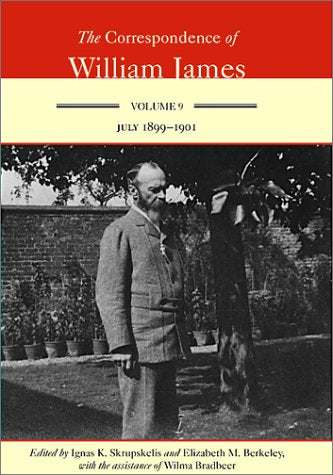
The Correspondence Of William James: Volume 9, July 18991901,Used
Sold by Ergodebooks, an authorized reseller.
Returns accepted within 30 days | support@ergodebooks.com
Shipping Information
- Free Standard Shipping — United States only
- Processing Time: 3–5 business days
- Estimated Delivery: 6–10 business days after dispatch
- Double-boxed, fully insured & discreetly packaged
- Tracking number sent via email once dispatched
Returns & Refund
Returns accepted within 30 days of delivery.
Damaged or Defective Item
Free return shipping + replacement or full refund
Wrong Item Received
Free return shipping + replacement or full refund
Change of Mind
Return shipping at customer's expense · 25% restocking fee applies
Payment Option

This ninth volume of a projected twelve continues the series of William James's correspondence with family, friends, and colleagues that was begun in Volume 4. Consisting of some 470 letters, with as many more calendared, it offers a complete accounting of James's known correspondence from July 1899 through 1901.Volume 9 covers the period of James's great collapse, of his years of exile in Europe in search of health, and of the beginning of his withdrawal from fulltime teaching at Harvard. In spite of his heart troubles, nervous prostration, and oftenproclaimed inability to work, James wrote and successfully delivered his Gifford Lectures, which in 1902 were published as The Varieties of Religious Experience, probably his most widely read work.In Europe, James develops a profound ambivalence toward America. He comes to realize how strong his attachment is to his home but at the same time he becomes more and more dismayed by the emergence of the United States as an imperial power with the consequent loss of what he perceives to be his country's moral purity.James's views on religion are expressed in various fragments and asides. While creeds and churches continue to make no claims upon him, he believes that religious experience places us in touch with a deeper stratum of reality. Because of his intimate association during these months with the dying Frederic Myers, problems of psychical research are also prominent.He corresponds with leading women in the emerging field of social work, including Frances Morse, Elizabeth Evans, and the Goldmark sisters, Pauline and Susan, and prominent intellectuals such as Thodore Flournoy, Wincenty Lutoslawski, Carl Stumpf, Ferdinand Schiller, Henry Sidgwick, Hugo Mnsterberg, Josiah Royce, George Herbert Palmer, Charles William Eliot, James Mark Baldwin, and Edwin Godkin. His daughter, Margaret Mary, and his youngest son, Alexander Robertson, receive fatherly advice and encouragement from a distance during the crucial years of their young lives.
⚠️ WARNING (California Proposition 65):
This product may contain chemicals known to the State of California to cause cancer, birth defects, or other reproductive harm.
For more information, please visit www.P65Warnings.ca.gov.